Collar Clip: Collar Attachment Options for Private Label Pet Carriers
A collar attachment point in a custom pet carrier is a light-duty connection - usually a 12-16 mm strap with a small trigger clip or split ring - used for transferring the animal's collar hardware, ID tags or a short lead while stationary, never for restraint. It adds USD 0.40-1.35 per unit at MOQ 500 and should always be specified with a stated maximum working load.
Collar attachment hardware occupies an unusual position: it is the least load-bearing of the three containment options and the one most likely to be misused, which is a combination that rewards unusually clear specification. Our design team treats it as a convenience interface first and a restraint second - indeed not a restraint at all - because that framing produces the right hardware, the right placement and, importantly, the right wording on the hangtag, which is where most of the real risk actually sits. Handled honestly it earns its place in travel capsules and city ranges where the handler is present and the animal is small, and it costs a fraction of what the alternatives do to build.
- Sampling: collar attachment prototypes built into nominated shells in 6-10 working days.
- Minimums: MOQ 500 units; bespoke split rings or branded clips add tooling.
- Schedule: light reinforcement and hardware assembly run within the carrier's 35-50 day bulk window.
- Quality: working-load limits, clip operation and stitch integrity inspected to AQL 2.5.
- Terms: T/T 30/70, FOB Xiamen, small hardware bagged to prevent scratches in transit.
For a custom pet tote or backpack carrier, strap geometry is the first thing to fix - width, padding and load-lifter position decide how the bag carries.
Where a collar attachment genuinely earns its place
Being candid at the outset saves everyone time: this feature does less than the other two containment options, and programmes that specify it expecting otherwise end up with copy they cannot defend. Its real value is in transfer moments rather than restraint moments.
The clearest use case is arrival. A handler opening the carrier in a hotel room, a taxi rank or a clinic waiting area wants somewhere to hold the animal's attention while arranging the lead, and a collar point does that in one motion. It is a convenience, and described honestly it is a good one.
The second use case is small animals, where neither harness nor tether hardware is proportionate. Toy and miniature breeds often wear collars rather than harnesses, and providing something appropriate for that audience is a genuine gap in many ranges.
The third is identity. ID tags, rabies tags and small accessories need somewhere to live when not on the collar, and a dedicated hardware point communicates that the product was designed around real ownership rather than around a generic feature list.
A fourth is occasionally overlooked: professional handlers managing several animals in sequence. Being able to park one animal briefly while dealing with another is a working advantage, and it is precisely why working-dog suppliers have used similar arrangements for decades.
Against those usefulnesses sits a real constraint. Loading a collar means loading the neck, and while that is entirely normal in supervised handling, it should never be the primary containment route for an animal inside a carrier. Stating that plainly in the specification, the documentation and the retail copy is not weakness; it is how responsible programmes are distinguished from careless ones.
Once the boundary is accepted, the feature becomes easy to specify well, because the load cases are honest from the beginning.
A useful exercise before costing anything is to write the two sentences the retail team will want in copy, then check whether the engineering supports them. When it does not, adjusting the specification is cheap; adjusting a printed carton two weeks before shipment is not, and that asymmetry is the argument for doing this first.
Programmes that skip this conversation tend to produce something neither fish nor fowl: too light to reassure, too heavy to justify, and described in copy that nobody read carefully enough.
Defining the load case before drawing anything
Light-duty hardware deserves honest numbers rather than vague reassurance. Start by naming what the point is expected to resist: a small animal taking a step or two, leaning briefly, or turning its head while the handler is arranging something else. That is the actual load.
Translated into numbers, this means a working load far below what harness hardware carries, with a safety factor applied and a stated failure behaviour. Specifying failure behaviour is the unusual part and the valuable one: it is better to know that a clip will open before something tears than to discover the alternative during an incident.
Direction matters more here than magnitude because collars concentrate force in one place. A side or downward pull from an animal simply shifting position arrives at completely different angles, and the anchor must tolerate both without the strap riding up.
Repetition deserves its own line even for light loads. A hundred small tugs over one journey represent the realistic duty cycle, and hardware surviving that cycle without loosening at the anchor is the difference between a feature rated for occasional use and one rated for daily convenience.
Duration is the second variable. A brief supervised pull and sustained pressure are very different cases, and sustained pressure should be designed out rather than designed for: the strap length should make it impossible for the animal to lean continuously against the point.
Breakaway options deserve consideration for this exact reason. A release mechanism that opens above a defined load converts a potentially bad outcome into a non-event, and while it adds hardware cost, it is the difference between responsible design and optimism.
Agree what deliberately happens beyond the limit. Equipment that holds past its working load may be stronger, but it transfers damage elsewhere, usually into the shell or the animal. Deciding the intended failure location in advance produces a safer product than allowing whichever part happens to be weakest to decide, and it is a question that takes minutes to answer properly at this stage.
Finally, write the maximum working load onto the product documentation and make sure it matches what the hardware can actually do. Buyers notice when those two numbers agree, because in much of the category they do not.
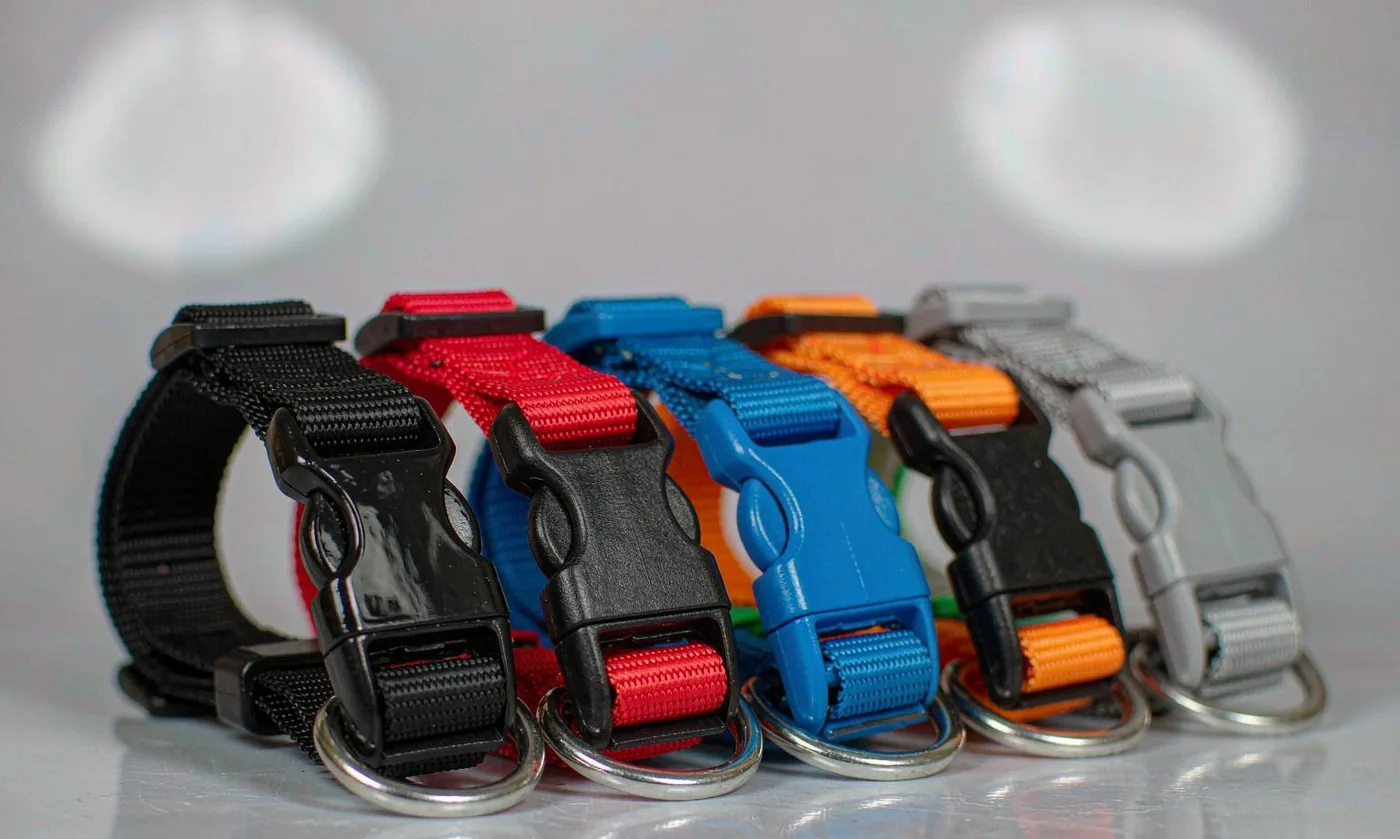
Hardware choices for light duty work
Three hardware families cover most programmes, and the differences are consequences of load rather than of style.
Small trigger clips are the most familiar. They operate one-handed, cost little and read clearly as hardware in photography. For light use they are entirely adequate, provided the gate spring is specified for enough cycles and the finish is tested for contact wear against the collar's own hardware.
Split rings are cheaper still and effectively fail-proof in normal service, but they are fiddly to operate and can deform plastically under surprisingly modest load. They suit programmes where the attachment is set once and left, rather than operated repeatedly.
Light carabiners, usually aluminium, offer the smoothest operation and the best appearance at a slightly higher cost. Because aluminium behaves differently from steel under load, the working figure should be scrutinised rather than inherited from steel experience.
| Hardware | Operation | Typical working load | Notes | Added unit cost |
|---|---|---|---|---|
| Small trigger clip | One-handed, spring gate | 25-60 kg static | Cycle-test the spring; check finish against collar hardware | USD 0.35-0.65 |
| Split ring | Two-handed, set once | 20-45 kg static | Deforms plastically; poor for repeated operation | USD 0.15-0.35 |
| Light aluminium carabiner | One-handed, smooth | 40-90 kg static | Best feel and appearance; verify aluminium figures | USD 0.70-1.35 |
| Breakaway clip | One-handed, calibrated release | Releases above limit | Converts misuse into a non-event | USD 0.90-1.35 plus setup |
Finishes deserve more attention at this price point than they usually receive. Small cheap hardware tends to arrive with sharp edges and inconsistent coating, either of which is immediately visible when the owner handles it. Specifying deburring on edges and a stated coating thickness costs very little and reads as quality.
Nickel and heavy metal content should be screened along with everything else metal on the product, since this hardware sits closer to the animal's neck than any other component. Checking against applicable restricted substance lists is straightforward and prevents an unpleasant late discovery.
Spare hardware also solves an after-sales problem that otherwise gets expensive. Owners lose small metal parts, and a spares line held in the same warehouse turns a replacement request into a cheap envelope rather than a replacement product.
Finally, buy with allowance for loss. Small hardware disappears during assembly at a higher rate than almost anything else, and having spares means production does not stall over a fifteen cent part.
Placement rules that keep the feature honest
Placement converts a modest light-duty feature into either something useful or something hazardous, and the deciding factor is where it sits relative to the animal's neck and body.
The first rule is height. A collar point anchored low encourages the animal to pull downward against the neck, which is exactly the loading nobody wants. Anchoring above shoulder height, so the strap runs roughly level rather than downward, removes most of that risk and also looks tidier.
The second is lateral position. Because collars sit centrally, a point placed off to one side introduces rotation every time the animal moves. Centring it in the chamber, or providing symmetrical alternatives, keeps forces where they belong.
The third is distance from the opening. Placing the point too close to the exit means an animal intent on leaving reaches it first; placing it deeper encourages reaching. Somewhere between the two, close enough to operate but not within easy reach, is the practical answer.
Strap length is then set by consequence rather than convenience. It needs to permit movement between standing and lying positions without ever allowing sustained tension, which usually means deliberately generous length combined with a clear statement that the point is for supervised use.
Snag risk deserves a specific check, particularly where small collars carry tags that dangle. A tag caught on the clip, then the animal moving, is precisely the scenario to design out through placement rather than to warn about afterwards.
Photography should be planned around honesty here. Showing the point clipped to nothing, or to something it would never realistically hold, sets an expectation photographs will be held to; showing it clipped to a tag during a transfer moment is both truthful and more persuasive.
Finally, consider whether the point can be concealed when unused. Because it is light-duty hardware, leaving it visibly accessible invites owners to attribute more capability to it than it has, whereas stowing it behind a panel and documenting its purpose keeps the message aligned with the engineering.
Materials, comfort details and matching the rest of the range
Because this is a contact-heavy component sitting near fur and skin, material decisions have more tactile consequence than their cost suggests.
Narrow webbing should be soft rather than stiff, because 12-16 mm straps sit close to the neck and stiff webbing abrades. A brushed or smooth-finished polyester usually performs best, and it should be specified with the same colour reference as the rest of the webbing so a small component does not introduce a visible mismatch.
Edge finishing matters here in a way that is easy to dismiss. Heat-cut edges are cheap and fray-resistant but produce exactly the sharp edge that should not be near an animal's neck; folded, bound or ultrasonic-cut edges are the responsible options and cost marginally more.
Hardware contact points benefit from small sleeves or covers, particularly where metal meets metal. The difference in noise alone is noticeable, and anyone who has travelled with a jingling bag will recognise why this detail earns its place in a specification.
Reflective elements deserve consideration because this component sits high and forward where vehicle lighting reaches it first. A short reflective yarn woven into the webbing costs very little and adds genuine visibility value for evening arrivals.
Colour consistency across soft goods and hardware should be checked under retail lighting rather than daylight, because this is the component where a slight difference between strap and shell reads most clearly as a mistake.
One small adjacency worth checking: proximity to any treat or food pocket in your range. Oils travel, and metal sited beside a treat compartment collects residue faster than expected, which is why this component should be specified alongside neighbouring features rather than independently of them.
Finally, remember washing. Hardware near fur collects oils faster than anything else, and specifying how the strap should be cleaned - and being confident the hardware tolerates it - prevents the most common reason this feature gets quietly abandoned by its owner.
Documentation, wording and staying on the right side of claims
Collar hardware attracts claims problems out of proportion to its size, mainly because copywriters reach for reassuring language that engineering cannot support. Three documents keep a programme safe.
The first is the internal specification, stating the intended use, the maximum working load with its test method, and the failure behaviour. This is the source document everything else should quote from, and where discrepancies are most costly.
The second is retail-facing copy. Phrases should describe supervised convenience: holding an animal briefly during transfer, managing tags and small accessories, keeping contact while the handler arranges something. They should never describe restraint, protection or safety outcomes, all of which imply performance claims the component has not been tested for.
The third is after-sales guidance, which is frequently the weakest link. Front-line teams answer questions about this feature more often than anyone expects, and they cannot invent nuance under pressure. Giving them the same three sentences the specification uses prevents a great deal of avoidable escalation.
Chemical compliance should be included in the same file rather than handled separately. Screening the finish against applicable restricted substance expectations, and keeping paperwork collected through independent third-party laboratory verification, means the answer to a retailer's question is a document rather than a promise.
Keep every version of the wording archived. When a claim is questioned, the relevant question is usually what was known and printed at the time rather than what is true today, and being able to produce the original approved text settles that quickly.
Finally, keep an eye on how expectations evolve. Buyers increasingly reference independent work such as that published by the Center for Pet Safety, and programmes written against current thinking rather than past convention stay listable longer.
Turning light-duty hardware into merchandising value
Because this component is small and cheap, it tends to get specified last and then expected to carry unreasonable merchandising weight. Approached properly, though, it can support several genuinely useful commercial structures.
The simplest is the essentials bundle: carrier, collar point, and a small branded tag or ID holder clipped in at shipment. The bundle reads as complete, photographs well and answers a real question about where tags go.
The least appreciated value is returned later, in reviews. Owners rarely praise features they were given honestly, but they do punish products that promised something they did not deliver, so restraint in the copy produces better long-term ratings than ambition does in the short term.
The second is tiering within a range. A base model ships without this hardware; a travel edition includes it. Because customers understand the difference immediately, it is one of the more effective ways to justify a step-up without adding much cost.
The third is collaboration with an identification or collar brand. Small hardware partnerships are easier to negotiate than large ones, and inclusion is cheap for both parties, particularly where the carrier's other attachment hardware such as the harness attachment interface already positions the range as equipment rather than luggage.
The fourth is seasonal relevance. A reflective version for darker months, a bright colourway for summer and a light version for kitten or puppy capsules all allow the range to be refreshed without redeveloping the shell.
A modest addition helps here: a printed scale mark on the webbing showing maximum recommended animal weight. It is unusual, it is immediately understood, and it communicates seriousness more effectively than a paragraph of marketing copy ever will.
Whatever is chosen, the packaging copy should answer two questions immediately: what this is for, and what it is not for. Doing that on the belly band rather than in a buried manual is the difference between a feature understood and a feature misused.
Finally, decide who owns this decision internally. Attachment hardware touches design, compliance and merchandising, and programmes without a clear owner tend to revise it late, at the point where changes cost the most and benefit the least.
The brands that get this right tend to look more considered than their spend suggests, largely because they were honest earlier than they needed to be.
Costing, sampling and inspection
Unit cost here is dominated by hardware finish and assembly labour rather than by material quantity. Split rings sit at the bottom of the range, small trigger clips in the middle, light carabiners and breakaway variants at the top, with total installed cost typically between USD 0.40 and 1.35 depending on finish volumes and whether bespoke tooling is involved.
Two decisions affect cost more than negotiation. Using one hardware reference across several models concentrates purchasing and removes a category of assembly error, and skipping bespoke shapes allows standard parts with enormous availability and no tooling risk.
Consider whether a demonstration sample should ship to retail rather than a photograph. Light-duty hardware is more persuasive in the hand than on a card, and a sample clipped to the fixture answers questions before they reach customer service.
Sampling should verify behaviour rather than appearance. Our production team builds prototypes into nominated shells within 6-10 working days, and we recommend testing each candidate for three things: how it feels in one hand while the other is occupied, how it behaves when the animal steps sideways, and whether anything about it catches or jingles.
Inspection criteria accepted to AQL 2.5 should include strap length within plus or minus 3 mm, absence of sharp edges, clip open and close through a defined number of cycles, hardware finish free of burrs, and correct anchor height verified rather than assumed. Where a breakaway is specified, its release threshold should be sampled rather than trusted across a batch.
Keep the hardware reference in the archived pattern file rather than only in the purchase order. Repeat seasons are where small components most often drift, usually because a cheaper equivalent was substituted when the original reference was no longer recorded.
Bulk follows the standard programme: MOQ 500 units, 35-50 days from sample approval, T/T 30/70 terms and FOB Xiamen shipment, with small hardware individually protected so it arrives unmarked rather than scuffed against neighbouring components in transit.
Order and quality terms
- MOQ 500 pieces per colourway; samples in 6-10 working days
- Bulk production 35-50 days after approval; AQL 2.5 inspection standard
- T/T 30/70 terms, FOB Xiamen, full document set per shipment
People Also Ask
Why offer a collar point if it is not for restraint?
Because real handling includes many brief supervised moments that need somewhere to hold attention. It is a convenience feature, and it is genuinely useful when presented that way.
Which breeds suit this feature?
Toy and miniature breeds that commonly wear collars rather than harnesses, where full harness hardware would be disproportionate to the animal.
Can it hold ID tags?
Yes, and it is one of the better uses. Owners routinely ask where tags should live when off the collar, and answering that question in the design is a differentiator.
Should the point be concealed when unused?
Often yes. Visible light-duty hardware invites owners to attribute more capability to it than it has, so concealment keeps the message aligned with the engineering.
How do we avoid snagging?
Through placement and strap length. Tags hanging from a collar can catch on a clip that sits too close, which should be designed out rather than warned about afterwards.
Does it add value to a bundle?
It does. Shipping with a branded tag or ID holder attached answers a real question, photographs well and makes the package read as complete rather than assembled.
Frequently Asked Questions
What is a collar attachment point for?
It is a light-duty convenience point used during transfer moments: holding an animal briefly while the handler arranges a lead, managing ID tags, or working with small breeds that wear collars rather than harnesses.
Is it a restraint?
No. It should never be presented or used as the primary containment route, because loading a collar means loading the neck. Supervised convenience is the honest and correct description.
What working load should we specify?
Base it on reality: a small animal stepping, leaning briefly or turning should be resisted, anything beyond that should not be. Then apply a safety factor and state the figure with its test method.
Should we use a breakaway clip?
It is worth serious consideration. A clip that releases above a defined load converts misuse into a non-event, which is usually worth the modest additional hardware cost.
Where should it be anchored?
Above shoulder height, laterally centred, and far enough from the opening that an animal intent on leaving cannot reach it first. Height prevents downward loading on the neck.
How long should the strap be?
Long enough to move between standing and lying positions without sustained tension, and short enough that continuous leaning is impossible. Generosity here is safer than tightness.
Which hardware suits light duty best?
Small trigger clips for repeated one-handed use, split rings where the connection is set once, light aluminium carabiners where feel and appearance matter most.
Are there edge finishing concerns?
Yes. Heat-cut edges leave sharpness near the neck; ultrasonic-cut, folded or bound edges are the responsible choice and cost marginally more.
What is the MOQ?
MOQ 500 units. Using one hardware reference across several models concentrates purchasing and removes a category of assembly error.
How quickly can we sample?
Prototypes built into nominated shells arrive in 6-10 working days, and should be tested with an actual collar attached rather than with the hardware alone.
Do we need chemical testing on this hardware?
Yes, along with every other metal component. It sits closer to the animal's neck than anything else, so screening finishes against restricted substance lists is proportionate.
How is it inspected in bulk?
Strap length within plus or minus 3 mm, absence of sharp edges, defined cycle operation, burr-free finish and verified anchor height, all accepted to AQL 2.5.
Talk to QUANZHOU JUNYUAN BAGS about a pet carrier program: MOQ 500 pieces per colourway, samples in 6-10 working days, bulk production in 35-50 days under AQL 2.5 inspection.
Get a free quote Request a sample