Custom Martingale Collar: Training
Private label pet bags and carrier programmes share one packaging standard here, so a mixed order does not add a second carton size or handling charge.
Reading the limited-slip mechanism as a design brief
Every martingale collar is built around one idea: a limited-slip loop that tightens under load and relaxes immediately afterwards. The whole design challenge is deciding how much travel that loop should have, because that single number determines whether the collar is comfortable, effective, or useless. Everything else follows from that one dimension, including hardware size and where decoration may safely be placed. It is a design decision rather than a technical afterthought, and it belongs at the very front of your specification.
Too much travel and the collar behaves like a fixed collar, defeating its purpose. Too little and it applies constant pressure, which customers experience immediately and describe afterwards in reviews. Most house technicians work to a settled range of roughly 40 to 60 mm of differential between relaxed and fully tightened circumference, adjusted upward for larger sizes.
The mechanism also dictates where decoration can live. Because the loop slides through the side ring, any embellishment on the wearing surface must either sit outside the travel zone or be engineered to tolerate movement through it. Ignoring this produces the most common defect in the category: a decorative band that jams or distorts the moment the collar tightens.
Written instructions matter here more than in most categories. A customer fitting this collar for the first time has almost certainly never handled one, and a badly fitted product produces complaints that have nothing to do with manufacturing quality. Budget for a clear diagram on the retail card, repeated on your website, and shared with retail staff during onboarding.
Consider also how the collar behaves when not under load. A well-designed martingale hangs open attractively rather than collapsing into a narrow band, because owners frequently leave it on between sessions. That resting silhouette is what appears in most photographs of the product and deserves deliberate shaping.
Finally, be honest about positioning. Some markets treat these collars as everyday wear, others strictly as training equipment. The difference influences everything from hand feel to width, and trying to serve both with one specification leaves you with something neither audience loves.
A useful exercise before costing is to write three sentences describing the dog, the handler and the moment of use. Every subsequent decision — width, hardware, fabric, price — should be defensible against those sentences without much argument. When it is not, the specification has drifted away from the customer rather than toward them, and the drift is nearly always visible later in sell-through rather than in development.
Layered construction: core, face fabric and edge treatment
A martingale collar is usually three materials doing three jobs, and separating those jobs is what makes a collar look considered rather than improvised. A strong inner core carries load, a decorative face carries the brand, and an edge treatment keeps the two behaving as one object through washing and wear.
Nylon or polyester webbing is almost always the core. It takes load predictably, it is inexpensive, and it is available in every width worth specifying. Tighter weaves feel more refined and resist dirt better, so paying a little more here is usually money well spent because the core is what the customer sees at every edge.
The face fabric is where the brand speaks. Cotton prints, woven jacquards, grosgrain ribbon and sublimated polyester all work, each with different minimum-quantity and colour-matching implications. Cotton gives the softest hand and the most heritage look; ribbon and jacquard read as crafted and support premium pricing; sublimation allows photographic design with no width restriction.
- Core webbing: 20-25 mm depending on size, specified by weave density rather than weight alone.
- Face layer: folded over the core with generous turn-under so no raw edge is visible from any angle.
- Edge binding: either a folded face or a separate grossgrain binding, decided before costing.
- Stitching: two-needle top stitch with matching or deliberately contrast thread, typically at 3 mm from each edge.
The join where face meets core is the detail experienced makers get right and everyone else gets wrong. If the face fabric ends abruptly under tension, it lifts away from the core and the collar looks permanently tired. Extending the face fabric well past the stress point and anchoring it under the hardware solves this at negligible cost.
Wash behaviour should be evaluated on the assembled article, not on components. Different fibre families shrink at different rates, and a differential of even one percent over a collar length shows as puckering along the top stitch line. Ask for shrinkage data for both layers before the pattern is cut.
Where a face fabric will be marketed as responsibly sourced, ask for traceability documentation rather than a generic claim, since retailers increasingly check. Ecological textile criteria published by OEKO-TEX provide language both sides understand. Documentation gathered during sampling costs very little; assembled retrospectively, it can hold a shipment while everybody waits for a signature.
Size grading and loop geometry
Sizing a martingale is not the same exercise as sizing a flat collar, because two circumferences must be specified rather than one. There is the relaxed measurement and the tightened measurement, and the relationship between them carries fit, comfort and function simultaneously. This is why copying a competitor's chart is risky.
Start from real neck data for your target breeds or, better, from your own returns history if you already sell collars. Most ranges use four to six sizes, and each size defines three numbers: minimum relaxed circumference, maximum relaxed circumference, and the fully tightened measurement. Without all three nothing about the fit is truly specified.
| Size | Neck range (mm) | Tightened (mm) | Width (mm) | Run share |
|---|---|---|---|---|
| XS | 200-260 | 240 | 16 | 8% |
| S | 260-330 | 300 | 20 | 20% |
| M | 330-410 | 370 | 20 | 32% |
| L | 410-500 | 450 | 25 | 27% |
| XL | 500-600 | 540 | 25 | 13% |
Width should step deliberately with size rather than staying constant. A 16 mm collar looks correct on a small breed and lost on a large one, while a 25 mm strap looks clumsy on anything under about ten kilograms. Two widths across five sizes is generally enough, with a third reserved for true giant breeds.
Grading should always be derived from one base size, never drawn independently. That discipline keeps the loop geometry proportionally consistent, which matters because travel distance is a relationship rather than an absolute number. Sizes graded independently tend to accumulate errors that show up as inconsistent feel across the run.
Finally, publish both body and finished dimensions. Owners may not know their dog's neck measurement, but they can compare the collar they already own against yours, which removes most of the uncertainty that otherwise suppresses online conversion. Add the dog's weight range alongside the measurements as well, because owners almost always know one and rarely know the other.
Hardware finishes as a brand language
Hardware finish is the fastest way to communicate price tier without changing the collar's design. Two identical collars, one with bright nickel and one with matte black hardware, read as entirely different products to a customer standing a metre away. Finish is therefore a branding decision as much as a component decision.
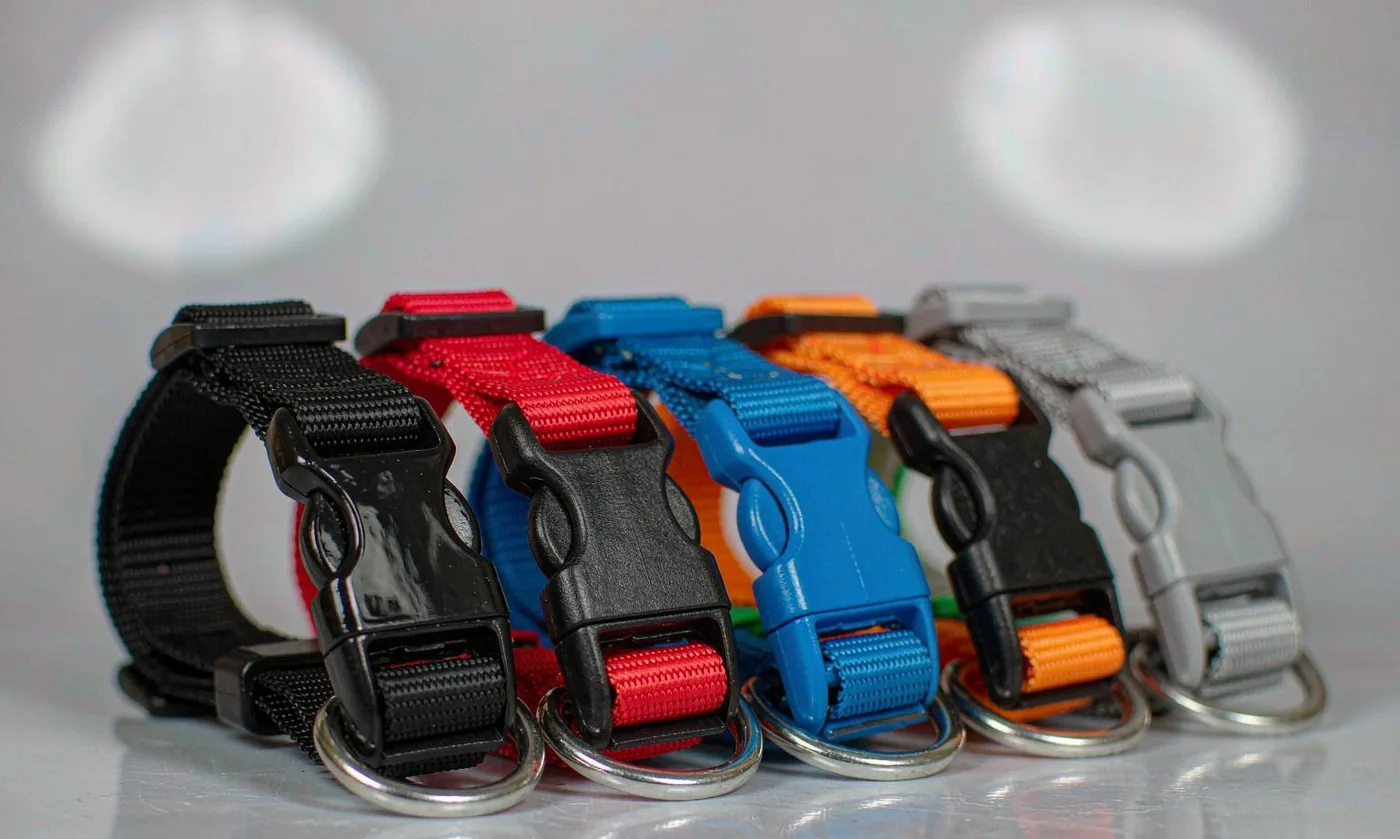
Three families cover most programmes. Bright finishes — polished nickel, antique brass — suit heritage and gift-led ranges and photograph warmly. Matte finishes — black, gunmetal — suit technical and urban brands, hide scratches better, and are the default for sport-led programmes. Coloured finishes — rose gold, champagne, colour-anodised — appear in premium seasonal capsules where the hardware is part of the colour story.
- Welded D-ring: the load-bearing component; specify inside diameter, wire gauge and weld quality.
- Side release or flat ring: chosen by whether the owner should be able to open the collar without removing it.
- Adjuster: must hold under repeated shock loading without creeping, which is the most common hardware failure.
Corrosion behaviour is worth specifying explicitly where the range ships to coastal or winter-salt markets. Plated components can look perfect initially and pit within a season, so request salt-spray data and make it a line item rather than an assumption. Nothing damages confidence faster than hardware that fails in month four, and reviews written then stay visible for years.
Consistency across a range is the other half of this decision. If your leads already use matte black, continuing that finish onto the collar — and eventually onto the custom long leads in the same family — creates a coherent wall display. Mixed finishes read as buying rather than designing.
Maintain one approved sample of every hardware item with its finish lot documented, ideally photographed alongside the reference number, so a reorder can be verified against physical evidence rather than memory. Photographs taken under the same lighting each season are more reliable than any written description, and enormously faster to compare.

Print, colour and seasonal storytelling on a narrow band
A martingale offers a surprisingly narrow canvas: the face fabric may be no more than 25 mm wide before the fold. That constraint should shape the design language rather than fight it, because most artwork designed for a 200 mm panel fails completely at this scale.
Three strategies work reliably. Repeat patterns designed specifically for the band and tiled to match across sizes; solid colour faces with a single centred motif such as a woven label or small print; and deliberately engineered gradients that exploit the length rather than the width, moving through several tones over the circumference.
Colour referencing follows the same discipline as any textile programme. Nominate one reference per colourway, approve each component under standard lighting, and note that different fibres will render the same reference differently. A careful combination — printed polyester face, dyed webbing core, coloured thread — needs three approvals, not one.
Fastness deserves specific attention because a collar sits against fur and skin and gets washed repeatedly. Both rubbing and washing behaviour should be measured on the finished article, and the relevant test methods maintained by AATCC give both sides an agreed language for acceptable performance.
Seasonal capsules work well here because the base construction never changes. Swapping only the face fabric and thread colour allows new stories every quarter with no re-engineering, archived specifications and no additional tooling — the cheapest possible route to an apparently fresh range.
Consider a core-plus-season approach: two permanent neutral colours carrying steady volume, plus one or two printed seasonal introductions that create the perception of novelty without multiplying dead stock. Announce seasonal introductions ahead of delivery so retail partners can plan display space instead of reacting after the cartons land. Where several retailers sell the range at once, that notice period is often the difference between a featured position and a shelf at the back.
Tier architecture: good, better, best
Most successful collar ranges eventually settle into three tiers, whether or not that structure was planned. Establishing it deliberately, before development begins, is considerably cheaper than discovering it afterwards and having to retro-fit designs into a price structure they were never built for.
The entry tier exists to recruit customers. It uses printed polyester faces, bright hardware and minimal packaging, and it is priced to sit comfortably alongside competitors at the same shelf position. Its job is to get your logo onto a dog, not to carry your margin.
The core tier is where most of the volume and most of the margin lives. It typically uses woven jacquard or ribbon faces, matte hardware and better retail collateral, retailing roughly sixty percent above the entry tier. This SKU deserves the largest share of your display and the largest share of your development attention.
| Tier | Face fabric | Hardware | Packaging | Retail band |
|---|---|---|---|---|
| Entry | Printed polyester | Bright nickel | Card only | 10-15 USD |
| Core | Woven jacquard | Matte black | Card with diagram | 18-28 USD |
| Premium | Ribbon with contrast binding | Brass or rose gold | Boxed | 32-48 USD |
The premium tier exists to raise the range's perceived ceiling. Even where it sells slowly, it changes how customers perceive the two tiers below it, which is an effect most brands underestimate. One beautiful expensive SKU makes everything else look better value.
Keep the base pattern shared across all three tiers wherever possible. Shared grading, shared loop geometry and shared hidden components mean the visible differences are entirely about face fabric and hardware — the cheapest possible route to a credible three-tier story, and the quickest to update whenever the market moves.
Finally, plan the merchandising before the pricing. Where three tiers share one card format and one size run, the fixture tells the story for you, and customers trade up without needing any explanation from staff. Shared fixtures also simplify planograms, which makes buyers noticeably more willing to grant space to a new brand.
Sampling, costing and the production calendar
Development runs in a predictable sequence, and knowing it in advance prevents most of the schedule surprises that plague first programmes. Gate one is a construction sample in plain webbing with no face fabric, purely to verify loop geometry and hardware behaviour. Gate two adds the face fabric, thread and all approved trims.
Gate three is the preproduction unit built exactly as bulk will be built, including packaging if you want it checked. This is the sample you approve and archive as the golden reference. Each gate typically absorbs one revision, so the whole sequence is comfortably accommodated within the 6-10 working day sampling window when artwork is ready and materials are already nominated rather than sourced from scratch, provided feedback arrives together rather than in a slow drip over several weeks.
Cost is dominated by four lines: webbing core, face fabric, hardware set and labour. Face fabric can be either the cheapest component or the most expensive depending on what you choose, and it is the variable most worth negotiating because it carries so much of the perceived value. Independent verification through organisations such as SGS also confirms that the material specified is the material actually delivered, which protects that investment at little cost.
- Webbing core: stable and modest; weave quality matters more than price here.
- Face fabric: the widest cost spread, from commodity prints to woven ribbon.
- Hardware set: scales with finish complexity rather than collar size.
- Labour: driven by construction complexity, particularly hidden joins.
MOQ is 500 pieces per colourway and can be distributed across the size curve, which means a five-size range with two colourways represents two minimums rather than ten. Discuss the split early, because production planning is easier when the size mix is known before cutting begins. Late changes to that split are the single most common cause of avoidable delay.
The calendar then runs 35-50 days of bulk after written approval plus transit. Working backwards from a seasonal date is the single most valuable habit a brand team can develop, because it converts abstract deadlines into specific artwork freeze dates nobody can argue with. Those dates, once published internally, are also the cheapest possible defence against late-stage changes, which quietly cost more time and considerably more money than anyone admitted at the meeting where they were proposed.
Merchandising collars: size blocks and wall systems
Collars are difficult to merchandise because they are small, they come in many sizes, and customers cannot easily compare them when they are stacked in a heap. Solving that display problem is often worth more than any change to the product itself, particularly in independent shops.
Size-block thinking works well. Group one colourway across all sizes on a single vertical rail rather than grouping all colours on one hook, because customers who have decided on a colour are looking for their size and will abandon anything that takes more than a few seconds.
- Vertical size blocks: fastest self-service, needs rail space but rewards it.
- Colour columns: better for ranges selling on design rather than fit.
- Carded sets: one colour per card, clearly size-tabbed at the top edge.
- Fitting gauge: a cheap branded measure loaned to retailers prevents most sizing returns.
Printed size tabs at the card's top edge are the single highest-value packaging detail in this category. A customer scanning a rail reads tabs rather than turning each card over, and whoever makes the search faster makes the sale.
Fitting gauges deserve more attention than they receive. Supplying retailers with a simple branded measuring tape reduces returns measurably, costs very little, and keeps your identity visible long after purchase. It is one of the few marketing items that customers actually keep, keep using, and occasionally photograph, which makes it unusually cost-effective over a multi-year lifespan.
Online, replicate the same logic. Show the size chart on the product page rather than behind a link, include body and finished measurements together, and use one image that shows the collar being fitted correctly, because most customers have never been taught how. One demonstration video, produced once and used everywhere, will repay its cost several times over across a full catalogue.
Order and quality terms
- MOQ 500 pieces per colourway; samples in 6-10 working days
- Bulk production 35-50 days after approval; AQL 2.5 inspection standard
- T/T 30/70 terms, FOB Xiamen, full document set per shipment
People Also Ask
What makes a martingale different from a flat collar?
It has a limited-slip loop that tightens under load and relaxes afterwards. That behaviour depends on the differential between relaxed and tightened circumference, which is why it must be specified rather than assumed.
Should martingale collars be left on all day?
Ranges positioned as everyday wear use softer faces and gentler geometry, while training-positioned products are built for sessions. Decide which you are making before specifying anything else.
How many sizes should a launch range include?
Four to five covers most breeds adequately. Each size needs three specified measurements, so every additional size also adds three specifications that must be graded, not guessed.
Why do prints look different at collar width?
Because most artwork is drawn for large panels. At 20 to 25 mm, fine detail disappears, so designs should be created as repeats specifically for the band rather than scaled down from a poster.
Does hardware finish really affect perceived value?
Yes, strongly. Two identical collars with bright nickel versus matte black read as different products at a metre. Finish is one of the cheapest and most effective ways to signal price tier.
Can white label collars ship with our own barcodes?
Yes. Woven labels, size tabs, care content, hangtags and barcodes are all produced under your identity with no reference to the production network on the finished unit.
Frequently Asked Questions
What is the MOQ for custom martingale collars?
500 pieces per colourway, distributed across your size curve rather than repeated per size. Two colourways across five sizes therefore represent two minimums, which is how most first ranges are structured.
How should we size a martingale collar range?
Specify three measurements per size: minimum relaxed circumference, maximum relaxed circumference and the fully tightened measurement. Five sizes from roughly 200 to 600 mm covers most breeds.
How much should a martingale tighten?
Most specifications settle between 40 and 60 mm of differential between relaxed and fully tightened circumference, adjusted upward for larger sizes. The loop should relax immediately when tension is released.
Which width suits which breed size?
Use 16 mm for small breeds, 20 mm for medium and 25 mm for large ones. Two widths across five sizes is typically enough, with a wider option reserved for giant breeds.
Can decorative fabric be used on the tightening loop?
Yes, provided the decoration is placed outside the travel zone or engineered to move through it safely. This is the most common defect in the category and should be resolved at sample stage.
What hardware finishes are available?
Bright nickel and antique brass, matte black and gunmetal, plus coloured options such as rose gold for premium capsules. Finish choice should follow the language already used across your leads and harnesses.
How long does sampling take?
6-10 working days across three gates when artwork is ready: construction sample, faced sample and preproduction unit. Custom face fabric or bespoke finishes add time and should be planned for.
Do you provide shrinkage data for face fabrics?
Yes, on request for every nominated fabric. Where two layers shrink at different rates the resulting puckering is a defect, so we prefer to check before patterns are cut. It also lets the pattern be adjusted rather than the fabric.
What inspection standard applies to the finished run?
Inspection to AQL 2.5 draws random cartons from the finished shipment. Critical failures such as broken rings or missed reinforcement are zero-tolerance and reworked before loading.
Can we produce three price tiers on one pattern?
Yes, and it is the recommended approach. Grading, loop geometry and hidden components stay constant while face fabric, hardware and packaging carry the tier distinction.
Are size charts supplied for our website?
We provide both body and finished garment measurements with tolerances, so customers can compare against a collar they already own and buy with confidence.
What are the payment and shipping terms?
Standard terms are T/T with 30% deposit and 70% before shipment, quoted FOB Xiamen. Consolidating collars with other items in the range spreads freight and reduces landed cost.
Talk to QUANZHOU JUNYUAN BAGS about a pet carrier program: MOQ 500 pieces per colourway, samples in 6-10 working days, bulk production in 35-50 days under AQL 2.5 inspection.
Get a free quote Request a sample