Custom Training Vest: Handler Gear
Personalized pet carrier embroidery is priced by stitch count and placement, so a chest panel and a full back panel are not comparable line items.
Why handler gear is a garment discipline, not an accessory one
The moment a product touches shoulders, it stops being sewn like a bag. A lead is judged on straight lines and hardware; a vest is judged on how it falls. That difference changes who should be leading the development conversation, what kind of sample you need, and how forgiving the sell will be. Brands that treat handler gear as an extension of their lead range tend to produce garments that hang badly and are returned for fit.
The commercial argument for entering the category anyway is strong. Handler gear carries the highest perceived value per unit of any soft good in a pet training range, it is worn rather than carried, and it puts your logo into every photograph taken at a class, event or competition. It is also the product category with the strongest repeat purchase pattern, because handlers replace worn gear far more often than they replace equipment.
Approach it with three disciplines from the apparel world. First, patterns: every panel gets a name, a seam allowance and a tolerance. Second, grading: sizes must be derived from a base size, never drawn independently. Third, fit sessions: decisions are made on a body, not on a photograph. Teams that adopt all three usually clear samling in two passes or fewer.
There is also a strategic reason to start with a vest rather than a jacket. A vest has no sleeve, no collar roll and no cuff, which removes three of the four most expensive pattern-fitting problems in outerwear. It is the cheapest garment a brand can learn to build properly, and the learning transfers to everything else in a handler line.
Finally, decide what the vest is for before you draw it. Competitive handlers want pocket volume and silence; everyday walkers want lightness and washability; professional walkers want durability and visible identity. These three briefs produce three genuinely different garments, and trying to serve all of them with one pattern usually produces one that serves none.
A word on how those decisions reach the tech pack. Each role should be translated into one measurable target before costing begins: pocket count for competitive gear, garment weight for everyday gear, wash cycles for professional gear. Targets give the costing conversation something objective to negotiate against, and they stop slow drift toward a specification that does several things badly. When a later request threatens a target, you will know within seconds which part of the product identity is being traded away.
Panel mapping and pocket architecture
Panel mapping is the drawing exercise that turns a sketch into something cuttable. Start from the centre back seam and work outward, naming each panel and deciding what it does. A typical handler vest uses seven to nine panels: two front, one back split into upper and lower yoke, two side inserts, two shoulder panels and a back hem facing. Each seam you add costs labour and creates a place for the garment to twist, but also creates shaping that boxy vests lack.
The upper back yoke is worth particular attention. Handlers reach forward constantly, and a back panel cut too short across the shoulder blade will pull tight and restrict the arm. Adding 15-20 mm of ease across the upper back, or inserting a knit action panel there, solves the problem at a cost of a few cents.
- Front lower pockets: 180 x 200 mm minimum for a treat pouch or a clicker and a phone.
- Chest pocket: a vertical zip pocket at 140 x 180 mm keeps small items reachable with one hand.
- Rear drop pocket: a full-width back pocket for toys and reward bundles, lined in wipe-clean fabric.
- Interior security pocket: hidden zip pocket for keys, cards and the handler's own phone.
- D-ring stack: two tape-mounted loops at the side seams for clip-on accessories.
Pocket placement must be validated with the equipment actually in it. A pocket that accepts a treat pouch on paper often fails once a pouch filled with soft treats is dropped inside, because the weight drags the pocket mouth open. Give each pocket a closure: reverse-coil zip, magnetic flap, or a deep facing that keeps contents below the pocket line.
Zippers deserve their own specification line. Specify the brand family, tape colour, coil size and slider type, not simply "black zip". Reverse-coil construction places the coil on the inside of the tape, hides the hardware, and reads considerably more expensive than a standard coil at nearly identical cost.
One further decision belongs in this section: how loud the garment is allowed to be. Every pocket closure, every strap and every dangling item adds sound during movement, and quiet handling is a surprisingly strong purchasing criterion for competition handlers who work close to their dog. Soft-loop zip pullers, faced pocket flaps and internally anchored D-rings all reduce noise for almost no added cost, but they must be decided during panel mapping rather than retrofitted afterwards.
Fabric and trim: soft-shell, mesh and stretch mapping
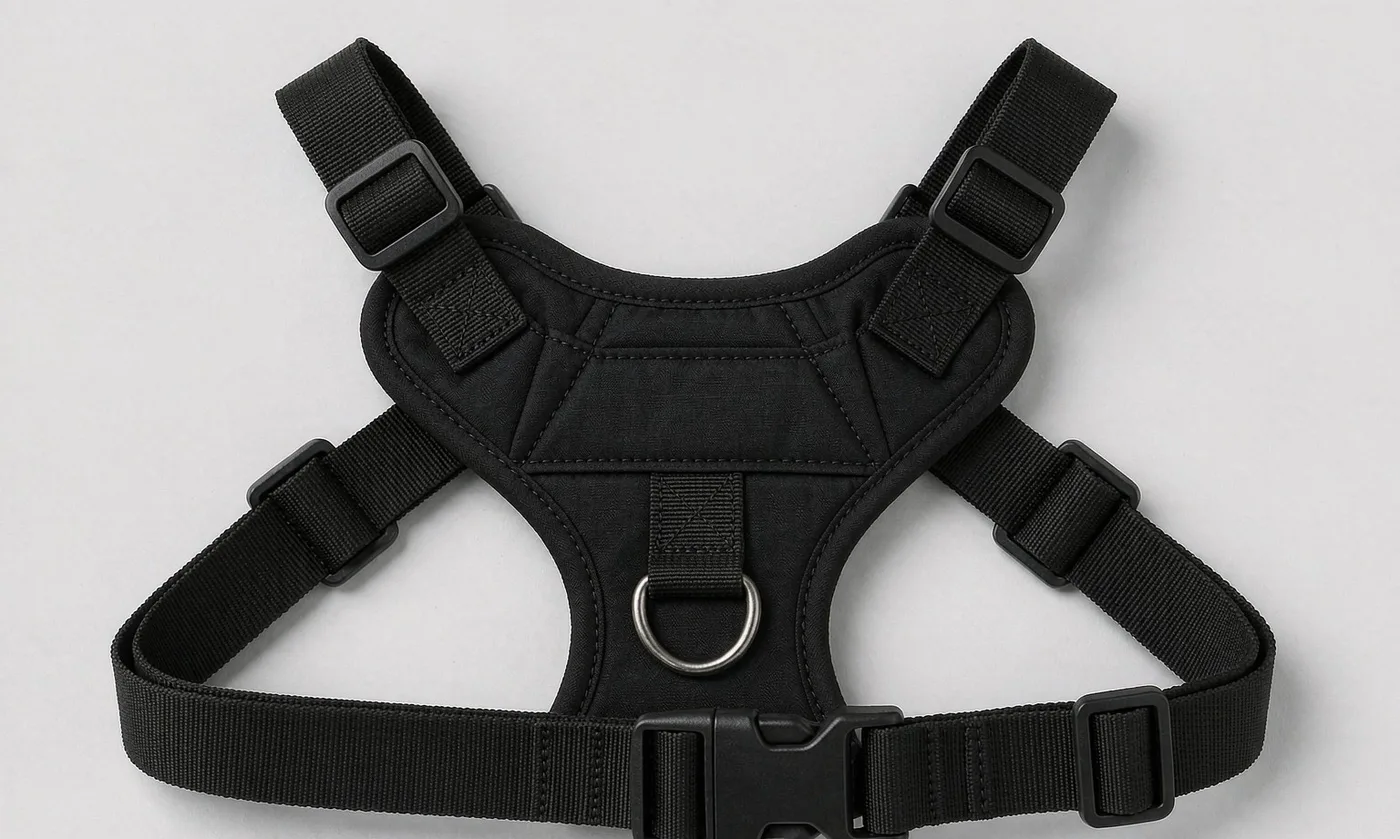
Handler gear fabric selection is a compromise between structure and silence. Soft-shell bonded fabric — a woven face, a membrane and a knit back — is the default for premium vests because it holds shape, resists wind, and looks technical without shouting. Its weakness is weight and breathability in warm conditions, which is why most ranges pair it with mesh ventilation.
Stretch woven or knit side panels have become standard rather than optional. A 4-way stretch insert under each arm accommodates the reach pattern described earlier and lets one size cover a wider range of bodies, which in turn reduces returns. Use a mid-weight interlock or a power-mesh depending on whether you want opacity or airflow.
- Face fabric: 100% polyester soft-shell, 300-320 gsm, with a durable water-repellent finish that has not been treated with long-chain fluorocarbons.
- Ventilation: airmesh inserts in the upper back and under-arm gussets, bonded rather than sewn to reduce bulk.
- Tape trims: 20 mm binding at the armhole, folded cleanly with no topstitch shadow on premium tiers.
- Lining: brushed tricot for warmth-tier vests; open mesh for summer editions.
Washability is the hidden spec. Handler gear gets washed far more than owners admit, and the failure mode is almost always at a seam where two different materials meet. Request shrinkage data for every nominated fabric and require pre-shrinking or a compensating pattern adjustment where the differential exceeds 2%.
For any input you intend to market as responsibly sourced, ask for documentation rather than a claim. Recycle-content yarns can be traced, and ecological textile criteria such as those administered by OEKO-TEX give buyers something concrete to file during onboarding. Quality system expectations in most retailer questionnaires begin at ISO 9001 requirements, which our partner facilities have maintained alongside BSCI social-audit compliance since 2014.
Trim deserves equal scrutiny, because it ages differently from the face fabric. A vest that looks superb new can look tired after twenty washes simply because the binding tape faded faster than the shell. Ask for wash testing on the assembled garment rather than on components in isolation, and request replacement trim lots from the same dye batch for reorders so the whole garment ages along a consistent curve.
Also agree early how the range will be extended. A vest is rarely produced alone for long; gilets with removable linings, short-sleeve overshirts and lightweight shells all follow from the same block. Nominating one face fabric family and one trim family up front means those extensions can be costed against shared minimums later, which is how a handler range grows without doubling development spend.
Size grading and the fit session you should not skip
Sizing is where handler gear programmes succeed or quietly fail. Returns in this category are overwhelmingly size-driven, and unlike a colour dislike they cannot be fixed by discounting. Build your size set from real body data for your target market rather than copying a competitor's chart, because two brands using the same letters frequently differ by 40 mm across the chest.
Grade from a base size — typically medium — rather than drawing each size independently. Every measurement then moves by a defined increment, which keeps the silhouette consistent across the run. Published apparel sizing systems provide the reference framework, and most experienced house technicians work to tolerances of plus or minus 10 mm on chest and plus or minus 15 mm on body length.
| Size | Chest (mm) | Back length (mm) | Shoulder (mm) | Share of run |
|---|---|---|---|---|
| XS | 880 | 560 | 340 | 8% |
| S | 940 | 585 | 360 | 18% |
| M | 1000 | 610 | 380 | 32% |
| L | 1060 | 635 | 400 | 27% |
| XL | 1120 | 660 | 420 | 15% |
Five things should be checked on a live model before pattern approval: shoulder seam position relative to the shoulder point, armhole depth under forward reach, pocket mouth behaviour when loaded, hem line when seated, and whether the garment can be zipped over a sweatshirt if it is intended as an outer layer. Each check takes under a minute and each one catches defects that photographs cannot.
Plan the fit set as part of the sample package. If budget allows only one stage of physical fitting, spend it here rather than on a second decoration round. A beautiful logo on a vest that pulls across the shoulder will not save the SKU, and re-patterning after bulk cuts begin is dramatically more expensive than correcting a pattern during development.
Document each fit decision in writing beside the revised pattern. Transcription errors between a verbal comment and the technician's adjustments are a real and recurring source of repeat samples, and a two-line written record per change removes nearly all of them. Ask for the updated tech pack to be returned with the revised sample so both sides are working from the same version.
Think too about how size data reaches your customer before they buy. Publishing garment measurements rather than only body measurements lets repeat customers order confidently, and including the weight range rather than a single weight keeps unusual builds covered. Fit complaints drop measurably when customers can compare against a garment they already own.
Decoration, colourways and team identity
A handler vest offers the largest continuous decoration area of anything in a training range, which is both an opportunity and a trap. Opportunity, because a 200 mm back panel can carry a mark with real presence. Trap, because the temptation to print large is what separates professional-looking handler gear from promotional merchandise. Restraint reads as expensive; coverage reads as an event giveaway.
The most successful layout we see uses three decoration positions with three different processes. Left chest carries a small flat mark, typically a woven patch or a subtle embroidery. Upper back carries the primary identity, often a heat transfer with fine detail. Sleeve or hem carries a repeat-word identity printed on binding tape, discovered rather than announced.
Reflective elements belong here and should be designed in, not added. Retroreflective piping along the shoulder and rear yoke is invisible in daylight and reads strongly under headlights at night, which makes it an honest functional feature rather than decoration. Ask for the reflective component to be specified with its performance data rather than its appearance alone.
Colourways should follow the rest of your range. If your leads and collars already run in three core colours, the vest should too, even though each additional garment colourway carries significant fabric minimums. Many brands solve this with one core shell colour plus seasonal limited runs, using prints and tapes to create variety without committing to another full fabric buy.
Finally, plan for team and club sales from the start. Handler vests are one of the few products with genuine bulk-institutional demand, and a club asking for twenty units with a sponsor logo is realistic — provided your offering includes a clear minimum, a defined lead time and a templated decoration layout they can drop their own artwork into.
Be equally clear about what teams cannot change. Club orders are volatile, deadlines are tight, and requests to alter panel layout or fabric arrive late. Publishing a fixed template — the same base garments, three nominated decoration zones, two approved processes — protects both your margin and your lead time, and it lets you say yes quickly when the order finally lands.
Size-mix economics, costing and the production calendar
MOQ for a custom training vest is 500 pieces per colourway, and crucially that quantity can be spread across a graded size curve rather than repeated per size. This is materially different from how many garment suppliers structure minimums, and it is what makes a five-size launch viable for an accessories brand testing the category for the first time.
A typical first buy puts roughly a third of units into medium, with the tails thinnest at XS and XL. Use the distribution above as a starting curve but ask your sales team what actually sells; regional differences are larger than most people expect, particularly between European and North American body profiles.
| Cost driver | Entry spec | Premium spec | Unit impact |
|---|---|---|---|
| Shell fabric | Woven polyester 210D | Bonded soft-shell 320 gsm | +2.80 USD |
| Zippers | Standard coil, visible | Reverse-coil, hidden | +0.65 USD |
| Stretch panels | None | 4-way knit inserts | +1.10 USD |
| Decoration | Single print position | Patch plus two prints | +1.40 USD |
| Reflective trim | Piping on rear yoke | Full piping plus print | +0.85 USD |
The calendar is the part brands underestimate. Sampling takes 6-10 working days; a fit round adds another week; bulk takes 35-50 days after written approval; ocean freight to Europe or the United States typically adds 25-40 days on top. Counting backwards from an autumn delivery date puts the artwork freeze in mid-winter, which surprises people every year.
Capacity should be booked early for seasonal goods. Our production network has been building sewn pet ranges since 2014 from a 4,950 m² SGS-verified base with 137 people across 7 lines and 149 machines, delivering 200,000 units monthly. Those headcount figures translate into finite line slots, and the 35-50 day window assumes your programme has one reserved.
Reorders deserve separate planning. Fabric lead time, not machine time, is usually the constraint on repeat runs, so nominating fabrics that are held in regular production saves weeks on your second season. Where a garment uses a custom-dyed shell or bespoke tape, ask us to hold a standing lot against your forecast rather than restarting sourcing each time.
Hold back a small reserve against the first season. A garment with a graded size run will always sell unevenly, and being able to reorder popular sizes quickly before the season ends converts better than discounting the sizes nobody wanted. Discuss reserving fabric at sample approval rather than after the first shipment lands.
Packaging, presentation and the photographic asset plan
A vest ships flat and arrives looking small. The gap between how it looks in a polybag and how it looks on a body is the single largest conversion obstacle in online retail for this category, so plan your assets accordingly. Budget for the garment to be photographed on at least two body types before the launch assets are due.
Physical retail has a different problem: hanging. If your vest is sold on a hanger, specify the shape and shoulder width of that hanger in the packing instructions, because a narrow hanger will stretch a soft shoulder seam over a season on the rack. Where possible, ship on the same form the retailer will use.
- Hangtag: size chart on the reverse, never on a separate insert that can go missing.
- Polybag: printed with safety warnings where required and vented to allow air exchange.
- Carton: size-assorted inner cartons labelled by size so stock rooms can replenish quickly.
- Care label: fibre content, care symbols and origin, positioned clear of the zip to avoid rubbing.
The size chart on the hangtag is a commercial asset as much as a practical one. Include both body measurements and garment measurements, because handlers buying their third vest already know which of your sizes fits them and will buy online with confidence only if that information is printed somewhere they can reach.
Plan collateral to land eight weeks before the ship date. Where a size-inclusive range is part of the brand story, say so on the card and in the photography plan — it costs nothing extra to show a genuinely broad range of handlers wearing the gear, and it converts in a category where fit anxiety is the primary barrier to purchase.
Finally, treat the vest as a multi-season franchise rather than a one-off launch. Archive the approved pattern, the fabric lot references and the decoration films together so next year's colour refresh can be sampled in days instead of weeks. Continuity is what turns a novelty garment into a permanent, profitable line.
Add one simple instruction card to every shipment: how to measure, how the garment should sit, and what to do if it does not. Returns fall when customers understand the fit intent, and the same card doubles as the visual asset your retailers use on their own product pages. Clear fit instruction is the cheapest conversion tool available in this category.
Order and quality terms
- MOQ 500 pieces per colourway; samples in 6-10 working days
- Bulk production 35-50 days after approval; AQL 2.5 inspection standard
- T/T 30/70 terms, FOB Xiamen, full document set per shipment
People Also Ask
Why do training brands add handler vests?
Because the garment is worn rather than carried, it delivers repeated logo impressions at events and classes and carries one of the highest perceived values in a soft goods range, while being replaced more often than equipment.
How many pockets should a training vest have?
Four working positions is the practical answer: two lower front pockets for bulk items, one secure chest pocket and one full-width rear drop pocket lined in wipe-clean fabric.
What makes handler gear comfortable for long sessions?
Stretch side panels, added ease across the upper back yoke, lightweight face fabric and placed ventilation. Weight matters too, so set a target garment weight in the tech pack and hold design changes to it.
Should a handler vest be size-graded like apparel?
Yes, always from a single base size with defined increments per measurement. Grading preserves silhouette across sizes and is the main defence against the returns that dominate this category.
What decoration reads as premium on a garment?
Restrained placement: a small chest mark, a considered back identity and a hidden repeat on tape. Full-panel prints at maximum coverage read as promotional rather than professional.
Can white label vests ship without supplier branding?
Yes. Woven labels, printed care content, hangtags and barcodes are all produced under your own identity, with no reference to the production base anywhere on the finished garment.
Frequently Asked Questions
What is the MOQ for a custom handler vest?
500 pieces per colourway, spread across a graded size curve rather than per size. A two-colour first buy on one pattern at 250 each is possible with a modest unit premium because cutting and changeover repeat.
Can I choose my own size distribution within the 500 pieces?
Yes. Provide your own curve or start from our recommended distribution of 8/18/32/27/15 across XS to XL. Regional body differences mean your own sales history is usually the better guide after the first season.
How many sizes should a launch range include?
Five sizes covers most markets adequately. Going to six or seven adds grading complexity and divides the same 500 units more thinly, which raises per-unit cost without improving sell-through in most channels.
How long does vest sampling take?
6-10 working days for a first sewn sample with one decoration strike-off. Add roughly a week for a fit session and pattern revision, and more if stretch fabric or custom tape has to be sourced.
Do you develop patterns from scratch for OEM briefs?
Yes. Supply a technical sketch or a reference garment and our team drafts the pattern, maps panels and produces a graded set. Starting from an existing ODM block is faster and cheaper if it fits your positioning.
Which fabric best for warm-climate handler vests?
Lightweight ripstop or a stretch woven with large airmesh ventilation panels. Avoid bonded soft-shell above roughly 28 degrees ambient unless the programme is explicitly positioned as an autumn layer.
Can you add reflective safety elements?
Yes, retroreflective piping, transfers and binding can all be specified with performance data supplied. Design them in at panel-mapping stage rather than adding them after the pattern is approved.
How are pockets tested for durability?
Loaded pockets are checked during fit sessions and again after wash testing. Minimum pocket opening is engineered around the accessory you intend it to hold, so share those item dimensions early.
Can we run a limited seasonal print?
Yes. Reactive or sublimation print panels are common in seasonal editions and carry the same 500-piece minimum unless you accept a print surcharge for a smaller run.
What is the bulk lead time for vests?
35-50 days after written sample approval, followed by inspection to AQL 2.5. Garment programmes trend toward the upper end of that range because they involve more operations than simple soft goods.
Do you supply size charts for resale listing pages?
We provide both body measurement and finished garment measurement charts, together with the tolerance applied during grading, so your e-commerce team can publish accurate data.
Can club and team orders be handled differently?
Yes. We offer templated decoration layouts, defined minimums and repeat-friendly archiving so a club reorder next season matches the original run without re-sampling.
Talk to QUANZHOU JUNYUAN BAGS about a pet carrier program: MOQ 500 pieces per colourway, samples in 6-10 working days, bulk production in 35-50 days under AQL 2.5 inspection.
Get a free quote Request a sample