Header Card: Retail Packaging for Peg Display
A header card is a shaped board panel - typically 350-450 gsm SBS, 100-160 mm tall - sealed or stapled to the top edge of a bagged pet carrier so the whole unit can hang from a retail peg. The card supports the product weight on a 5-8 mm hole, carries branding at three metres, and replaces a rigid box for about one third of the cost. Typical supply runs USD 0.18-0.45 per unit at MOQ 500.
The header card is the least glamorous and most commercially decisive piece of packaging in a pet carrier range. It decides whether the product can be merchandised on a peg wall at all, how many units fit in one carton, and how much a retailer's staff have to think before refilling the shelf. Well specified, it makes a soft product behave like a boxed one at a fraction of the freight. Poorly specified, it tears off under its own weight and the brand loses a whole fixture.
- Sampling: printed, die-cut and welded pre-production units in 6-10 working days.
- Minimums: MOQ 500 cards per artwork; one 640 x 900 mm sheet nests three card shapes to control waste.
- Schedule: card printing and die cutting take 8-12 days, booked to land inside the carrier's 35-50 days bulk cycle.
- Quality: die-cut registration, weld strength and print are inspected to AQL 2.5 against a signed sample.
- Terms: T/T 30/70, FOB Xiamen, cards shipped flat and folded into the packing line with the bulk goods.
When a custom pet bag has to ship flat, the pattern changes: removable stiffeners and a fold line that does not crease the coated face.
What a header card does that a hang tag cannot
A hang tag informs; a header card performs structural work. It converts a floppy, bag-shaped product into a rectangular, stackable, hangable retail object without enclosing it in a carton. That single transformation changes three merchandising outcomes at once: the product can go on a peg wall rather than needing shelf depth, it can be faced front-on so the branding is square to the aisle, and it occupies roughly 30-40 percent less shipping volume than the equivalent boxed version.
The card must therefore be engineered first and decorated second. Physically it has to support the product's hanging weight through one or two holes for months without tearing, resist humidity move in a warehouse, print legibly at aisle distance, and survive being pushed along a rail by staff twenty times a day. Those requirements fix board grade and hole reinforcement before anyone opens a design file.
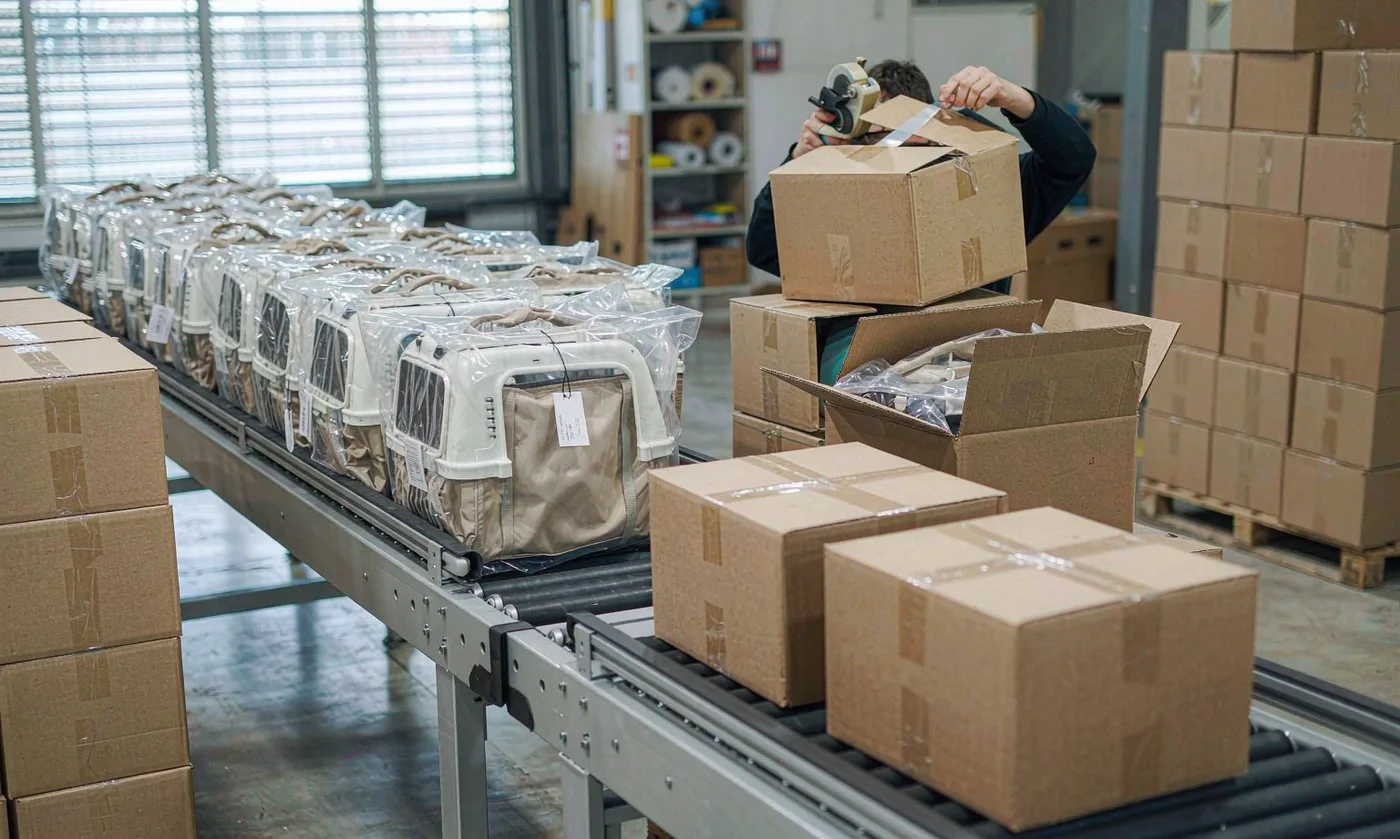
It also protects the product in a way the sealed bag cannot. A properly dimensioned card acts as a stiffener across the top seam of a poly bag, stopping the bag from folding over the peg and hiding the branding. When the carrier has a structured top handle, the card can be shaped to cradle it, which is why design teams often extend the die line down the sides as two short wings - an 18-25 mm return that visibly improves presentation on the fixture.
From a brand perspective, the header card is the only packaging surface that both hangs at eye level and carries real area: typically 5,000 to 12,000 square millimetres of printable space, roughly ten times what a hang tag offers. That is enough room to run one photograph, four product claims, a size ladder and a barcode without crowding - provided the hierarchy is planned, which is the subject of the sections below.
For accessories rather than carriers - collars, leashes, bowl sets, travel mats - the same logic applies at smaller scale, and the cost advantage over a carton grows as the product gets floppier. Soft-goods ranges benefit most when the board specification is decided alongside the shell itself rather than afterwards; see our notes on shell fabric selection for how material choice and packaging structure interact on cost and presentation.
Board selection: grade, caliper and humidity behaviour
Solid bleached sulphate (SBS) board is the default because it is bright, holds a clean fold, and takes both offset and digital printing well. Solid unbleached sulphate (SUS) offers better tear resistance per gram at the cost of a browner print surface, and coated recycled board brings sustainability credentials with a slightly dustier look. The choice is mostly driven by what the product weighs when hung.
Caliper comes next. Below 300 gsm a card carrying anything above about 400 g starts to bow at the peg; between 350 and 450 gsm covers the vast majority of soft pet products; above 500 gsm you are approaching the cost and weight of a carton and should revisit the structural decision entirely. When humidity is a factor - shipping through monsoon-season ports, storage in unconditioned warehouses - specify board with a moisture-resistant sizing, or add a thin matte lamination that also doubles as scuff protection.
| Board | Caliper | Tear resistance | Print surface | Cost index |
|---|---|---|---|---|
| SBS C1S | 350 gsm | Moderate | Bright white, sharp | 1.0x |
| SBS C2S | 400 gsm | Moderate | White both sides | 1.15x |
| SUS natural | 400 gsm | High | Kraft brown, muted | 0.95x |
| Recycled coated | 450 gsm | Moderate-high | Slightly grey | 1.25x |
| SBS + matte lamination | 350 + 12 micron | High | Rich, sealed | 1.45x |
Grain direction is the invisible variable that separates a good card from a curling one. Board fibres run in one direction; fold or score across it and the card flexes easily, but hang it so the load runs with the grain and it resists bending. Always state on the print order that grain must run vertically across a hanging card - otherwise the printer will optimise for layout economy and the unit will slowly droop on the peg.
Two testing habits save the season. Hang a loaded unit on an actual store hook for fourteen days and look for creep at the hole; and cycle three units through a humidity cabinet - roughly 40 to 90 percent relative humidity - to see whether the card cups. Both tests take minutes to set up and are routinely skipped, which is why the failure usually surfaces at a retail partner rather than in development.
Die line planning: holes, wings and sheet efficiency
The die line is where a packaging designer earns their fee. Start from the fixture, not from the shape. North American peg walls overwhelmingly use either a 6.3 mm Euro-slot or a standard round hook slot; European fixtures often run different spacing and hole shapes entirely. Confirm the target retailer's specification, then design the hole - usually positioned 6-8 mm below the top edge, centred horizontally, with at least 8 mm of solid board above it.
For anything above roughly 600 g of hanging weight, single holes are risky. Two approaches solve it. The first is a reinforced hole: a clear ring patch laminated around the slot, or a metal eyelet, spreading the load over a much wider area for about USD 0.02 per card. The second is a sombrero or 'delta' slot, whose inverted-V profile resists tearing better than a plain round hole because it redistributes stress downward into the card body.
Wing returns deserve more use than they get. Extending 18-25 mm of board down either side of the bag gives the unit the visual footprint of a box while keeping the flat-shipping advantage of card. It also creates two additional printable surfaces that are visible at an angle in the aisle - a genuine merchandising gain for roughly 8 percent more board area.
Shape economics matter as well. Cards are cut from standard 640 x 900 mm or 700 x 1,000 mm sheets; whether three, four or six nest per sheet directly changes unit price by 15-30 percent. A rounded top profile often nests better than a rectangular one because adjacent shapes interlock. Ask the printer for the layout before approving the shape, and be ready to trim 2 mm off a dimension to reach a better nesting count - that small concession frequently pays more than switching to a cheaper board.
Finally, plan the fold or score if the card wraps over the bag top. A single score line at 6 mm from the seal edge lets the card fold cleanly rather than creasing unpredictably, and it keeps the front face truly flat against the fixture. Registering that score to the bag seal rather than to the artwork is the single most common source of 'misprinted' complaints in this category.
Keep a version history for the die line as well. Small changes accumulate - a 2 mm top extension for a new retailer's hook, a widened throat to clear a bulkier handle - and without a dated drawing set, the fifth revision is often cut from a file nobody can verify. Store each approved die drawing with the purchase order reference, note which customers use which revision, and the twelfth reprint will match the first one instead of drifting quietly for two years.
Attachment: welding, stapling and sealing to the bag
How the card meets the film determines how the unit behaves in a customer's hands. Three methods dominate, and the right one depends on the bag construction rather than on budget.
Heat sealing works when the card has a heat-activated coating and the bag is polyethylene or a PE-laminate film. A sealing bar at 130-160 C for about two seconds bonds the card to the film with a clean, tamper-evident joint that will not scratch the product or snag fabric. It is the cleanest retail presentation and the method most large pet chains prefer, but it requires the card stock to carry the coating - specify it at order rather than assuming standard board will bond.
Ultrasonic welding suits thinner films and mixed materials where heat would scorch the print. It produces a narrow, strong bond line in under a second and tolerates recycled films that refuse to heat seal consistently. Setup cost is slightly higher per tooling jig but changeover between SKUs is fast, which favours programmes with many small radio-frequency runs.
Stapling is the pragmatic fallback for heavy units or when film chemistry is uncooperative. Use rust-resistant staples, a reinforcing strip of board over the staple line, and never staple through a printed claim area. The aesthetic is rougher than a weld, but structural reliability for a 2 kg travel carrier can justify it, especially when paired with a hanging tab designed to take load independent of the staples.
Whatever joins them, the joint must survive handling abuse. A practical acceptance test: hang the unit, grip the product, pull downward with roughly twice the product weight for three seconds, and check that the card does not separate or tear. Documenting that threshold on the technical file turns a subjective complaint into a measurable criterion, and it can be verified during third-party inspection by SGS alongside ISO 9001 documented procedures.
One more consideration: openability. A shopper should be able to remove the card with their hands, not with scissors. Specify a perforated tear line 5 mm below the weld when the joint is strong, so that removing the card is easy but cannot happen accidentally in transit.
Communicating at three metres: hierarchy for the aisle
A peg display is read from across an aisle, at a distance of roughly 2.5 to 3.5 metres, under vertical light that flattens everything. Design for that condition, not for the PDF viewer. The test worth running is simple: print the card at actual size, pin it at eye level, walk three metres, and note what you can still identify. In most cases the answer is less than the design team expects - usually only product type and one dominant colour.
Build the hierarchy from that distance inward. Level one is a high-contrast photograph or silhouette identifying what it is, occupying perhaps 40 percent of the printable area. Level two is the product name or short benefit line at 14-18 pt equivalent. Level three is supporting claims and the size ladder, readable at arm's length. Level four is finer detail including care and compliance. If anything from level three competes visually with level one, the card fails at distance no matter how elegant the artwork.
Colour blocking by size is a proven tactic. Assigning each size its own colour band across the header lets a customer find the right size visually from across the store and lets staff spot an out-of-stock size instantly. It complicates printing slightly - four or five card variants rather than one - but it improves sell-through enough that most pet chains now expect it, and it keeps the range looking like a system rather than a set of unrelated bags.
Leave an unprinted zone for the price gun or retailer label. Many North American chains apply their own barcode and price sticker over the lower quarter of the card; a reserved 30 x 55 mm white space prevents their label from covering a claim you paid to print. Similarly, keep your own UPC in the lower third with a 4 mm quiet zone, oriented so it reads horizontally when the unit hangs.
Language planning should happen now, not at reorder. A single card design with a two-column compliance block - English and French for Canada, English and Spanish for many US accounts - avoids reprinting for each market and costs nothing extra in printing, only in layout discipline.
Freight maths: why flat-packed cards beat cartons
The commercial case for header cards rests on cube. A carrier packed flat with a header card ships in roughly a third to a half of the volume of the same product in a folding carton, and volume rather than weight governs most ocean freight costs for soft goods. Multiply that across a forty-foot container and the difference typically covers several thousand dollars per shipment - often more than the entire printed collateral spend.
| Option | Per-unit packaging cost (USD) | Shipping volume index | |
|---|---|---|---|
| Poly bag + header card | 0.22 - 0.45 | 1.0x | Hangs on peg wall |
| Folding carton | 0.55 - 0.95 | 2.1x | Stacks on shelf |
| Rigid two-piece box | 1.40 - 2.60 | 3.4x | Premium gift |
| Blister card | 0.85 - 1.30 | 2.6x | High security, poor eco story |
The counterweight is handling and damage risk. Bag-and-card units are more exposed in transit than cartons, so specify film thickness accordingly - 0.05 to 0.08 mm LDPE for soft carriers is typical - and use a carton divider layer if the product has hard hardware such as hooks or clips. Damage rates below 0.5 percent are achievable with sensible packing; above 2 percent the freight saving evaporates quickly in credits.
Warehouse efficiency deserves a mention too. Flat cards arrive nested, occupy minimal storage, and can be packed with the product in the same operation, whereas cartons must be erected. That saves labour minutes at the packing line and removes a whole station from the workflow - a benefit that rarely appears in the packaging comparison but shows up clearly in line output. Programmes that later move part of their range into collapsible folding boxes often keep header cards for entry price points precisely because of this line-time advantage.
Sustainability on shelf: the card as an honest answer
Retail-ready packaging is under scrutiny because shoppers judge it first. A card plus bag combination can be a genuinely good answer here: one sheet of recyclable board and one mono-material PE bag, both kerbside recyclable where facilities accept film. Compare that with a blister pack, where board is permanently fused to PET and neither stream is clean.
Two decisions make or break the claim. First, avoid laminating or foiling the whole card if you intend to print a recyclable symbol; a 12 micron polypropylene film changes recyclability in many municipal systems even at low coverage. Second, print the bag with a resin identification code and, where local rules require, a recycling instruction such as 'check locally - not curbside in all areas'. Vague green claims attract complaints; precise ones build trust and are easier to defend.
Reducing board area is the most effective lever available. Every square millimetre removed reduces cost, freight and material use simultaneously, which is rare in packaging. Shape optimisation typically finds 6-12 percent of area that serves no communication purpose - oversized margins, decorative curves, duplicated text - and removing it makes the remaining message stronger rather than weaker.
Finally, design for the end of life of the display itself. Shelf-edge tested units are frequently damaged and discarded at the store; if the card uses a water-based coating rather than a film, damaged units are still fully recyclable at store level. Our production team has supported sewn goods programmes since 2014 under BSCI and ISO 9001 systems, and the single most useful habit we see in retailers' own packaging teams is this kind of end-of-life thinking at the start rather than at the end.
Pre-production, inspection and the packing line
Treat the header card as a component with tolerances, not as artwork. The pre-production sample should be a genuine packed unit - card printed from the production plates, die-cut on the production tool, welded or stapled with the line's actual parameters, and bagged with the actual film. Approving loose printed sheets is how discrepancies slip through, because the failure modes live in the joint, the score and the hole.
Set measurable specifications at that stage: die-cut tolerance of +/- 0.5 mm against the drawing, colour within Delta-E 3.0 of the proof on coated board, score position within 1 mm of the bag seal, and card-to-bag bond surviving a sustained pull of twice the hanging weight. Write them into the technical pack so that incoming inspection has something enforceable rather than an opinion.
Incoming inspection follows statistical sampling with two classes. Critical defects - wrong UPC, unreadable barcode, card detaching under its own weight, hole tearing - carry zero acceptance because they make the unit unsaleable. Everything cosmetic counts to AQL 2.5 against the signed production sample: minor scuffing, small print deviations, slight curl that flattens under light pressure.
Watch two things on the packing line, where most damage is actually created. Jig alignment: if the card is placed even 2 mm high relative to the bag, the hook hole ends up too close to the top edge and the card tears on the first restock. And seal dwell: operators sometimes shorten cycle time to increase throughput, producing joints that look fine and separate a week later. Both are solved by a simple first-piece check each shift, retained on a card for reference.
Finally, plan the reprint trigger. Boards and dies are stable for years, but UPC allocations, claim wording and compliance text change. Keeping the die line unchanged across reprints means only plates and text update - typically halving both cost and the 8-12 day turnaround on subsequent orders, and keeping the whole line visually consistent for seasons at a time.
Order and quality terms
- MOQ 500 pieces per colourway; samples in 6-10 working days
- Bulk production 35-50 days after approval; AQL 2.5 inspection standard
- T/T 30/70 terms, FOB Xiamen, full document set per shipment
People Also Ask
Is a header card cheaper than a folding carton?
Yes, typically 40-60 percent less per unit, plus roughly half the shipping cube. The trade-off is less transit protection, so film thickness and carton dividers matter more.
How much weight can a header card hold on a peg?
A 350-450 gsm SBS card with a reinforced hole comfortably holds 1.2-1.5 kg indefinitely. Above about 600 g of hanging weight, always reinforce the slot with a ring patch or eyelet.
Why do some cards tear at the hook?
Usually insufficient board above the hole, wrong grain direction, or no reinforcement. A sombrero slot redirects the load into the card body and costs nothing extra to cut.
Can the same card design serve several SKUs?
Yes. One die line with variable print keeps tooling shared and holds reprint costs down; only plates and text change between sizes or seasons.
Do barcodes print reliably on uncoated board?
They scan reliably when placed on coated or laminated stock. On uncoated recycled board use slightly larger bar widths and always scan-test five random units per delivered lot.
Should the bag be printed as well as the card?
Print one abbreviation of the warning and resin code on the bag for compliance, then let the card do the selling. Double-printing the same claims looks cluttered and adds cost twice.
Frequently Asked Questions
What board weight should a pet carrier header card use?
350-450 gsm SBS for most soft carriers; below 300 gsm the card bows under the hanging weight and above 500 gsm you are paying for a carton without getting one. Heavy products justify SUS board at 400 gsm for better tear resistance.
Which peg hole style do retailers use?
North American peg walls commonly use a 6.3 mm Euro-slot or standard hook slot; European fixtures differ. Confirm the target retailer's specification before designing the die line, and keep 8 mm of solid board above the hole.
How is the card attached to the bag?
Heat sealing when the card has a heat-activated coating and the bag is PE-based, ultrasonic welding for mixed or recycled films, and rust-resistant staples with a reinforcing strip for heavy units that need extra load security.
What quantity is the minimum order?
MOQ 500 printed cards per artwork. Because cards nest several per printed sheet, adding units to the first run is comparatively cheap - moving from 500 to 1,000 typically cuts unit cost by around 35 percent.
Can the card carry different sizes in one design?
Yes. Colour-blocking the card by size while keeping one die line lets you print four or five variants economically and makes size identification instant from across the aisle.
Will the card curl in a humid warehouse?
It can, particularly uncoated board above 90 percent relative humidity. Specify vertical grain direction, consider moisture-resistant sizing, and cycle samples through 40-90 percent RH during development to check for cupping.
Is a header card recyclable?
A PE bag plus uncoated SBS board is recyclable in most systems where film is collected. Adding lamination or foil changes that, so omit full-sheet films if you intend to print a recyclable claim.
How much space should be left for retailer labels?
Reserve a white 30 x 55 mm zone in the lower third for their price gun or barcode sticker, and keep your own UPC there too, oriented to read horizontally with a 4 mm quiet zone while hanging.
What tolerance applies to the die cut?
+/- 0.5 mm against the drawing is typical, with score position held within 1 mm of the bag seal. Both should be written into the technical pack so incoming inspection has something enforceable.
Can wing returns be added to the card?
Yes. Extending 18-25 mm of board down each side adds about 8 percent board area, gives the unit the visual footprint of a box, and creates two angled print surfaces visible from the aisle.
How long does card production take?
Printing and die cutting run 8-12 days after proof approval, which normally sits inside the 35-50 day bulk production window rather than extending it. Reprints using an existing die are faster.
Should the card have a tear-off perforation?
When the joint is strong, yes. A perforation 5 mm below the weld lets customers remove the card by hand while keeping it secure during transport and restocking.
Talk to QUANZHOU JUNYUAN BAGS about a pet carrier program: MOQ 500 pieces per colourway, samples in 6-10 working days, bulk production in 35-50 days under AQL 2.5 inspection.
Get a free quote Request a sample