Split Grain Leather Pet Carriers: Budget Tier, Premium Read
Yes. Split grain leather can carry a budget-tier pet carrier: it runs roughly 35-50% cheaper per square metre than top grain, which is usually the difference between a USD 34.99 and a USD 24.99 retail tier. Spend the saving on a corrected finish, a 1.0 mm gauge in stress zones, and one visible genuine-leather logo patch.
Executive summary
Split grain leather is the fibrous layer left beneath a hide's top grain. It lacks the tight grain surface that makes premium panels expensive, but it takes embossing, pigment and PU laminate finishes exceptionally well, and it sews like leather because it is leather. For a price-led private label program, the smart route is a hybrid build: split leather on handles, trim, binding and logo patches, technical fabric on the shell.
Commercial terms are stable and easy to plan around. MOQ 500 pieces per colourway; samples in 6-10 working days from tech pack approval; bulk production 35-50 days after sample sign-off; inspection to AQL 2.5 with T/T 30/70 terms, FOB Xiamen. Hide selection is booked per shade, so locking colour early protects both the price and the calendar. Our production team runs pet carrier programs from an SGS-verified production base audited to BSCI and ISO 9001, and every hide-forward spec ships with the test reports the buyer's compliance desk will ask for, including REACH and California Proposition 65 screening coordinated through recognised labs such as SGS. Design teams settle those trade-offs fastest when they start from the part list rather than the price list: choose which three components carry the leather story, fix gauge and finish for each, and let costing follow from that decision.
Private label pet bags and carrier programmes share one packaging standard here, so a mixed order does not add a second carton size or handling charge.
What split grain leather actually is
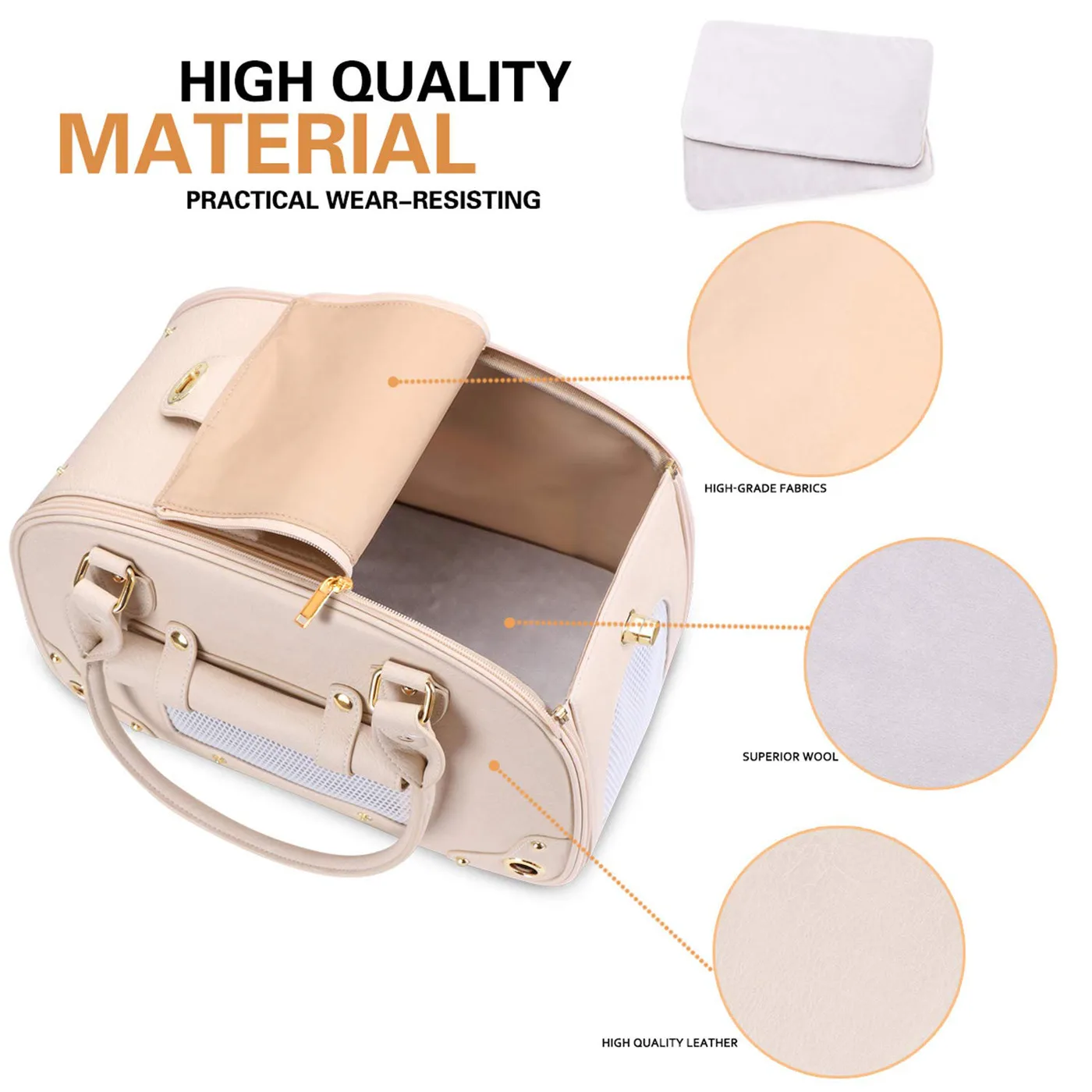
Split grain leather is what remains after a hide is horizontally split. Top grain keeps the dense outer surface; the lower, looser fibre structure becomes split. Because that lower layer has no natural grain membrane, mills correct it: they apply pigment, emboss a grain pattern, or laminate a thin polyurethane film. The base material is genuine animal hide, which is why it still feels warm and breaks in over time, unlike a fully synthetic sheet.
For bag programs the practical appeal is dimensional. A full hide is limited in usable area, and top grain commands a premium because defect-free surface is scarce. Splitting multiplies usable area per hide by roughly two to three times depending on thickness targets, so unit economics improve without asking the design team to abandon leather entirely.
The trade-off sits in the surface. An unfinished split absorbs water, scuffs pale, and has low tear resistance at stitch holes. A finished split performs differently again, so specification must always name the finish rather than simply requesting "split leather". Getting that distinction onto the tech pack is the first job of a development brief.
Brands often meet this material through the back door. A buyer asks for "real leather at a lower price", the sourcing team quotes a split, and the first sample disappoints because nobody specified embossing depth, film thickness, or backing. Nothing is wrong with the material; the specification was incomplete.
- Natural split: fibrous, matte, absorbent; best hidden inside linings or under wide binding
- Pigmented split: colour-corrected, still matte, good for trim and patches that will not be abraded
- Embossed split: pressed grain pattern reads as full grain from arm's length
- PU-laminated split: film adds wipe-clean behaviour and stabilises stretch
A designer can therefore treat split grain as a family of four materials rather than one. Each behaves differently under needle, heat and abrasion, and each lands at a different cost band. That variety is what makes it useful in a tiered line architecture.
Where split leather earns its place in a carrier build
Rule one for price-led programs: put split leather where hands and eyes go, put technical fabric where load and weather go. Handles, grab loops, zipper pulls, binding tape, base corner guards and logo patches are low-area, high-touch components. A 1.0 mm split on those parts signals quality far above the added cost, because the shopper's fingers find leather within the first three seconds.
Rule two: never ask split leather to be the primary tensile structure. Shoulder straps carrying a 9 kg pet on the move need predictable elongation and high stitch-hold, and engineered webbing delivers both at a lower price. Combining a split leather handle wrap over a polyester webbing core is a classic, and it is honest: the contact surface is leather, the strength member is technical. There is a costing corollary too: because engineered webbing carries load more predictably per gram than any hide, every gram the team shifts from structure to trim improves the strength margin and the unit cost simultaneously.
Rule three concerns edges. An exposed unfinished split edge fuzzes within weeks and looks like a defect even when it is performing correctly. Budget builds should therefore specify either a turned edge, a binding that wraps the raw edge, or edge paint applied in two passes with drying time between them.
Rule four is about adjacency. Leather touching mesh invites snagging, and leather touching light fabric invites colour transfer after a damp outing. Separate them with a binding tape or an interface panel so natural fibres do not rub directly against technical ones.

Trim zones that read expensive
Three placements consistently outperform their cost. A continuous leather binding along the top opening replaces fabric tape and lifts perceived value disproportionately, because the opening is where the eye lands on shelf. A leather zipper garage hides hardware and removes the plastic rattle that makes budget bags feel cheap. And a stacked leather patch on the front panel, edge-painted and saddle-stitched, gives the logo a material story that printing cannot.
The common mistake is spreading a small leather allowance thinly across every panel, which produces large areas of mediocre material and weak seams. Concentration wins. A single 12 cm x 6 cm patch with clean edges reads better than 200 square centimetres of badly sewn split panel.
Cost planning reinforces the same idea. A development team can usually afford one generous leather component per price tier, and every additional one should be justified by something the shopper demonstrably touches. Handle wraps, zipper pulls and front patches clear that test; decorative back-panel overlays do not.
Finishing routes: embossing, laminate and corrected grain
Finish choice determines how the material ages, and aging is the story a brand tells in reviews. Embossed split with a light topcoat looks closest to full grain at a distance and develops a soft patina at fold lines after weeks of use. Heavy pigment resists marks but can crack at flex points if the coat is too thick.
PU laminate changes the value proposition entirely. A 0.15-0.25 mm film bonded to the split gives a uniform grain, predictable colour, and a wipe-clean surface that pet owners appreciate after a muddy walk. It also stabilises elongation, which makes automated sewing faster and reduces pucker on curved panels.
Heat is the constraint to remember. Split with a PU film scorches above roughly 150 degrees Celsius, so laser cutting is safer than hot knife cutting, and any heat-transfer branding step must be tested on the exact laminate. Insist on a signed-off swatch rather than a verbal approval.
| Finish route | Typical gauge | Look from 1 m | Abrasion behaviour | Cost index (top grain = 100) |
|---|---|---|---|---|
| Matte pigmented split | 0.9-1.2 mm | Dry, natural, flat | Marks pale, buffs out | 45-55 |
| Embossed corrected grain | 1.0-1.4 mm | Reads as full grain | Good with topcoat | 50-65 |
| PU-laminated split | 1.0-1.3 mm | Uniform, slight sheen | Wipe-clean, film can scuff | 55-70 |
| Microfiber synthetic | 0.6-0.9 mm | Suede-like, very even | Excellent, lightweight | 70-90 |
| Top grain reference | 1.2-1.6 mm | Natural grain depth | Very good, patinas | 100 |
Read that table as a designer's palette, not a ranking. The lowest index is not always the best answer for a specific component; it is the best answer where the component is hidden, low-stress, or disposable after a season. The finish route, not the grade name, decides how a budget-tier carrier looks after twelve months.
Colour also interacts with finish. Dark pigment hides the embossing pattern and any handling marks, so navy, espresso and black forgiving by nature. Pastels show everything, including seam shadows, so reserve them for panels with backing support.
Costing ladder from entry Tier to premium
Unit cost for a mid-size carrier moves roughly USD 1.10-2.40 when leather trims replace woven tape, depending on how much area the pattern consumes and how many separate components the sewing line has to handle. Labour, not hide, is usually the larger part: each extra leather component adds needle time, trimming and edge finishing.
The practical lever is component count, not material price. Converting three separate leather accents into one continuous binding keeps the visual story while removing two operations. Designers who cost their own work this way consistently land sharper prices than those who negotiate hide rates.
A useful planning model splits a carrier into three cost tiers and assigns materials deliberately. Entry tier uses one leather touch point, usually the handle wrap or the zipper pull, keeping material cost under USD 1.00. Mid tier adds a leather logo patch and top binding, moving spend to roughly USD 1.60-2.00 while supporting a retail price increase several times that amount.
Premium tier within this framework still avoids full leather shells. It concentrates instead on heavier gauge, edge paint rather than raw edges, and antique-finish hardware. The reason is simple: a leather shell adds weight, climate-sensitivity and price all at once, and weight is the enemy of a product that must be carried through an airport terminal.
Freight and duty deserve a line in the costing sheet too. Leather-forward builds weigh more, and every additional 100 g per unit changes both air-freight economics and the landed margin on a palletised shipment. Ask for a component-level weight estimate at sample stage, not after the first costing round.
Finally, remember that a tier ladder only works if the differences are legible on shelf. If an entry and mid product sit side by side and a shopper cannot tell which is which, the extra spend is wasted. Make each tier's material story visible at arm's length.
Branding routes that suit a fibrous surface
Split grain behaves differently under every branding method, and picking the wrong one wastes the only premium surface in the build. Blind debossing is the strongest option: heat and pressure sink the embossed grain by 0.3-0.5 mm, leaving a tonal logo that ages with the material and costs no ink. It suits heritage-positioned labels and survives abrasion because there is no surface layer to chip.
Foil stamping also works but needs a flatter, heavier topcoat; on a soft open split the foil bridges the texture and looks moth-eaten after a month. Screen printing sits proud and tends to crack at fold points, so restrict it to flat patches away from stress. Embroidery directly into a 1.2 mm split is possible with a 75/11 needle but leaves visible perforation; a better route is stitching a pre-embroidered patch onto the panel.
Then there is the hardware route. A small antique-brass badge riveted through a leather backing plate adds perceived value beyond its cost and removes the risk of a badly executed print on a variable natural surface. For a budget tier that must look disciplined, metal plus leather beats ink every time.
- Blind deboss: no colour cost, permanent, best for heritage and monogram marks
- Foil stamp: needs heavy topcoat and a flat press area; sample-test before committing
- Stitched applique patch: allows full-colour logos without perforating the panel
- Riveted metal badge: hides surface variation, adds weight and shelf presence
- Avoid: thick plastisol prints on any component that will flex more than 30 degrees
Whatever the route, brand it where the buyer photographs the product. A logo buried on the back panel never appears in a review image; one placed at the upper third of the front panel, level with the grab handle, is captured in almost every social post.
Durability targets and honest product copy
A Finished split on a carrier should survive 24-36 months of regular weekend use before Handle edges fray or a corner patch lifts. Setting that expectation with the buyer protects the brand more effectively than any warranty claim, because disappointed reviews usually come from mismatched promises rather than material failure.
Testing should be specified by method rather than by adjective. Martindale abrasion above 20,000 rubs for laminated split, colour fastness to rubbing at grade 4 per AATCC methods, and a strap cyclic load test that pulls to 1.5 times stated pet weight for 500 cycles are reasonable starting points for a retail program.
Copy matters as much as construction here. "Genuine leather trim" is accurate and defensible; "luxury leather carrier" invites a returns queue. The rule for a budget tier is to describe precisely what is leather and where, then let the texture speak. Buyers respect specificity, and compliance teams do too.
Chemical compliance deserves equal attention. Pigments, adhesives and finishing agents must be screened for restricted substances under EU REACH rules, and California Prop 65 warnings reviewed with the importing brand before the first shipment. A hide that fails this screening is unsellable regardless of how good it looks.
Hardware is the quiet failure point in leather builds. A cheap zamac ring will darken a leather handle wrap within a season as metals oxidise against the finish; specifying a sealed or antique-plated fitting costs very little and prevents complaints that read as material failure rather than hardware failure.
Care instructions close the loop. Tell the buyer to air-dry rather than machine-dry, to use a neutral cream rather than a silicone spray, and to expect softening at fold lines. A one-card care instruction inside the box turns normal ageing into a story of ownership instead of a defect claim.
Warranty language should then match those instructions. Covering delamination and stitch failure while excluding normal patina and scuffing gives retail partners a clear script and protects margin. Vague promises are what generate chargebacks in this category.
Finally, plan spare-part economics early. If handle wraps are the fastest-wearing part, quote a replacement programme alongside the initial order; it costs little, extends the product's life story, and gives brand teams a customer-service hook that competitors using all-synthetic trims cannot match.
Building a coherent colour system across panels
Colour is where multi-material builds fall apart. A leather "cognac" and a fabric "cognac" can sit two shades apart under retail lighting, and at a distance nothing reads more cheap than mismatched neutrals. Solve this before the first sample rather than after it.
The method is a physical shade library. Match every panel that touches another to a single reference chip under standard lighting, then name each in the tech pack using the same reference standard throughout the program. Digital colour communication via a shared reference such as Pantone coordinates the brand, the material vendors and the line, but a physical signed card still settles arguments faster than a hex value.
Natural hides vary batch to batch even within one tannery. Agree an acceptable Delta E tolerance in writing, typically 1.5 or less for adjacent panels and 2.0 for non-adjacent parts, and require the packing team to sort by tone so one carton does not contain three visibly different browns.
Neutrals should carry a tier line: one dark anchor, one mid-tone hero, one light accent. Retail planners can merchandise three shades profitably; five shades multiply inventory risk without adding shelf impact. Discipline in palette reads as confidence, not poverty.
Season two is where most colour systems fail. The brand adds a fourth shade, the reference cards are lost, and a reorder arrives two Delta E units away from the original. Keep the reference library in two places and require suppliers to quote it by number on every purchase order.
Lining colour is a deliberate choice too. A light lining makes the interior easy to photograph but shows every scuff; a dark lining hides wear but makes contents hard to see. Many programs split the difference with a mid-tone that still reflects light for product photography.
Finally, treat hardware colour as part of the palette rather than an afterthought. Brass, gunmetal and matte nickel each shift how the same brown reads, and mixing two metal finishes on one carrier is the fastest way to make a considered design look accidental.
Swatch cards should also be photographed under the lighting conditions the product will actually face: warm retail spotlights, cool warehouse fluorescents and daylight through a car window. A combination that survives all three rarely generates mismatch complaints, whatever the lab numbers say.
Sampling checklist before you commit 500 pieces
A good sampling round de-risks everything downstream. Order one development sample, then two confirmation samples built from production-intent materials, because tanners and film suppliers substitute quietly when a shade runs short. Approve the swatch card, not the photograph: screens flatter every hide.
Use the round to answer operational questions too. Does the needle size leave visible perforation? Do edge-paint and topcoat cure within the packing window, or will units stick together in the polybag? Is the deboss depth consistent across twenty pulls? Each answer changes tooling or line setup, and each is cheaper to fix now than after container loading.
- Signed physical swatch cards for every leather and adjacent fabric combination
- Approved gauge and tolerance written into the tech pack per component, not globally
- Stitch-hold test on the exact leather and thread combination
- Crocking and abrasion reports from an accredited third-party laboratory
- Restricted-substance screening aligned with the destination market
- Edge-finishing method confirmed with a production-intent finish
- Carton packing test to check for blocking, scuffing or colour transfer in transit
Once those seven items are closed, the order is ready for booked capacity. Our production team issued 6-10 working day sample turnarounds against this checklist during the 2025 season, and every item on it costs less than one rejected container.
Inspection planning belongs in the same conversation. Agreeing an AQL 2.5 sampling plan, a packing method that separates leather panels from hardware, and an acceptable defect classification list turns subjective arguments into countable events at final audit.
Booking hides early is the single most reliable way to protect both price and lead time. Tanneries allocate by season and grade; a rush booking in peak months can add two weeks and meaningful cost. Approve the swatch card quickly and then let the buyer secure material.
After the first shipment, run a structured post-mortem with the line. Which components consumed the most labour, which defects clustered, and which choices the brand's own customers noticed feed directly into the second season's specification. The cheapest quality improvement in any leather program is usually a specification change written from real defect data.
Programs that treat this cycle as ongoing rather than transactional tend to settle into a predictable rhythm: seasonal recolor from a stable base pattern, one structural revision per year, and material upgrades driven by actual returns data instead of trend pressure.
Order and quality terms
- MOQ 500 pieces per colourway; samples in 6-10 working days
- Bulk production 35-50 days after approval; AQL 2.5 inspection standard
- T/T 30/70 terms, FOB Xiamen, full document set per shipment
People Also Ask
What is the cheapest genuine leather for bags?
Split grain leather is the lowest-cost genuine option, typically 35-50% below top grain per square metre. It is usually embossed or PU-laminated to give a consistent surface. Used on trim rather than full panels, it delivers a real-leather touch point at entry-tier pricing.
Does split leather feel like real leather?
It is real leather, so the warmth and break-in are genuine. The difference is surface density: without the tight top grain it feels drier and more matte until a finish or embossing is applied, after which most shoppers cannot distinguish it from corrected top grain.
Can you emboss a logo into split leather?
Yes, blind debossing works exceptionally well because the open fibre structure takes a deep impression. Expect 0.3-0.5 mm depth with heat-assisted tooling. Foil stamping is possible but requires a heavier, flatter topcoat to avoid a broken-looking mark.
Is split leather waterproof?
Not inherently. Unfinished split absorbs water readily. A topcoat, wax finish or PU laminate raises water resistance substantially, but no leather construction should be described as waterproof; wipe-clean and water-resistant are accurate claims.
How thick is split leather usually supplied?
Common gauges are 0.9-1.4 mm for bag trim and 1.2-2.0 mm where more body is needed. Thickness tolerance should be written per component; loose tolerance creates bulk at seams and inconsistent edge paint results.
Should a budget carrier mix leather with fabric?
Almost always yes. Leather at contact points delivers the perceived quality; technical fabric on the shell controls weight, cost and weather performance. Hybrid builds typically cost less overall than all-leather equivalents while looking better at retail.
Frequently Asked Questions
Is split grain leather real leather?
Yes. Split grain leather is genuine animal hide taken from the lower layer after the top grain is split away. It is fibrous rather than tight-grained, so it is usually pigment-finished, embossed or laminated before use in a bag program.
How much cheaper is split leather than top grain?
Per square metre, finished split typically lands 35-50% below comparable top grain, depending on the tannery, finish and thickness. Because most components are small, the saving per carrier is usually USD 0.60-1.80 in material, with labour differences varying by how many components the design requires.
Will split leather crack or peel?
Unfinished or poorly topcoated split can crack at flex points. A properly embossed and topcoated split flexes normally for 24-36 months of regular use. A PU-laminated split behaves differently again: the film can scuff, but the substrate will not crack under the same conditions.
Can split leather be used for load-bearing straps?
We do not recommend it as the tensile member. Use engineered webbing for the core structure and apply leather as a contact wrap or grip. That combination gives the hand feel buyers associate with quality plus predictable strength and elongation.
What thickness should I specify for trim and patches?
Specify 1.0-1.2 mm for binding, zipper pulls and patches, and 1.2-1.4 mm for handles that will be stitched and folded. Anything below 0.9 mm looks thin at edges; anything above 1.6 mm creates bulk at seams and heavy needle deflection.
Which branding method lasts longest on split leather?
Blind debossing lasts longest because it removes no surface layer and adds no film. It requires no ink and ages with the material. For multi-colour marks, a stitched applique patch or a riveted metal badge outperforms any print.
Does split leather meet REACH and Prop 65 requirements?
It can, but this depends entirely on the finishing chemistry rather than the hide itself. Ask the tannery for a restricted-substance declaration and verify it through accredited third-party testing before booking hides for a specific destination market.
How do I keep the leather matching the fabric over repeat orders?
Maintain a physical reference library with signed cards for each combination, set a numeric colour tolerance, and require the finishing line to sort cartons by tone. Matching every adjacent panel against one reference under standard lighting prevents almost all mismatch disputes.
How many units do I need to start a leather-trim program?
MOQ 500 pieces per colourway. Below that volume, hide cutting waste, tannery minimums and machine setup make unit cost unpredictable. Splitting one order across two colourways doubles the MOQ commitment, so plan the palette before booking.
How long do samples and bulk production take?
Samples take 6-10 working days from tech pack approval; bulk production runs 35-50 days after sample sign-off. Leather components add lead time at the tannery, so secure hide bookings as soon as the colour combination is approved.
Is split leather suitable for vegan-positioned collections?
No. Split leather is an animal-derived material and cannot support a vegan claim. Brands wanting that positioning should look at PU, microfiber or bio-based alternatives such as cactus or apple-derived materials.
What are the most common defects to watch for?
Loose break at folds, excessive stretch under stitch load, colour transfer onto light linings, delamination of laminated film, and inconsistent emboss depth between batches. Each is preventable through pattern engineering and incoming material inspection rather than end-of-line sorting.
Talk to QUANZHOU JUNYUAN BAGS about a pet carrier program: MOQ 500 pieces per colourway, samples in 6-10 working days, bulk production in 35-50 days under AQL 2.5 inspection.
Get a free quote Request a sample