Poop Bag Dispenser: Waste Management Feature for Branded Pet Carriers
An integrated poop bag dispenser on a custom pet carrier is a 34-40 mm portal with a bound or moulded grommet that feeds bags from an internal roll of 15-20 units, so the owner can draw one bag mid-walk without opening the bag. Built properly it costs USD 0.85-2.10 per unit at MOQ 500 and removes the clipped-on plastic accessory most competitors still ship.
Waste management is the one carrier feature that speaks to somebody other than the buyer. Neighbours, building managers and municipal officers form their impression of a pet brand in the moment an owner reaches for a bag, and a product that makes courtesy automatic earns goodwill no campaign can buy. For a private label, replacing a throwaway clip-on accessory with a built-in dispenser also pulls the whole system into the company's colour and material language - which is precisely the kind of difference that survives a shelf comparison. Done well, the feature pays for itself twice: once through the perception of completeness in the store, and again through every refill roll bearing your mark rather than a competitor's.
- Sampling: dispenser prototypes sewn into your nominated shell in 6-10 working days, roll-loaded for real pull testing.
- Minimums: MOQ 500 units; custom moulded bezels need their own tool, stock grommets do not.
- Schedule: bezel and portal assembly built within the carrier's 35-50 day bulk run.
- Quality: tear-off consistency, bezel retention and portal wear inspected to AQL 2.5.
- Terms: T/T 30/70, FOB Xiamen, internal sleeves shipped with a starter roll and desiccant.
A bespoke pet carrier brief is built from a tech pack: dimensions, fabric, hardware finish and the test standard the finished bag has to meet.
The commercial case for building waste management into the shell
Most carriers sold today solve this problem the same way the industry solved it in 2010: a small plastic cylinder clipped to a D-ring, printed with somebody else's logo. It works, which is exactly why nobody questions it. It is also the single most replaceable part of the product, and every time it breaks, the brand loses a touchpoint to whatever generic item replaces it.
Integrating the dispenser changes the economics of that moment. The branded surface stays on the product, the colour story stays consistent, and the refill relationship stays with whoever specified it. For programmes sold through urban specialty channels, this is also the easiest way to have a credible sustainability conversation without writing a manifesto: fewer single-use plastic housings shipped per unit is a measurable claim.
There is a merchandising argument too. Buyers reviewing a range look for one feature that signals the brand has thought further than its neighbours. A built-in dispenser with a moulded bezel reads as intentional product development, while a clipped accessory reads as an afterthought - and the visual gap between those two on a fixture is wider than the cost gap between them.
Finally, it solves an objection that rarely gets voiced in range reviews but gets voiced constantly in returns handling: small detached accessories go missing in transit, in store, and in the owner's home. Integrated components cannot be lost, so the owner's first-week experience matches what the packaging promised.
From a design standpoint the integration also frees the handle area. When the waste function moves inside the shell, the external hardware can return to doing structural work, and the silhouette gets cleaner without any loss of utility.
None of this requires invention. It requires treating the dispenser as a specified assembly rather than a purchased add-on, which is a change in how the line item appears in a tech pack more than anything else.
Brands that make that shift usually discover something else: once the owner stops carrying a separate accessory, they start describing the carrier as a complete system. That vocabulary is worth more in reviews than any single specification number.
It is also worth deciding early whether the dispenser is presented as a standard feature or as a range signature. Build it into every unit and the cost is simply absorbed into the bill of materials; restrict it to one tier and it becomes a reason to trade up. Both work, but that single decision determines how bezel tooling is amortised and how the range is merchandised, so it belongs in the opening brief rather than in a later revision.
Anatomy of the assembly: portal, reinforcement and internal sleeve
A working dispenser has three elements, and failures almost always trace to one being under-specified. The portal is the visible opening through which bags emerge. The reinforcement around that opening - whether a bound edge, a moulded TPU bezel or a metal eyelet - controls wear and tear resistance. The internal sleeve or cradle holds the roll in alignment with the portal.
Access for cleaning is underestimated in this assembly too. Whatever arrives on the portal eventually arrives inside the sleeve, and a sleeve that cannot be turned out or wiped will smell. Specifying a wipeable cradle face costs almost nothing, and it is the single most effective defence against the review nobody wants to read about a bag that manages waste badly.
The portal diameter is not arbitrary. A roll bag folded flat presents an effective thickness of roughly 8-14 mm, and the slot needs to pass that comfortably while still providing enough friction that gravity does not unspool the roll inside the shell. Our design practice is a 34-40 mm round portal or a 30-36 mm flat slit, tested against the actual bag rather than against a nominal figure.
Reinforcement choice is where durability is decided. A raw bound edge costs least and looks acceptable on soft goods, but repeated contact with damp hands and bag film abrades it. A TPU moulded bezel costs USD 0.30-0.75 depending on size and can be Pantone-matched and logo-embossed, making it both structural and branded. A metal eyelet is the most abrasion-resistant and the heaviest, and it can clash aesthetically with soft, matte brand languages.
The internal sleeve gets skipped most often, and it is why many integrated attempts feel sloppy. Without a cradle, the roll migrates as it empties, the last few bags feed at an angle, and the whole thing jams at precisely the moment the owner most needs it. A simple elastic-faced sleeve, 60-90 mm in length, costs very little and prevents almost every jam complaint we see.
Loading access matters as much as the dispensing path. Side-loading sleeves are easiest to manufacture but require the roll to be threaded through the portal, which most owners will not do twice. Top-loading sleeves with a flap closure let an owner drop in a fresh roll in one motion and are worth the extra panel.
Two reinforcing details deserve a drawing note because they are invisible once the bag is assembled but decisive afterwards. Bar-tacking the sleeve corners into the panel seam keeps a loaded roll from prising them open, and adding a 3 mm topstitch around the portal prevents the rolled edge that develops after a few hundred pulls. Neither is expensive, and both are far cheaper than the warranty claim they prevent.
Roll standards: core size, count and film thickness
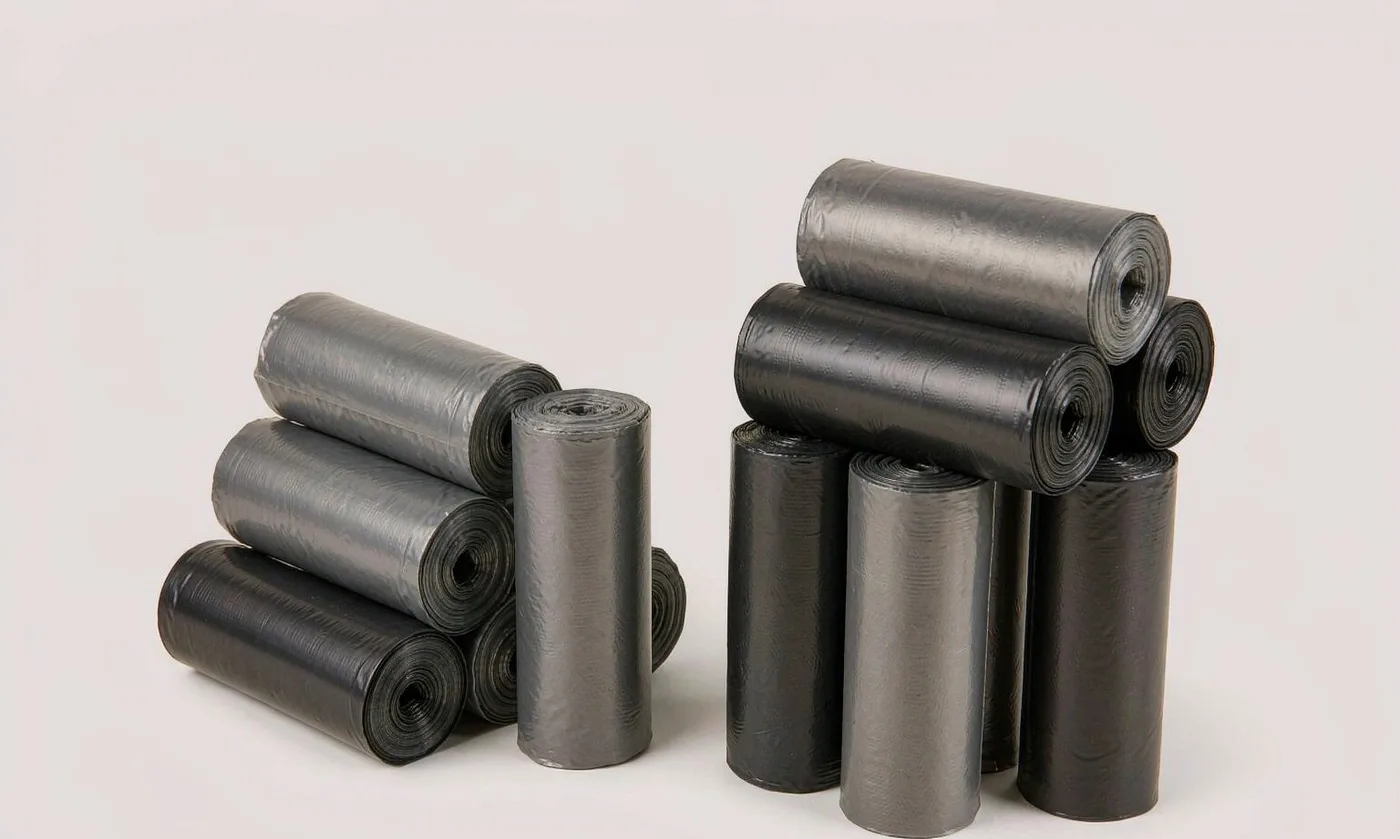
Design to the standard roll rather than inventing one. Most retail dog waste refills use a cardboard core around 38 mm outside diameter and 20-25 mm length, carrying 15-20 bags per roll in standard pocket sizes. Deviating from that norm locks the owner into a bespoke refill, which is occasionally a deliberate strategy but usually a complaint waiting to happen.
Film thickness is the variable that most affects both feel and cost. Thicker film feeds more predictably through a bound portal and resists tearing mid-tear-off, but adds bulk and weight. Very thin compostable films are the most finicky: they stretch at low humidity and tear unpredictably in cold weather, which is why tolerances have to be set with the actual film in hand rather than a data sheet.
Perforation quality determines perceived quality more than film thickness does. Rolls whose perforations tear cleanly feel like a premium product even when the film is modest; rolls that tear mid-bag generate the same complaint regardless of how much was spent. We therefore ask clients to nominate two or three refill suppliers, then test each for single-bag separation before fixing the portal dimension.
Roll diameter also interacts with panel thickness. A full twenty-count roll occupies roughly 55-70 mm of diameter, which on a slim shell becomes a visible bulge unless the cradle is inset. Deciding whether that bulge is acceptable - or whether the programme should use fifteen-count refills for visual cleanliness - is a design judgement worth making explicitly rather than discovering in the sample photograph.
The table below summarises the three configurations we routinely quote, with the construction each one implies.
| Configuration | Typical roll | Portal | Sleeve length | Added unit cost |
|---|---|---|---|---|
| Bound portal with fabric cradle | 15 bags, 38 mm core | 36 mm round | 70 mm, side load | USD 0.85-1.20 |
| TPU bezel with elastic sleeve | 20 bags, 38 mm core | 40 mm round | 85 mm, top load | USD 1.30-1.80 |
| Moulded bezel plus rigid cradle | 20 bags, mixed cores | 40 mm round with splash guard | 90 mm, top load with flap | USD 1.70-2.10 |
Colour and print are worth a sentence here because stock availability varies by market. If the programme promises a coloured bezel, secure the masterbatch reference at development rather than at bulk; colours mixed against a later supplier batch deviate visibly on a part this small, and the deviation is most obvious on the parts handled most.
Capacity should be stated honestly on packaging. Owners count bags, and a dispenser designed around a 20-count roll described as holding "plenty of bags" invites disappointment, while a specific "fits 15-20 count rolls" is both useful purchasing information and a demonstration that somebody thought about it.
Mixed-core tolerance is worth specifying even if not immediately used. Some markets favour coreless rolls, which need the sleeve to retain shape rather than rely on a spindle. Building that tolerance into the pattern costs nothing at development and saves a tooling change later.
Compostability and recycled-content claims that survive scrutiny
Sustainability language around waste bags is where otherwise careful brands get into trouble. The claims worth making are narrow, specific and verifiable; the ones that cause problems are broad, absolute and unprovable at the product level.
The practical method is to build a claim matrix in the tech pack: one row per claim, one column for the evidence, one for where it may appear. Rows without a certificate stay off the hangtag. This sounds bureaucratic, but it is the difference between a sustainability story that survives a retailer's technical review and one that gets pulled two weeks before launch, by which point the packaging run is already paid for.
Start with what is being claimed. If the refill film is certified compostable, the claim belongs to the refill, not to the carrier shell, and the two should be described separately. If the bezel uses recycled TPU, that is a component-level claim with documentable evidence. Neither justifies describing the entire carrier as compostable or biodegradable, and doing so invites the kind of challenge that generates headlines rather than sales.
Where clients want certification, we encourage aligning to recognised standards and documenting them at purchase. Compostability test methods published by standards bodies give claims a defensible footing, and we cross-check fragrances, plasticisers and inks against published ASTM standard test methods before printing language that a retailer's technical team may later audit.
Chemical compliance applies to this assembly in an unexpected way: the portal is in contact with a bag that may contain fragranced or treated film, so the bezel and any adjacent coating need to be screened against the same restricted substance lists as the rest of the product. We check candidate resins against European chemicals registration requirements and against California's warning list before the first tool cut.
The most defensible claim is usually the simplest one we can help a brand make: the carrier does not ship a disposable plastic housing. That is true, measurable, and immediately understood by any shopper holding the product.

Placement, one-handed access and keeping the streamline
A dispenser only works if it can be used with the other hand occupied, which in practice means holding a lead. Everything about placement follows from that single constraint.
The strongest position across most formats is the lower third of either side panel, angled slightly downward so that the emerging bag falls into the hand rather than curling against the shell. On sling and crossbody formats this becomes the outer face, positioned so the natural reach lands near the wearer's hip rather than across the chest.
Avoid two positions in particular. The base panel collects the dirt the feature is designed to manage, and the top-of-bag position requires an awkward rotation that most owners will abandon within a week. Where a programme calls for waist-level access on a backpack shell, we route the portal through an angled gusset rather than through the main face, so the reach stays inside the natural sweep of the arm and the portal does not sit directly against the wearer's clothing.
Structural integration is less demanding here than for a wet wipe pocket, because the load is small, but the orientation of woven fabric matters. Cut the portal on the bias relative to the weave and it will distort under tension; cut it square and it stays dimensionally stable through repeated pulls.
Finally, think about how the feature looks when unused. A black portal ring on a pale shell competes with every other visual element, so matching the bezel to the shell rather than to the trim often produces the more expensive-looking result. Where budgets allow, a tonal bezel with a debossed mark is the combination most often requested for premium capsules.
Treat position and appearance as one decision rather than two, because every change to placement changes how much visual weight the bezel carries. A portal tucked into a seam shadow can be brighter; one sitting in the middle of a panel usually needs to be tonal, or it will read as a hardware mistake rather than as a designed feature.
One last ergonomic detail: check access while the carrier is loaded and being worn, not empty on a table. Load changes the geometry substantially - panels bow, seams rotate, and a portal that was perfectly placed in the flat can swing several degrees out of the reachable zone once weight is inside.
Branding the dispenser area and owning the refill relationship
The bezel is the natural branding site and arguably the highest-value one on a city-oriented product. It is handled several times a day, it is at eye height in photographs, and unlike print it cannot be washed off.
Debossed or embossed logos moulded directly into a TPU bezel cost nothing per unit once the tool exists and read clearly in product photography. Silicone inserts in a second colour give higher contrast and a jewellery-like finish, at a small assembly cost. We would avoid printing on this part entirely: it sits exactly where abrasion is highest.
The refill relationship is the more interesting commercial lever. Because the dispenser is dimensioned to a standard core, a brand can sell private-label refills without requiring exclusivity, and every refill roll becomes a repeat purchase with the logo on it. For subscription-oriented programmes this is usually the reason the feature gets specified at all.
Packaging should support that loop. Including one starter roll means the owner experiences the mechanism immediately rather than discovering it weeks later, and it gives the e-commerce listing a concrete, photographable inclusion.
Hangtags and the product page should say which roll format fits, in numbers. This is also where cross-merchandising inside a range works particularly well: cross-referencing organisation features such as the key clip and secure small-item storage builds a coherent story about keeping essentials in reach, and gives merchandising teams a natural two-product fixture.
Taken together, these decisions turn a compliance nicety into a revenue thread - modest, recurring and entirely owned by the label rather than by whoever sells the cheapest accessory.

Cost breakdown, sampling discipline and bulk inspection
Unit cost for a built-in dispenser divides into the reinforcement element, the sleeve construction and the labour of setting the portal accurately. Bound construction with a fabric cradle is the lightest option at USD 0.85-1.20; moulded components with rigid cradles reach USD 1.70-2.10. Tooling for a custom bezel shape runs USD 400-900 and is typically amortised within two seasons.
Two decisions move cost more than any negotiation. Using a stock portal size rather than a bespoke one removes tooling entirely and shortens development by two to three weeks. And producing all colourways through one bezel colour removes the separate purchasing minimums that quietly turn a small feature into a large commitment.
One more criterion belongs in the brief: what counts as acceptable double-feed behaviour. Every dispenser will occasionally present two bags; the question is how often, and whether it happens at the start or the end of a roll. Agreeing that threshold before bulk converts a subjective complaint into a pass or fail check, which is the only way a feature like this stays stable across seasons.
Sampling should be functional, not photographic. We deliver prototypes loaded with the nominated roll within 6-10 working days and ask clients to perform exactly the motion a tired owner performs: lead in one hand, one pull, one tear. Bags that tear at the perforation rather than mid-film, or rolls that jam at five remaining bags, are both diagnosable at this stage and expensive later.
Inspection criteria accepted to AQL 2.5 should include: twenty consecutive single-bag pulls without double-feed; bezel retention under 5 kg of pull; verification that the roll cannot migrate more than 10 mm inside the sleeve after agitation; and a visual check for portal distortion after ten load cycles. These are objective, teachable and fast to run.
Finally, plan packaging around the feature rather than afterwards. A dispenser that ships closed and flat looks identical to a plain panel once the product is in a polybag, which wastes the gadget entirely; shipping with the portal reveal, a starter roll visible and a single line of instruction copy on the belly band costs cents and converts measurably better in photography-driven retail.
Production then follows the standard programme: MOQ 500 units per colourway, 35-50 days for bulk following sample approval, T/T 30/70 terms and FOB Xiamen shipment, with sleeves packed flat and each carton humidity-controlled so core material does not soften in transit.
Why brands source here
- Pet carrier programs run since 2014; founding team in sewn goods since 2004
- SGS-verified production floor of 4,950 m² with 137 workers across 7 lines
- Monthly capacity of 200,000 units, audited to BSCI and ISO 9001
People Also Ask
Is an integrated dispenser better than a clip-on accessory?
Yes for most branded programmes. It keeps the logo where cheaper alternatives replace it, removes a component that goes missing in transit, and frees the handle area for structural hardware.
Why do integrated dispensers jam?
Usually because the roll floats rather than sitting in a cradle, so it migrates and the last bags feed at an angle. A simple elastic-faced sleeve prevents most of it.
What size should the dispensing hole be?
34-40 mm round, or 30-36 mm if executed as a flat slit, tested against your actual chosen bag film rather than a nominal figure.
Do compostable bags work in a built-in dispenser?
They do, but they are less predictable: thin compostable film stretches in low humidity and tears erratically in cold weather, so tolerances must be set with the real film.
Can we sell our own refills for it?
Yes. Because the cradle is dimensioned to a standard core, private-label refill rolls are a natural recurring purchase and a strong reason to specify the feature in the first place.
Does the dispenser weaken the carrier shell?
No, provided the portal is cut square to the weave and captured into a load path. Bias-cut openings distort under tension; square-cut ones remain dimensionally stable.
Frequently Asked Questions
What is an integrated poop bag dispenser?
It is a portal of roughly 34-40 mm, reinforced with a bound edge, TPU bezel or eyelet, feeding bags from an internal cradle that holds a standard 15-20 count roll. The assembly lets the owner draw and tear one bag without opening the carrier.
Which refill rolls will fit?
We dimension to the common 38 mm outside-diameter core used by most retail refills, which means standard 15 and 20 count rolls fit without adaptation. Coreless rolls can be accommodated if stated before pattern development.
Is a moulded bezel necessary?
Not always. A bound portal is cheaper and adequate for light domestic programmes. A moulded TPU bezel is worth specifying when durability, colour matching or logo debossing matters, and it typically adds USD 0.30-0.75.
Can the dispenser be washed?
Yes, in the sense that the portal and sleeve tolerate wiping and air drying. Avoid machine washing the whole carrier unless every other component in the bill of materials has been tested for that cycle.
How do we avoid bags jamming inside the sleeve?
Use a cradle rather than letting the roll float, keep sleeve length at 60-90 mm for standard cores, and specify enough internal clearance that the roll stays aligned as it empties. Most jam complaints trace to omitted cradles.
What is the MOQ for this feature?
MOQ 500 units per colourway. Using one bezel and one sleeve colour across all colourways is the simplest way to keep each variant comfortably above minimum.
How long does a dispenser sample take?
Roll-loaded prototypes in your nominated shell fabric arrive in 6-10 working days, so the tear behaviour can be judged with the actual film rather than with a substitute.
Can we make compostability claims?
Yes, at component level and with documentation. A compostable refill film is a claim about the refill; the carrier itself should not be described as compostable unless the entire product has been tested to that standard.
Does the dispenser add weight?
Very little. The assembly adds 20-45 g; the loaded roll adds 60-120 g depending on count and film thickness, which is negligible against a typical carrier but relevant to how the sleeve is anchored.
Where should the portal be positioned?
Lower third of a side panel, angled slightly downward, so the bag falls into the hand. Avoid base panels, which collect dirt, and top panels, which require an awkward rotation most owners abandon.
Can the bezel be Pantone matched?
Yes. Both moulded TPU bezels and silicone inserts can be matched to a Pantone reference and approved against a physical chip under retail lighting before bulk.
How is the feature inspected in bulk?
Twenty single-bag pulls without double-feed, bezel retention under pull load, roll migration below 10 mm after agitation, and no visible portal distortion after ten load cycles, all accepted to AQL 2.5.
Talk to QUANZHOU JUNYUAN BAGS about a pet carrier program: MOQ 500 pieces per colourway, samples in 6-10 working days, bulk production in 35-50 days under AQL 2.5 inspection.
Get a free quote Request a sample