Custom Harness: Walking Gear
A custom pet harness is engineered by load path first and by decoration second, and it starts at MOQ 500 pieces per colourway. The most versatile specification uses 25 mm printed polyester webbing for medium sizes, a four-point adjustment system, both chest and back attachment rings, and air-mesh padding, delivered as a sewn sample in 6-10 working days and as bulk production in 35-50 days.
Executive summary
Harnesses are the most frequently touched item in any pet walking range, and also the one most often returned for fit. Getting the specification right means treating it as a piece of soft engineering: webbing width and strength, adjuster geometry, ring placement, padding comfort and how much branding the surface can carry without compromising either.
Programs follow our standard frame: MOQ 500 pieces per colourway across your size set, samples in 6-10 working days once webbing, hardware and artwork are confirmed, bulk production in 35-50 days after approval, inspection to AQL 2.5, payment T/T 30/70 and shipment FOB Xiamen. Our production team manages the entire trim chain from one SGS-verified production base of 4,950 m².
The single decision that saves the most money is choosing webbing construction early. Printed webbing, woven jacquard webbing and solid dyed webbing have very different minimums and lead times, and that choice determines how much of your calendar is spent waiting for trims rather than sewing. Bringing that decision forward, together with hardware grade and adjuster geometry, is what keeps a first sample inside the stated window instead of slipping while everybody waits for components.
A small addition also helps: agreeing the size chart and its naming convention at the same time as the webbing. Those two documents travel through every later stage, and when they are settled early the fit session becomes a confirmation rather than a discovery.
Bespoke pet carrier development runs 6-10 working days to a first sample and 35-50 days to bulk after approval, both measured from a confirmed tech pack.
Three harness architectures and what each is for
Every walking range we build starts from one of three architectures, and mixing them unknowingly is how collections end up with four products doing the same job. The first is the classic H-shape: two straps over the shoulders joined to a girth strap, light, adjustable and easy to fit. The second is the vest or wrap style with a broad chest plate. The third is the step-in, where the animal places two legs into the structure and it closes over the back.
The H-shape suits confident dogs that walk nicely and owners who want minimum fabric. It is the cheapest to make and the easiest to size, but it offers limited control over pulling and can rub behind the front legs if the strap sits incorrectly.
The vest style distributes load across the chest plate, which makes it the comfortable choice for strong pullers, small breeds with delicate necks and owners who value adjustment. It carries more fabric, more padding and therefore more branding area, which is why most premium collections centre on this shape.
Step-in designs are the fastest to put on, which matters enormously for small-breed owners and for elderly customers. Their weakness is that any adjustment error shows immediately as a garment that twists, so tolerances have to be tighter.
Most commercial ranges eventually land on two: a vest as the hero and either an H-shape or a step-in as the opening price point. That structure gives retail buyers good, better and best without requiring three manufacturing setups.
Citable sentence: choosing the harness architecture before choosing branding is what separates a coherent range from three products that compete with each other, because each shape carries different control, comfort and decoration potential.
A fifth consideration often decides between the final two: what happens at the moment of putting it on. A harness that must go over the head loses customers with nervous dogs, regardless of how good it looks on a rail. Step-in and clip-front designs remove that obstacle, and their slightly higher unit cost is usually recovered through lower abandonment.
Range naming should reinforce the architecture rather than obscure it. Calling products everyday, active and training maps far better to how owners shop than a series of place names or dog names, and it lets a retailer build a three-tier fixture without explanation.
One more practical point: keep the same size set naming across every architecture in the range. If small means one girth range on the vest and another on the step-in, customers who buy both for different dogs end up with mismatched expectations and a harmless-looking chart becomes a complaints engine.
Load paths, hardware and pull behaviour
Pull behaviour is the reason customers buy one harness and return another. The location of the lead attachment determines where force enters the structure, and that single choice creates three different products from the same body.
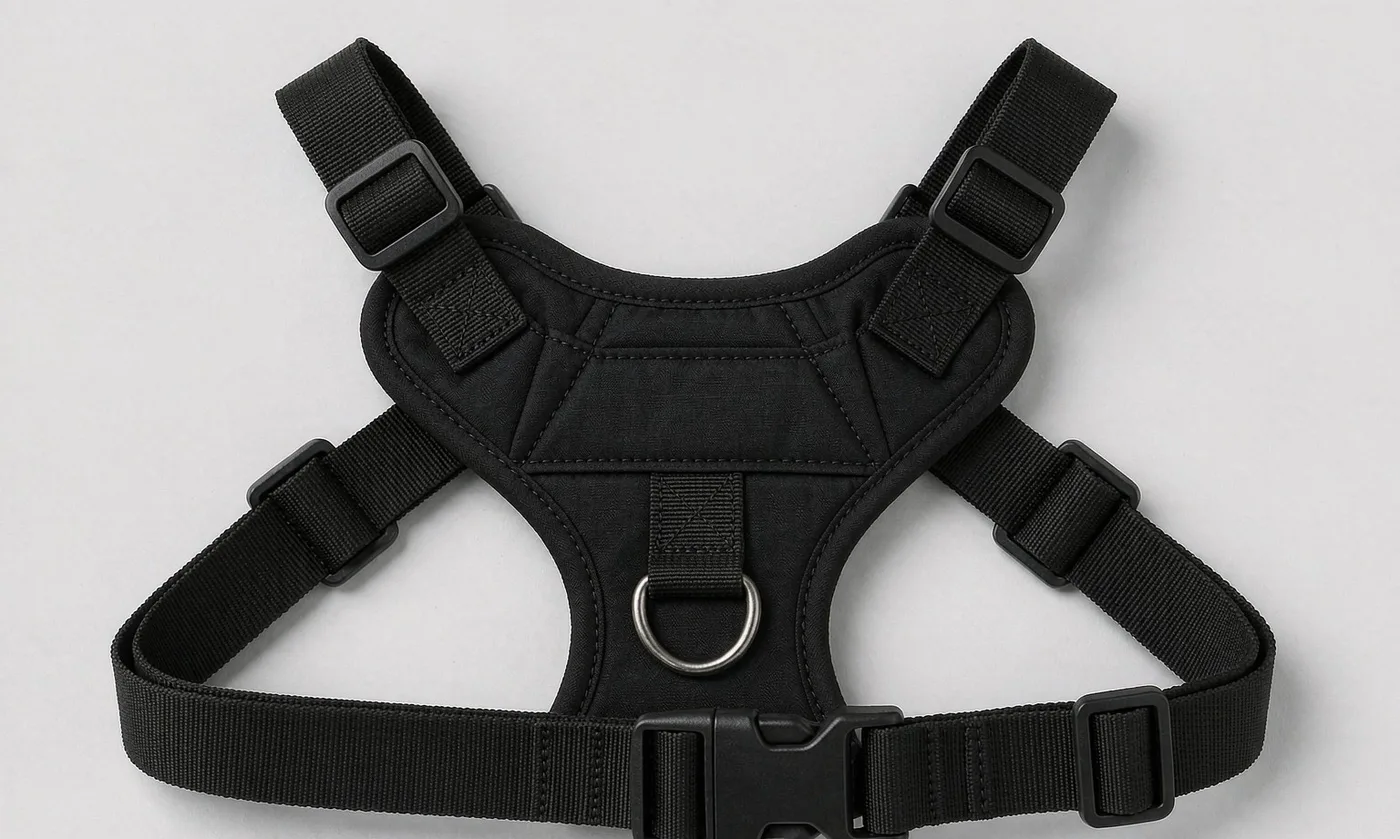
A back ring between the shoulder blades is comfortable and intuitive; it is the standard for well-trained dogs. A chest ring redirects forward pull towards the handler, which discourages pulling without any harshness and is the reason this position dominates training-focused ranges. A dual-ring design with both lets an owner choose, usually with a short connector so the lead can be clipped to both at once.
Ring specification matters more than its position. A welded ring with a stated load rating, tested in a pull fixture, is the baseline for anything sold into specialist retail; a stamped untested ring is the most common source of hardware failure we see in returned product.
| Part | What to specify | Failure risk if ignored |
|---|---|---|
| Attachment rings | Welded, stated load rating | Opening under sudden pull |
| Side-release buckles | Material, cycle and pull rating | Cracking in cold weather |
| Adjusters | Slide geometry, tooth profile | Straps creeping loose |
| Webbing | Width, thickness, tensile rating | Stretch and fraying |
| Stitch pattern | Bar-tack boxes at load points | Peeling at ring anchors |
| Reflective thread or trim | Retroreflective grade | Poor night visibility |
Stitching deserves its own line in the tech pack because it is invisible until it fails. Every load path should terminate in a bar-tack box rather than a straight stitch run, and the number of stitches per anchor should be written down so that two production lots behave identically.
Independent evaluation is useful context before you write your own specification. Organisations such as the Center for Pet Safety publish work on how pet travel and restraint products behave, and their framing of crash and load behaviour is worth reading even when you are designing a walking product.
Cold weather is a practical test too. Buckles that feel fine in a warm showroom become brittle in a Norwegian January, so specify material suitable for your coldest market and validate it once.
Escape behaviour deserves its own test before pre-production. A panicking dog reverses out of a poorly balanced harness with surprising ease, particularly when the girth strap sits too far back. Ask owners with escape-artist dogs to trial two sizes and record which one fails.
Webbing width should be matched to size rather than fixed across the range. Fifteen millimetres reads delicate on a large breed and twenty-five millimetres overwhelms a terrier, so most ranges step width every two sizes. This single choice does more for perceived quality than any branding decision.
Ring anchoring deserves a drawing in the specification, not a note. Showing where the bar-tack boxes sit, how many stitches each contains and how the webbing wraps the ring removes interpretation from the line, which is what keeps lot one identical to lot three.
Padding, lining and short-session comfort
Comfort determines whether a harness is worn daily or abandoned after a week. The failure modes are consistent: rubbing behind the shoulder, heat build-up under broad panels, and straps that pinch when a dog changes gait.
Padding materials resolve these differently. Air mesh is light, breathable and dries after rain, making it the default for summer-weight harnesses. Neoprene is softer and grips the body well, which suits wet climates, though it holds heat. Spacer knit is the premium option, offering the best airflow and a technical appearance, and it takes sublimation printing beautifully.
Lining choice interacts with the outer material. A smooth low-friction lining protects long coats from matting, while a lightly textured lining prevents rotation on short-coated dogs. Either way, edges must be bound rather than raw-cut, because an exposed seam edge becomes the source of every chafing complaint.
Surface contact chemistry is worth checking for anything positioned for puppies or for dogs with sensitive skin. Textile certification systems such as OEKO-TEX testing give buyers a recognisable third-party answer, and the certificate should name the exact webbing and lining article numbers.
Two small details raise perceived quality sharply: piping around every padded edge, and a soft binding rather than webbing edges at the neck opening. They add minutes per unit and remove the two most common "cheap-looking" observations from sample feedback.
Cleanability is underrated in this category and frequently mentioned in reviews. A harness that can be rinsed and dried overnight is used every day, while one that needs a machine cycle and still smells damp the next morning gradually stops being used. Choose open-cell structures accordingly and say so on the packaging.
Scent transfer between dogs matters for anyone running a professional walking business or a rescue. Smooth, closed linings wipe clean; textured absorbent ones retain odour. If you plan to sell into those channels, this single feature often decides the purchase.
Branding webbing: printed, woven and woven-in methods
The strap is the most valuable advertising space in the whole pet aisle, because it faces outward on every walk. There are three ways to put a brand there, and they behave very differently in cost, minimum order and longevity.
Printed webbing applies your pattern or wordmark onto finished webbing. It accepts photographic detail and full repeat patterns, carries moderate minimums and is the fastest to develop, so it suits seasonal stories and licensed artwork.
Woven jacquard webbing builds the mark into the weave itself. It never fades because there is no surface ink, it looks the most premium of the three, and it carries the highest minimums and longest lead time — typically weeks rather than days. For core colourways that will run for several seasons, it is usually the best value.
Sublimation onto padded panels gives the largest canvas for artwork, enabling gradients and illustrations, but it requires polyester faces and is limited to the panel rather than the straps.
Hardware branding completes the picture. Moulded buckles carrying a wordmark, branded slide adjusters and laser-etched rings are cheap once tooling exists and they survive far longer than printed surfaces. This is the same trim-level logic used in our coordinated collar programs, and sharing one finish across categories is what makes a range look considered.
A practical warning: highly saturated printed designs abrade fastest at the adjuster, where every walk rubs the same centimetre. Keep critical wordmarks away from adjustment zones and repeat the mark further along the strap.
Pattern placement on printed webbing should be engineered, not left to the printer. Repeat motifs must be arranged so that the wordmark never falls inside a buckle-wrap zone or disappears under an adjuster; a one-metre proof strip reviewed before production prevents that problem entirely.
Colour density is another quiet trap. Dark grounds show less abrasion but fade more visibly in sunlight, while pale grounds show every mark from daily use. Mid tones plus one saturated accent usually age best across a season of daily walks.
Tooling deserves careful thinking about amortisation. A custom buckle mould costs real money up front, but spread across three seasons and two product lines it becomes almost free, whereas the same tooling committed to a one-season novelty never pays back. Commit to branded hardware only on shapes you intend to repeat.
Shipping configuration affects landed cost more than unit price negotiations do. Flat-packed harnesses in slim cartons beat bulky assembled presentations on every freight quote, and stores can assemble product onto cards locally if the presentation matters.
Finally, build the second season into the calendar from the beginning. Block out when you will review webbing colour additions, when hardware finishes rotate and when the core line is locked, and the whole range evolves on schedule instead of in bursts of panic.
Sizing systems, adjusters and the return-rate maths
More harnesses are returned for fit than for any other reason, and nearly all of those returns originate in the sizing system rather than the sewing. The fix is unglamorous: fewer, better-chosen sizes with wider adjustment, plus a chart that owners can actually use.
Four-point adjustment — two at the chest, two at the girth — covers a far wider body range than two-point systems and reduces the number of sizes you need to stock. It also means a retailer can fit an unusual dog from floor stock instead of ordering a special size.
The chart itself should lead with girth, followed by neck or body length, with weight as a supporting hint rather than the primary metric. Publish it identically on the product page, hangtag and insert, and add one sentence telling owners to allow two fingers beneath every strap.
Adjuster geometry is the quiet variable. Slides that are too narrow let straps creep under load; those that are too wide make fine adjustment impossible. Request samples of two geometries and test them on the same dog before committing.
Finally, photograph the fit rather than describing it. A hangtag showing front view, side view and adjuster position removes more uncertainty than paragraphs of copy, which is why we recommend budgeting photography into every harness program.
Packaging can carry the return-rate fight too. Printing measurement instructions with a small paper gauge tucked into the card costs very little and gives the owner something to do before choosing a size, which shifts responsibility from guesswork to a measured step.
Finally, watch how the size chart is expressed across markets. Centimetres suffice in most of the world, but North American customers still convert mentally from inches, and online retailers often require imperial values in the listing fields. Publish both and every downstream listing is easier.
Compliance, quality gates and where programmes go wrong
Walking gear sits in a lightly regulated space, but retailers apply requirements of their own. Restricted substances on webbing and hardware plating, fibre declarations for the padding, care labelling and country of origin all belong in one document that travels with the tech pack.
Veterinary and behavioural guidance is useful input here too. The American Veterinary Medical Association publishes owner-facing material on welfare and handling that helps shape responsible usage language, particularly around escape risk and supervision.
Quality gates start long before final inspection. Webbing should be tested for tensile strength and colourfastness per lot, hardware should be sampled for pull and cycle performance, and every load point should be checked inline. Final inspection runs to AQL 2.5 with majors and minors defined in the purchase order.
Third-party verification is straightforward and cheap relative to its value. We book SGS testing for webbing strength, hardware pull, colourfastness and restricted substances, and send results with the shipping file.
The three failures we see most often in first programs are predictable: choosing decoration before choosing webbing, skipping adjuster testing, and assuming that sizing mistakes are a customer problem rather than a design one. All three are avoidable in specification.
Traceability should be planned at the same time as compliance. Recording the hardware lot number, the webbing lot and the inspection result for every production order costs a few minutes and turns any future question into a one-email answer rather than an investigation.
Retailer questionnaires increasingly ask about social compliance alongside product testing. Working through a production network audited to BSCI and ISO 9001 means those forms can be answered with evidence rather than assurances, which shortens supplier onboarding considerably.
Finally, plan how you will handle an incident, however unlikely. Knowing in advance who reviews a complaint, which records you would pull and how quickly you could identify a lot removes the panic from a situation that rarely happens but always matters.
Cost drivers, packaging and building the walking range
Harness cost is driven by trims rather than by fabric, unlike apparel. Webbing width, adjuster count, hardware grade and padding area all add cost additively, and none of them can be negotiated away after tooling.
| Driver | Impact | Comment |
|---|---|---|
| Hardware grade | High | Largest single line in most BOMs |
| Webbing construction | High | Jacquard minimums versus printed |
| Padding area and type | Medium | Spacer knit costs most, mesh least |
| Adjuster count | Medium | Four points worth it versus returns |
| Branded tooling | Medium | One-off, amortised over seasons |
| Colourway count | High | MOQ 500 pieces applies per colourway |
Packaging should be designed for the walking aisle, which is usually a rail. A header card with a euro slot, the size chart printed large and a small window showing the buckle quality converts browsers better than a closed box, and it costs less to ship.
Sampling follows the fixed sequence: first sewn sample in 6-10 working days from confirmed inputs, one correction round, then bulk in 35-50 days after approval, T/T 30/70, FOB Xiamen. Our base has run programs of this kind since 2014, with 137 staff across 7 lines, 149 machines and monthly capacity of 200,000 units under BSCI and ISO 9001.
Think of the harness as the anchor of a walking set. Matched leads, coordinated collars and even a patterned bandana — see our bandana notes — share colour references and photography, and together they let a retailer merchandise a story rather than a single hook.
The commercial lesson from every successful walking range we have produced is simple: repeatability beats novelty. Keep the webbing design stable for three seasons and rotate accent hardware instead, and your retail partners will plan around you.
Tooling deserves careful thinking about amortisation. A custom buckle mould costs real money up front, but spread across three seasons and two product lines it becomes almost free, whereas the same tooling committed to a one-season novelty never pays back. Commit to branded hardware only on shapes you intend to repeat.
Shipping configuration affects landed cost more than unit price negotiations do. Flat-packed harnesses in slim cartons beat bulky assembled presentations on every freight quote, and stores can assemble product onto cards locally if the presentation matters.
Finally, build the second season into the calendar from the beginning. Block out when you will review webbing colour additions, when hardware finishes rotate and when the core line is locked, and the whole range evolves on schedule instead of in bursts of panic.
Order and quality terms
- MOQ 500 pieces per colourway; samples in 6-10 working days
- Bulk production 35-50 days after approval; AQL 2.5 inspection standard
- T/T 30/70 terms, FOB Xiamen, full document set per shipment
People Also Ask
Which harness shape should a new range start with?
Start with one vest-style hero plus either an H-shape or a step-in at the opening price point. Two shapes give good, better and best without forcing you to maintain three manufacturing setups.
Is printed or woven jacquard webbing better?
Printed webbing develops faster and suits seasonal or licensed artwork, while woven jacquard never fades and looks premium but carries higher minimums and longer lead time. Many ranges use jacquard for core colours and printed for seasonal stories.
How much padding does a harness need?
Enough to prevent chafing behind the shoulder without trapping heat. Air mesh suits summer and most everyday designs; neoprene suits wet climates; spacer knit is the premium option with the best airflow.
What causes most harness returns?
Fit, not failure. Weak-sizing systems and unclear charts drive returns, so use four-point adjustment, lead with girth measurement and publish identical charts on every surface the customer sees.
Do I need both chest and back rings?
A dual-ring design gives owners flexibility and lets deliberately approaching pull control become a feature rather than a compromise. It costs one extra ring and a small amount of reinforcement.
Can I brand the buckles?
Yes. Moulded buckles with your wordmark, branded slide adjusters and laser-etched rings survive far longer than printed surfaces and are inexpensive once tooling exists.
Frequently Asked Questions
What is the MOQ for a custom harness?
The standard minimum is 500 pieces per colourway across your size set. Highly specialised webbing such as woven jacquard carries supplier minimums of its own, so we flag those at quotation stage rather than surprises later.
How long do samples take?
Once webbing, hardware and artwork are settled, the first sewn sample takes 6-10 working days. If you choose jacquard webbing, allow additional time for the webbing itself before that clock begins.
What is the bulk lead time?
Bulk production runs 35-50 days after pre-production sample approval, with the precise figure depending on hardware availability and how many sizes are being cut.
Which payment terms apply?
T/T with a 30 percent deposit and 70 percent balance against bill of lading copy, shipped FOB Xiamen unless another arrangement is requested through your forwarder.
Can you supply hardware test results?
Yes. We arrange SGS testing for ring pull strength, buckle cycle performance, webbing tensile strength and colourfastness, and issue reports per production lot.
Do you offer reflective webbing?
Yes. Reflective yarn can be woven into webbing, reflective thread can be stitched alongside binding, or a retroreflective transfer can be applied to padding. Woven-in options last longest in everyday use.
Can harnesses be printed with full-colour artwork?
Printed webbing accepts repeat patterns and wordmarks, while sublimated padding panels accept detailed illustrations and gradients. We advise keeping critical marks away from adjuster zones where abrasion is highest.
What is the best way to present a harness in store?
A header card with a euro slot, the size chart printed large and a small window exposing the buckle. It merchandises on a rail, converts browsers better than a closed box and ships more cheaply.
How many sizes should we launch?
Four sizes with four-point adjustment cover most ranges efficiently. Adding sizes increases minimum total inventory faster than it increases sell-through, particularly when the chart is unclear.
Are metal or plastic buckles better?
Plastic side-release buckles are light, quiet and cold-friendly, and they suit most walking products. Metal hardware reads premium and carries higher strength but adds weight and can chill in cold climates.
Do you support matching leads and collars?
Yes, and we recommend it. Shared colour references, webbing designs and hardware finishes make the set photograph as a family, and it raises average order value per customer noticeably.
Can we get recycled webbing?
Recycled polyester webbing is available from certified suppliers, with documentation supporting the claim. Tell us at quotation stage so that mill minimums and certificates can be arranged.
What happens if our first fit sample is wrong?
Corrections within the same tech pack are not re-charged. Send measurements from your fit session and we adjust the pattern for a second round before pre-production begins.
Talk to QUANZHOU JUNYUAN BAGS about a pet carrier program: MOQ 500 pieces per colourway, samples in 6-10 working days, bulk production in 35-50 days under AQL 2.5 inspection.
Get a free quote Request a sample