Custom Pet Carrier Design: Complete Process
A custom pet carrier design program runs in eight defined stages and takes 55-70 calendar days from signed brief to shipped cartons. Plan 6-10 working days for the first prototype, budget two to three sample rounds, allow 35-50 days for bulk after sign-off, and start at 500 pieces per colourway.
This is the working path our design and production team uses with private label, OEM and ODM clients who need a repeatable branded product rather than a one-off experiment. Commercial floor is MOQ 500 pieces per colourway, because below that the fabric dye lot, hardware tooling and print set-up cannot be amortised into a sane unit cost. Sample development runs 6-10 working days per round, and most branded programs close in two to three rounds. Bulk production runs 35-50 days after sample approval and deposit clearance; every shipment is released only after an AQL 2.5 inspection with a written report. Terms are T/T 30/70, FOB Xiamen, with dye lots matched to a Pantone reference and approved in a controlled light box before cutting. Colour, logo and packaging are signed off as one package, never in isolation, because the three decisions interact on cost and on shelf impact. Development follows eight stages: brief, silhouette, material palette, decoration method, sampling, colour system, packaging, then bulk and launch. Every stage has a named deliverable and a named decision maker, and the program is tracked against one golden sample held under controlled conditions. Artwork should be supplied as vector files so that the same mark can be re-cut for print, embroidery, woven label or patch without redrawing.
Custom dog carrier programmes usually run three size platforms at MOQ 500 pieces per colourway, with sizes mixed inside one style to reach the threshold.
Stage 1 - The Design Brief: One Page That Removes Three Sample Rounds
A strong custom pet carrier design brief is a constraints document, not a mood board. It answers eight questions in writing before any pattern is cut: target retail price band, size architecture, pet weight range, decoration area, colourway count, packaging format, compliance markets, and launch date. When one of those eight is missing, the project pays for it later in an extra sample round, and every extra round costs 6-10 working days plus freight both ways.
Size architecture deserves the most attention. A brand almost never needs ten sizes; it needs a three-step ladder that covers 80 percent of the addressable market, typically a small for pets up to 4 kg, a medium to 8 kg, and a large to 12 kg, each with stated interior floor dimensions rather than a vague "small/medium/large" claim. Interior floor length and width drive the pet's comfort, while exterior dimensions drive the airline under-seat question, and those two numbers pull against each other. Decide which one wins before sampling starts.
Decoration area is the second most commonly skipped line item. A logo that reads beautifully at 90 mm on a tote panel may be unreadable at 45 mm on a curved carrier end cap, and a design built around a 4-colour screen print cannot simply be converted to embroidery when the launch quantity drops. Write the maximum decoration width, the minimum legible height, and the acceptable method family into the brief.
Compliance markets should also be fixed on day one. A program sold into the United States carries CPSIA and Prop 65 expectations; a program sold into the European Union carries REACH substance restrictions. Those affect material selection, ink selection and trim selection, and changing them after a sample is signed off can invalidate the whole material set. Our team works to a single declared market list per program so that the Bill of Materials is built once, correctly.
Finally, state the launch date backwards. If cartons must land in a distribution centre on a fixed date, subtract 35-50 days of bulk, subtract 2-3 sample rounds at 6-10 working days each, subtract ocean transit, and the remaining date is the real deadline for a signed tech pack. Brands that skip this arithmetic end up paying air freight to recover a schedule that was never feasible.
Stage 2 - Silhouette and Structure: Fix the Volume Before the Surface
Silhouette is the most expensive decision in a private label pet carrier program and the hardest to reverse, because it controls the pattern, the foam set, the frame parts, the packaging dieline and the carton cube. Changing a silhouette after the first sample effectively restarts development; changing a colourway after the first sample costs one fabric booking. The design order should therefore always be volume, then structure, then surface.
Three silhouette families cover most branded programs. The structured duffle keeps its shape empty, photographs well on a shelf, and supports heavier hardware and piping. The soft-sided tote collapses for retail shipping efficiency and reads casual, but needs internal framing to stop the floor sagging under a 10 kg pet. The backpack hybrid frees the owner's hands, commands the highest price band, and adds strap engineering, load distribution and back-panel ventilation to the pattern.
Structure decisions follow the silhouette: single-panel floor versus reinforced board insert, fixed versus removable comfort pad, top load versus end load versus both, and whether the ventilation field is mesh panel, perforated shell or a combination. Each of those changes the sewing sequence and the number of components in the Bill of Materials. A carrier with a removable board and a washable pad has four more components than one with a stitched-in floor, which is roughly four more failure points to inspect and four more items to spec.
Our designers also settle the "photography pose" at this stage. E-commerce conversion on a pet carrier is driven by the first image, and the first image is usually a three-quarter view showing the ventilation field, the logo placement and the handle drop. If the logo only reads in top view, the product page is fighting the product. We block the logo inside the panel that faces the camera in a three-quarter shot, which is normally the long side panel, not the lid.
Ventilation is a design element as much as a functional one. A mesh field can be set as a wide architectural band, as a discreet side gusset, or as a pattern of perforations that reads as a brand motif from a distance. Treated as a graphic element rather than a hole, it becomes one of the strongest recognition cues in the whole product, and it costs nothing extra in unit price.
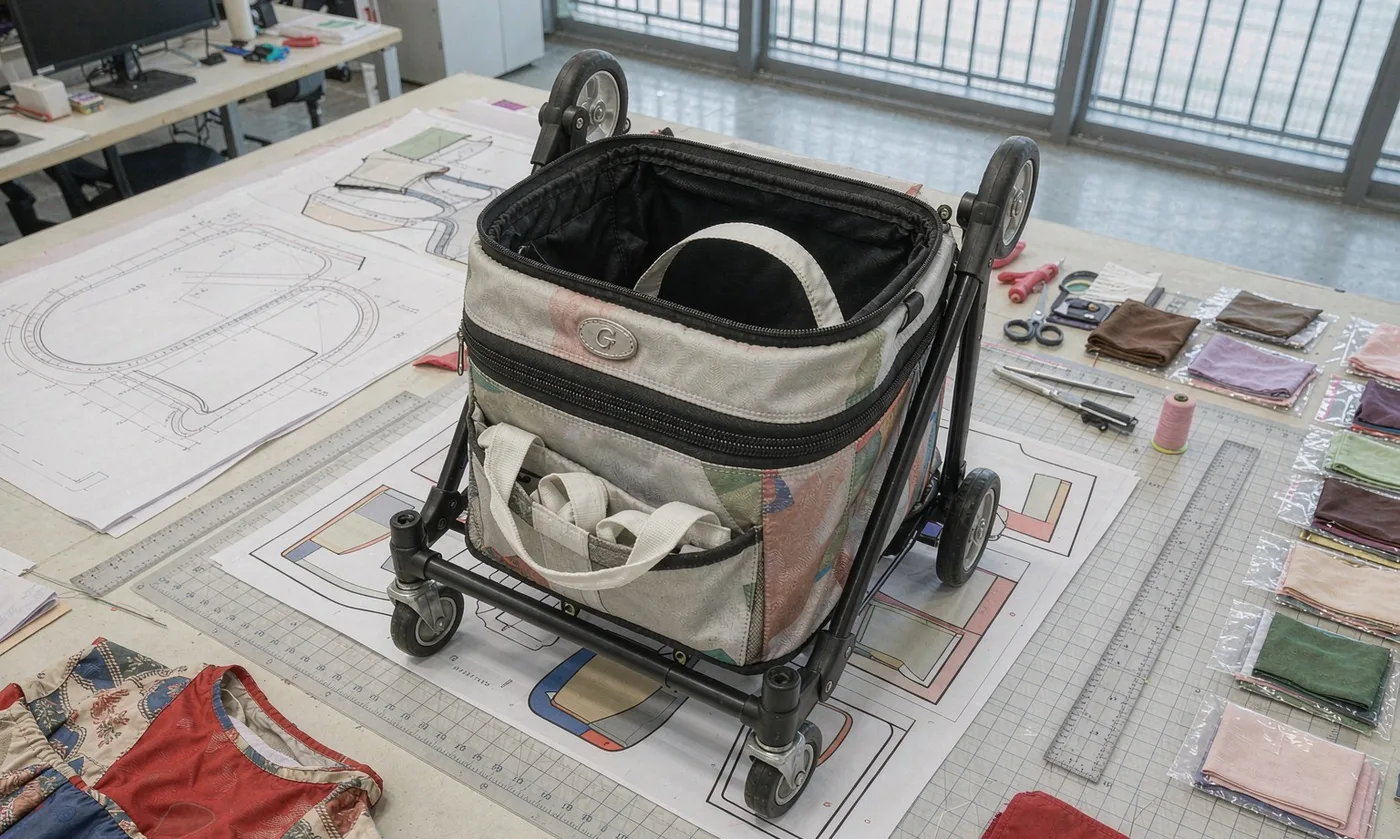
Pattern engineering and tolerance
Every dimension in the tech pack needs a tolerance, and the tolerance should reflect what a sewing line can realistically hold. On a soft-sided carrier, +/- 5 mm is achievable and cheap; +/- 2 mm requires jigs and slows the line, which shows up in unit cost. State tolerances per dimension rather than a blanket number, tighten them only where fit matters - the board insert, the pad, the zip track - and leave them generous everywhere else.
Stage 3 - Material and Hardware Palette
Once the volume is fixed, the material palette decides the hand feel, the price band and the perceived brand tier. The palette is a short list: one shell fabric, one lining, one mesh, one foam specification, one zipper family, and one set of hardware finishes. Brands that spec four fabrics across three colourways multiply their minimum order quantities and their risk of shade variation, and they rarely gain any shelf benefit from it.
Shell fabric selection usually lands between three families. Polyester is the workhorse: stable shade, low cost, wide finishing range, and good print receptivity. Nylon reads more technical and more premium, takes a softer hand after finishing, and costs more per yard with slightly more shade risk between dye lots. Coated canvas or RPET blends carry a sustainability story that a brand can actually put on a hang tag, at the price of a heavier hand and a slower drying time.
Hardware finishes do more for perceived value per dollar than any other single line item. A light gold zipper pull and matching D-ring lift a 200-denier polyester shell into a mid-tier visual position, while a black oxidised finish on the same shell reads utility. The rule of thumb our team uses: spend the incremental dollars on the touchpoints the customer's hand actually meets - pulls, runners, buckles, and the underside of the handle wrap - and save them on broad surface areas.
The table below summarises how the palette choices interact with cost tier and brand positioning. Use it as a starting grid, then adjust for the specific colour system and decoration method of the program.
| Palette element | Entry tier | Mid tier | Premium tier | Brand signal |
|---|---|---|---|---|
| Shell fabric | 300D polyester, PU coat | 600D polyester or RPET | Nylon twill or coated canvas | Hand feel and drape |
| Lining | 210D plain dyed | 210D with printed motif | Brushed tricot or RPET | Inside-the-bag surprise |
| Ventilation field | Single mesh panel | Dual mesh with binding | Perforated motif + mesh | Recognition at distance |
| Zipper family | #5 nylon coil | #5 reversed coil, branded pull | #8 metal-look with custom pull | Sound and weight of the pull |
| Hardware finish | Black nickel | Light gold or gunmetal | Matched set + engraved plate | Perceived price band |
| Foam / pad | 8 mm foam board | 12 mm foam + removable pad | Memory foam, washable cover | Comfort claims on pack |
| Substance compliance | REACH Annex XVII | REACH + OEKO-TEX Standard 100 | Full documentation pack | Retail buyer confidence |
Substance compliance is not optional at any tier. Materials are screened against REACH restrictions for the European market, and OEKO-TEX certification is available where a retail buyer requires a documented textile standard. Ask for the certificate numbers with the sample, not with the shipment - a certificate that arrives after the goods have sailed cannot fix a rejected delivery.
Stage 4 - Logo Decoration: Match the Method to the Surface
The decoration method is where most private label programs either save or waste their margin, because the method determines set-up cost, per-piece cost, minimum quantity, and how the logo survives the first wash. There is no universally best method; there is only the right method for a given surface, colour count and quantity.
Screen printing is the default for flat polyester panels with one to three spot colours, with a low per-piece cost and a set-up charge per colour per placement. Heat transfer handles gradients and photographic artwork that screen cannot hold, and it is the usual answer for a logo with a colour blend. Sublimation works only on light polyester and gives full-bleed artwork across a whole panel at no extra per-colour cost, which makes it the strongest tool for an all-over brand pattern. Embroidery reads as craft and permanence, carries a per-piece cost driven by stitch count, and is the natural choice for a brand positioned on heritage or outdoor. Woven labels and rubber or silicone patches sit at the top of the perceived-value curve for a modest absolute cost.
Placement should be decided with the photography pose from Stage 2. The long side panel is the primary position for a brand mark, the end cap suits a small secondary mark or a woven flag, the handle wrap suits a repeated micro-pattern, and the interior lining is the place for a hidden brand moment that costs almost nothing and generates the most social sharing.
Two practical warnings. First, keep the primary mark at least 15 mm clear of any seam, zip track or binding, because artwork that crosses a seam will distort in production no matter how clean the sample looks. Second, decide legibility at the smallest size in the range, not the largest - a mark designed for the medium carrier will usually break on the small.
Where a program needs several methods at once, treat them as a system rather than as unrelated add-ons: one primary mark in one method, one secondary mark in a second method, and one repeated motif, all sharing one colour system. A carrier with four different decoration techniques reads as undecided; a carrier with three coordinated ones reads as designed. Detailed method-by-method cost and durability notes are covered in our custom printed pet carrier printing guide.
Stage 5 - Sampling and Sign-Off: 6-10 Working Days per Round
Sample development is where a design becomes a spec. Each round runs 6-10 working days from released tech pack to courier dispatch, and the rounds have distinct jobs: round one confirms silhouette and volume, round two confirms material, colour and decoration, round three confirms packaging and the final packing method. Trying to close all three in one round is the single most common cause of a slipped launch.
Round one is a construction sample, usually in a substitute colour close to the target. Its job is purely three-dimensional: does the pet fit, does the floor hold, does the handle drop feel right, does the ventilation field read. Judge it without the colour conversation, because a brand team that starts debating shade on a construction sample will burn the round on the wrong question.
Round two is the sales sample or confirmation sample. It carries the actual dyed fabric, the actual decoration, the actual hardware finish and the actual woven label. This is the sample that goes to a retail buyer, to a photo studio, and to any compliance laboratory that needs a production-representative unit. It is also the sample that should be signed off physically, by hand, and then kept as the golden reference for bulk.
Round three, where needed, is the packaging and packing sample: retail box, hang tag, insert card, polybag, carton mark and carton packing count. Packaging is approved last because it depends on the final exterior dimensions, which are only truly stable after round two.
Sign-off discipline matters more than sample speed. We ask for one consolidated revision list per round, issued by one named decision maker, with every change marked as either must-fix or nice-to-have. Fragmented feedback from five stakeholders produces contradictory revisions, and contradictory revisions produce a fourth round. Two clean rounds and a packaging check is a realistic target for an experienced brand team.
Stage 6 - Colour System and Repeatability
Colour is the element that most often breaks between sample and bulk, and it breaks for a mechanical reason: a lab dip approved on a phone screen under office lighting is not the same colour as a dyed roll approved under a D65 light box. Every branded program should therefore run its colour system on physical references, and the reference standard used across the industry is the Pantone system, which is why our colour approvals are issued against Pantone codes rather than hex values.
Start with a colour system of three to five core shades. One is the brand hero, usually the darkest or most saturated and used on the shell; one is a neutral used on lining and binding; one is an accent used on pulls, tags and stitch; and the remainder are seasonal extensions. Seasonal shades are where minimum quantities bite, because a seasonal colourway still has to meet the dye lot minimum, which is why most programs start at MOQ 500 per colourway rather than per style.
Shade tolerance should be stated numerically, not emotionally. A Delta E of 1.0 or below against the approved standard is achievable on polyester and nylon under controlled dyeing; above roughly 2.0 a customer standing in a store will notice a difference between two pieces sitting side by side. Our production team works to a declared tolerance and re-approves a fresh lab dip if a dye lot falls outside it, rather than shipping and negotiating later.
Colour fastness is the second half of the system and is frequently forgotten until a customer complains. Rubbing fastness, wash fastness and light fastness are tested by recognised textile methods issued by bodies such as AATCC, and a dark accent colour rubbing onto a light lining is a classic failure that shows up in transit rather than in the sample room. Specify a minimum fastness level per colourway and test the darkest shade in the system, because it is always the one that fails first.
Metamerism is the trap that catches even experienced buyers: two materials that match under the showroom light and diverge in daylight. Any program combining a coated shell with a woven label, a printed tape and a metal-look pull should approve all four components together under at least two light sources before the dye lot is released.
Stage 7 - Packaging, Hang Tags and the Shelf Story
Packaging is the last design decision and the first thing a customer touches. It carries three jobs at once: protect the product through transit, communicate the brand in the five seconds before a purchase, and satisfy the retail buyer's administrative requirements. Those three jobs are frequently in conflict, and the resolution is to design the outer retail box for the shelf and the inner packing for the transit test.
The retail box is a graphic surface with a structural job. A four-colour printed carton with a matte lamination and one spot UV on the logo is the standard mid-tier specification; a kraft board with a single-colour print and a die-cut window reads sustainable and costs less per unit. Window placement should show the ventilation field and the logo together, because those are the two features that sell the product.
The hang tag is the compliance surface. It carries the barcode, the size, the colourway name, the material composition, the country of origin, the care instructions and any required regulatory statement. Because the tag is the cheapest component in the entire program and the one most likely to be read at shelf, it deserves the same design attention as the product itself; our dedicated custom hang tag guide covers structure, stock and finishes in detail.
The insert card is the retention surface. A thank-you note, a care card and a registration prompt cost a few cents and measurably lift repeat purchase, because the unboxing is the only moment a brand has the customer's full attention with no competitor present. Design the insert sequence deliberately: card on top, care information beneath, and a single call to action rather than three.
Transit protection is verified, not assumed. Drop, compression and vibration performance of a packed carton is assessed with recognised test methods published by standards bodies such as ASTM International, and the carton specification - board grade, inner packing count, and void fill - is set from the result. A beautiful box that arrives dented has failed the only test that matters.
Stage 8 - Bulk Production, AQL 2.5 and Launch Calendar
Bulk starts when three things are true: the confirmation sample is physically signed off, the material set is booked and in house, and the deposit has cleared. From that point the program runs 35-50 days, and the length depends far more on material availability than on sewing capacity. A stock polyester in a standard colour can move in 35 days; a custom-dyed canvas with an engraved metal pull will take the full 50.
Inspection is built into the schedule, not added at the end. Pre-production checks confirm the shade and the decoration set-up on the first pieces off the line. Inline checks watch seam integrity, mesh alignment and hardware attachment while the run is still correctable. Final random inspection follows the AQL 2.5 sampling plan, with defects classified as critical, major and minor, and no shipment releases until the report is issued and accepted. Independent verification is available through third-party inspection bodies such as SGS, and the quality system behind the line is maintained to ISO 9001 requirements.
The launch calendar closes the loop. Work backwards from the on-shelf date: 35-50 days of production, 2-3 weeks of ocean transit plus port and drayage, one week for the distribution centre to receive and allocate, and 20-30 days of sample development before that. The resulting number is the date the tech pack must be signed, and it is almost always earlier than the brand team expects.
Two closing design principles. First, plan the second season at the same time as the first: a core shell fabric and core colour that carry across seasons let the second drop be a decoration and colourway change rather than a full re-development, which cuts the second season to a fraction of the first in both time and money. Second, hold one golden sample in a controlled location, because every future reorder, colour dispute and quality conversation will be resolved against that physical piece.
A brand that follows this eight-stage sequence treats custom pet carrier design as a repeatable system with known dates, known costs and known acceptance criteria, which is exactly what turns a one-product launch into a product line.
Production capability
- SGS-verified production space of 4,950 m², 149 machines, 7 assembly lines
- Pet carrier and pet bag output since 2014 from a 137-person team
- 200,000 units shipped monthly under BSCI and ISO 9001 systems
People Also Ask
What is the first step in custom pet carrier design?
The first step is a written design brief that fixes eight constraints: price band, size architecture, pet weight range, decoration area, colourway count, packaging format, compliance markets and launch date. Missing constraints are paid for later in extra sample rounds.
How much does it cost to develop a custom pet carrier?
Development cost is driven by sample rounds, tooling for custom hardware or patches, and print set-up charges per colour per placement. Unit price is then driven by material palette, hardware finish and decoration method rather than by silhouette alone.
Can small brands start a private label pet carrier line?
Yes, at MOQ 500 pieces per colourway. A focused first drop - one silhouette, two colourways, one decoration method - keeps the program inside a realistic budget and creates a clean base for a second season.
How do I choose between a structured and a soft-sided carrier?
Structured carriers photograph better, hold their shape empty and support heavier hardware, while soft-sided carriers ship more efficiently and read casual but need internal framing to stop floor sag above roughly 10 kg.
Where should a logo be placed on a pet carrier?
The long side panel, because it faces the camera in the three-quarter hero shot that drives e-commerce conversion. Keep artwork at least 15 mm clear of seams, zips and binding, and check legibility on the smallest size in the range.
How do I make sure bulk matches the approved sample?
Keep one physically signed golden sample, approve colour under a controlled light box against a Pantone reference, and require an AQL 2.5 inspection report before shipment release.
Frequently Asked Questions
How long does a custom pet carrier design project take?
End to end, plan 55-70 calendar days: roughly 20-30 days for sample development across two to three rounds at 6-10 working days each, then 35-50 days of bulk production after sign-off and deposit. Add ocean transit and distribution centre receiving time before the on-shelf date.
What is the minimum order quantity for a custom pet carrier?
The standard starting point is MOQ 500 pieces per colourway. The figure is driven by fabric dye lot minimums, hardware and trim minimums, and decoration set-up amortisation rather than by sewing capacity.
Can we change the silhouette after the first sample?
Yes, but treat it as a restart. A silhouette change touches the pattern, foam set, frame parts, packaging dieline and carton cube, so it resets development and adds a full sample round. Colour and decoration changes are far cheaper at that stage.
How many sample rounds should we budget for?
Two to three. Round one validates construction, round two validates material, colour and decoration as a sales sample, and round three validates packaging and packing. Experienced brand teams routinely close in two rounds plus a packaging check.
Which inspection standard is used before shipment?
Final random inspection follows an AQL 2.5 sampling plan with critical, major and minor defect classifications. No shipment is released until the written inspection report is issued and accepted. Independent third-party inspection can be arranged on request.
How is colour matched between sample and bulk?
Colour is approved against a physical Pantone reference under a controlled light box, not against a screen or a hex value. A measurable shade tolerance is agreed in advance, and a fresh lab dip is issued if a dye lot falls outside it.
What compliance documentation can you provide?
Material screening against REACH restrictions for EU-bound programs, CPSIA and Prop 65 considerations for the US market, and OEKO-TEX certified fabrics where a retail buyer requires a documented textile standard. Certificate numbers should be requested with the sample, not after shipment.
Can packaging be developed together with the product?
Yes, and it should be. Packaging depends on final exterior dimensions and is approved last, normally as a third sample round covering retail box, hang tag, insert card, polybag and carton packing count.
What are the commercial terms?
T/T 30/70 with FOB Xiamen as the standard structure. Production starts after the confirmation sample is signed off and the deposit has cleared; the balance is due against the shipping documents.
How do we reduce lead time on a second season?
Carry a core shell fabric and core colour across seasons so the second drop becomes a colourway and decoration change rather than a full re-development. That approach removes most of the pattern and material development work from the second cycle.
Can we mix decoration methods in one design?
Yes, most branded programs use two or three: a primary mark in one method, a secondary mark in another, and a repeated motif, all sharing one colour system. More than three methods usually reads as undecided rather than designed.
What file format do you need for logo artwork?
Vector artwork is required for screen print, embroidery digitisation, woven label development and rubber patches. Raster artwork at 300 dpi or higher is acceptable for heat transfer and sublimation. Our design team confirms method suitability before tooling.
Talk to QUANZHOU JUNYUAN BAGS about a pet carrier program: MOQ 500 pieces per colourway, samples in 6-10 working days, bulk production in 35-50 days under AQL 2.5 inspection.
Get a free quote Request a sample