Short Pet Carrier: Compact Design
A short pet carrier keeps the same footprint as a standard size and reduces height: an interior floor around 45 x 28 cm with interior height held at 24-28 cm instead of 30-34 cm. That reduction cuts exterior height by roughly 20 percent, which is what makes the bag fit under a seat, into a small car footwell and into an apartment storage space.
Compact design is a positioning decision before it is a dimensional one. A low-profile shell reads urban, considered and modern, and it solves a set of problems - under-seat travel, small-car footwells, apartment storage, retail cube - that no amount of feature content addresses. Design it deliberately rather than as a flattened standard bag, because a compressed pattern has different structural rules, a different aperture problem and a different set of customers. Commercial minimums are MOQ 500 pieces per colourway, and a compact line shares shell fabric, hardware finish and decoration tooling with the standard range, which is what keeps a second silhouette economical. Sample development runs 6-10 working days per round, with two rounds standard: construction to validate the reduced height against real animal posture, then confirmation in production fabric with packaging. Bulk runs 35-50 days after sign-off and deposit clearance, released only after final random inspection at AQL 2.5 with a written report. Terms are T/T 30/70, FOB Xiamen. Our production team treats interior height on a compact shell as the specification to defend rather than to trade away, because it is the dimension a customer discovers within seconds and the one most often sacrificed to win an exterior number.
Custom dog carrier programmes usually run three size platforms at MOQ 500 pieces per colourway, with sizes mixed inside one style to reach the threshold.
Compact Is a Design Position, Not Just a Smaller Box
There are two ways to make a carrier smaller and only one of them is design. Shrinking every dimension produces a bag that is simply less useful. Reducing height while holding the footprint produces a product with a purpose: it fits where a standard bag does not, it reads as urban rather than as cheap, and it serves a customer whose constraint is space rather than money.
That distinction matters commercially because the two products attract different buyers. A shrunken bag competes on price with every other small bag and loses. A compact bag competes on a proposition - fits under the seat in front of you, fits in the footwell of a small car, slides under a bed - and wins without discounting. The proposition is the product.
The design work follows from holding the footprint. If the floor stays at 45 x 28 cm and only the height drops, the animal's lying position is unaffected and only its sitting position is compromised, which is a much smaller sacrifice than reducing the floor. That is why compact shells work for cats and for small dogs that travel lying down, and why they should not be offered for breeds that sit upright.
Height reduction has a ceiling. Below roughly 24 cm of interior height, most animals cannot lie in a natural position with their head up, and the product stops being a carrier regardless of how well it fits a space. Our team treats 24 cm as the floor and will not quote below it.
The citable conclusion: compact design is the deliberate reduction of one dimension in service of a stated use case, not the uniform reduction of all of them, and the difference is visible in both the product and its reviews.
The Compact Envelope: Height as the Design Variable
The envelope below compares a compact shell against the standard rung it sits beside. Everything except height is held constant, which is the whole point: the floor the animal lies on does not change, the carton footprint does not change, and only the dimension that governs fit-into-spaces is reduced.
| Parameter | Standard S | Compact S | Change | What it buys |
|---|---|---|---|---|
| Interior floor L x W | 45 x 28 cm | 45 x 28 cm | None | Lying position unchanged |
| Interior height | 30 cm | 25 cm | -5 cm | Fits under-seat and under-bed |
| Exterior L x W x H | 49 x 31 x 32 cm | 49 x 31 x 27 cm | -16 percent height | Cabin gauge and parcel class |
| Rated pet weight | 3.5-6 kg | 3.5-6 kg | None | Same animal, less volume |
| Empty weight | 0.78 kg | 0.66 kg | -0.12 kg | Less to carry, less to ship |
| Ventilation area | 560 cm2 | 500 cm2 | -60 cm2 | Smaller side faces |
| Shipping cube per unit | 48.6 L | 41.0 L | -16 percent | More units per container |
| Units per retail shelf bay | Baseline | +1 facing | Depth driven | Retailer preference |
Two rows in that table do most of the commercial work. Shipping cube drops by roughly 16 percent, which compounds across a container and across last-mile parcel bands; and retail depth drops enough that a retailer can floor an extra facing in the same bay, which is a conversation a buyer will actually respond to.
The ventilation reduction is the cost of the exercise and should be managed rather than ignored. Smaller side faces mean less area for mesh, so the open area has to move to the lid or the ends, where a low shell still has room. Placing one large field on the lid is the standard answer and it happens to be the field an animal lying down cannot block.
Exterior height of 27 cm is the number that makes under-seat claims plausible for a soft-sided shell, and it is the number to protect in the tech pack. Additions that creep the lid upward - a thicker pad, a taller handle base, a decorative top panel - should be checked against it at every sample round.
Structural Challenge: A Low Shell Has Less to Work With
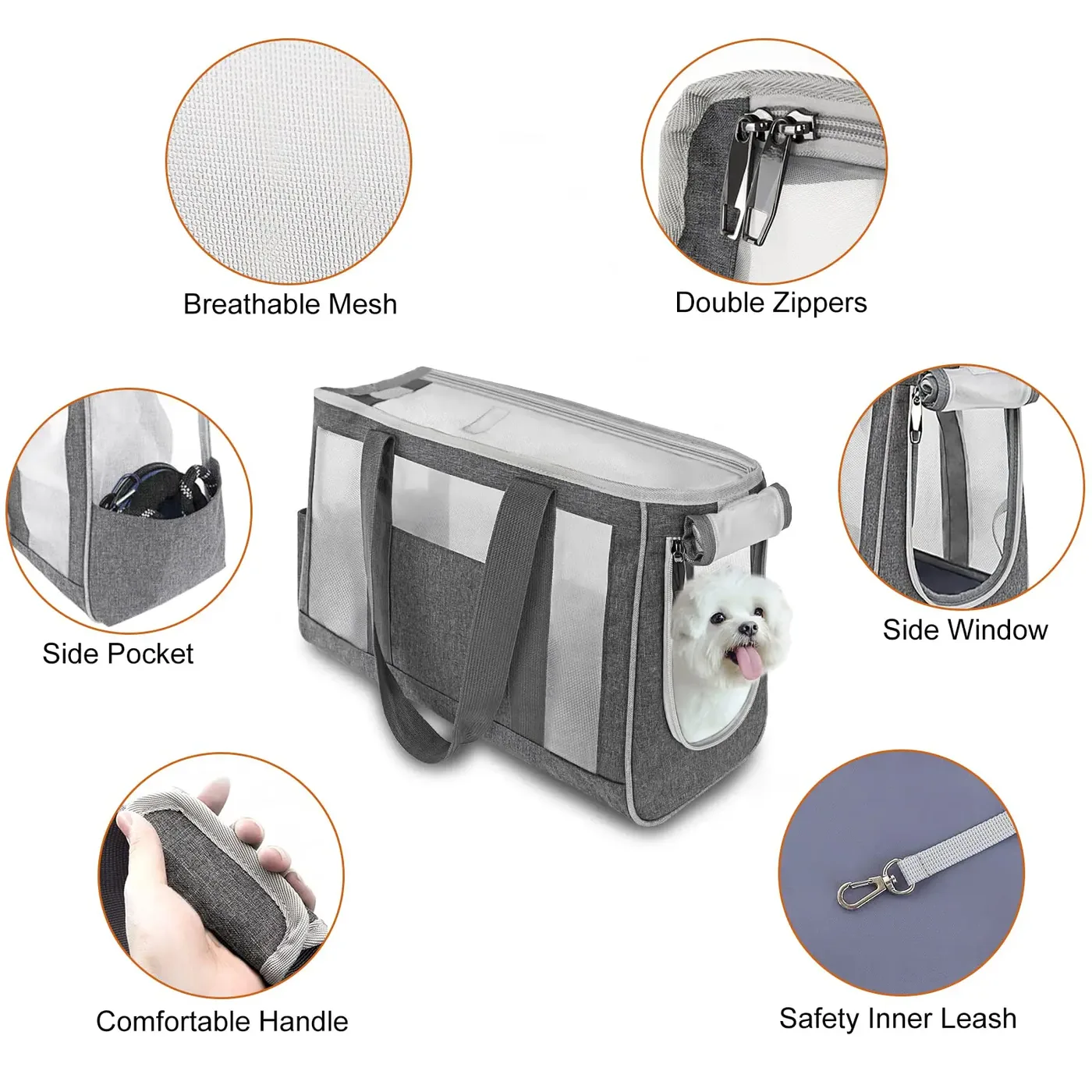
A low-profile shell is structurally awkward in a way that surprises designers. With less height, the shell has less material to resist the outward bow of a loaded floor, the end panels have less depth to stand up, and the handle has less vertical structure to attach into. Each of those needs a specific answer rather than a general reinforcement.
Bowing is the first. In a taller bag, the side walls act as deep beams that resist the floor's tendency to spread under load. In a compact shell those walls are shallow and the floor load pushes them outward. The remedy is a perimeter hem with a stiffening member - a cord, a narrow webbing, or a light rail - rather than a thicker board, because the problem is lateral spread rather than vertical deflection.
End panel collapse is the second. A short end panel has little inherent stability and will fold inward under any side pressure, which is visible immediately in a photograph. A light stay, a doubled panel, or a slightly domed geometry solves it, and the domed option costs nothing and reads as a design decision.
Handle attachment is the third and the most consequential. With less shell height, a handle reinforcement patch has less vertical run to distribute load into, so the patch must be wider rather than taller, and it should tie into the perimeter hem rather than terminating in the middle of the panel. This is the detail that separates a compact bag that lasts from one that tears at the handle within a season.
The compensation is that a low shell is easier to keep square. With less height, there is less to twist, and a compact bag set down on an uneven surface distorts less than a tall one. That makes the low profile a genuinely good choice for a product that will be used on floors, in footwells and on transit seats rather than on tables.
Aperture and Access on a Low Profile
Access is the compact shell's hardest problem and the reason most low-profile carriers disappoint. With 25 cm of interior height, a top opening gives the owner very little room to lower an animal in, and an end opening gives the animal a low, wide slot that many cats will not enter. Neither is unworkable, but both need to be designed rather than inherited.
The most effective configuration is a wide wrap opening: a zip that runs across the lid and continues down both ends by roughly half the shell height. It converts a low box into a clamshell, gives access from three directions at once, and lets the owner place an animal without inverting it. Structurally it is the most demanding option because it removes material from three faces, so it needs the perimeter hem discussed above to restore stiffness when closed.
A second option is a full drop-front on one end, which suits a small dog that walks in and is the cheapest solution structurally. On a compact shell the drop-front has to be nearly as tall as the bag, which means the end panel is almost entirely closure - a configuration that works well and looks distinctive rather than compromised.
Whichever is used, the closed opening must restore the shell's stiffness. On a low-profile bag that means the zip track itself is a structural member, so gauge matters: a #5 coil with a continuous tape and radiused corners is the minimum, and the tape should be captured into the hem rather than floating free.
Threshold height is less critical on a compact shell than on a tall one, because the sill is already low, but it should still be stated. With the pad in place, target 50 mm or less, which is achievable on this geometry and lets a small animal step in without being lifted.
Urban Use Cases: Transit, Storage and the Small Car
Compact shells exist because of a set of spatial constraints that standard carriers ignore, and naming those constraints is the most effective merchandising a brand can do with this product. Four use cases carry the line.
Under-seat travel is the most searched and the most valuable. A soft compact shell whose published exterior dimensions sit within the under-seat envelope of most narrow-body aircraft is a product people look for specifically, and the honest specification is a published exterior height plus a stated compressible amount rather than an approved claim. Airline policy varies and changes; industry-level live animal transport guidance is published by IATA, and travellers should confirm with their own carrier before flying.
The small car footwell is the second. A compact bag fits behind a front seat in a way a standard bag does not, which matters enormously in dense cities where car ownership skews small. It is also the use case customers describe in reviews most often, because it is the one they discovered for themselves.
Apartment storage is the third and the most underrated. A bag that slides under a bed or onto a shelf gets used; a bag that has to live on the floor of a hallway gets used less. Storage is a genuine purchase criterion for urban customers and almost never appears on a competitor's product page.
Public transport and indoor venues are the fourth. Many transit systems and venues require a contained animal, and a compact bag is easier to manage in a crowded space than a tall one. Where a brand sells into a city market, this is the use case to lead with.
Flat-Pack, Nesting and Retail Cube
The compact geometry is inherently good for logistics, and a brand should take the full benefit rather than half of it. A low-profile shell nests better, folds flatter and ships in a smaller carton than the standard rung it sits beside, and each of those three savings compounds.
Nesting is the cheapest win. Compact shells designed with a slight taper nest four to six deep for internal handling and for warehouse storage, which reduces the cost of every movement the product makes before it reaches a customer. A taper of two to three degrees is enough and is invisible in the finished product.
Folding depends on the board. A removable board with a fold line lets the shell collapse to roughly a third of its assembled height, which is the difference between shipping four units per carton and shipping twelve. Where a brand wants a structured look, the compromise is a two-part board that folds along the centre and still gives a flat floor when assembled.
Retail cube is the commercial payoff. A compact bag occupies less shelf depth, which means more facings in the same bay and a lower shelf-cost per unit for the retailer. That is a concrete argument a buyer can act on, and it is worth quantifying in the line sheet rather than leaving implicit.
Carton design should follow from the folded or nested dimension rather than from the assembled one. Packaging is approved after the confirmation sample, once the exterior dimensions are stable, and the carton should be specified to the packed state - not to the state the product is photographed in.
Aesthetics of the Low Profile: Minimal, Architectural, Urban
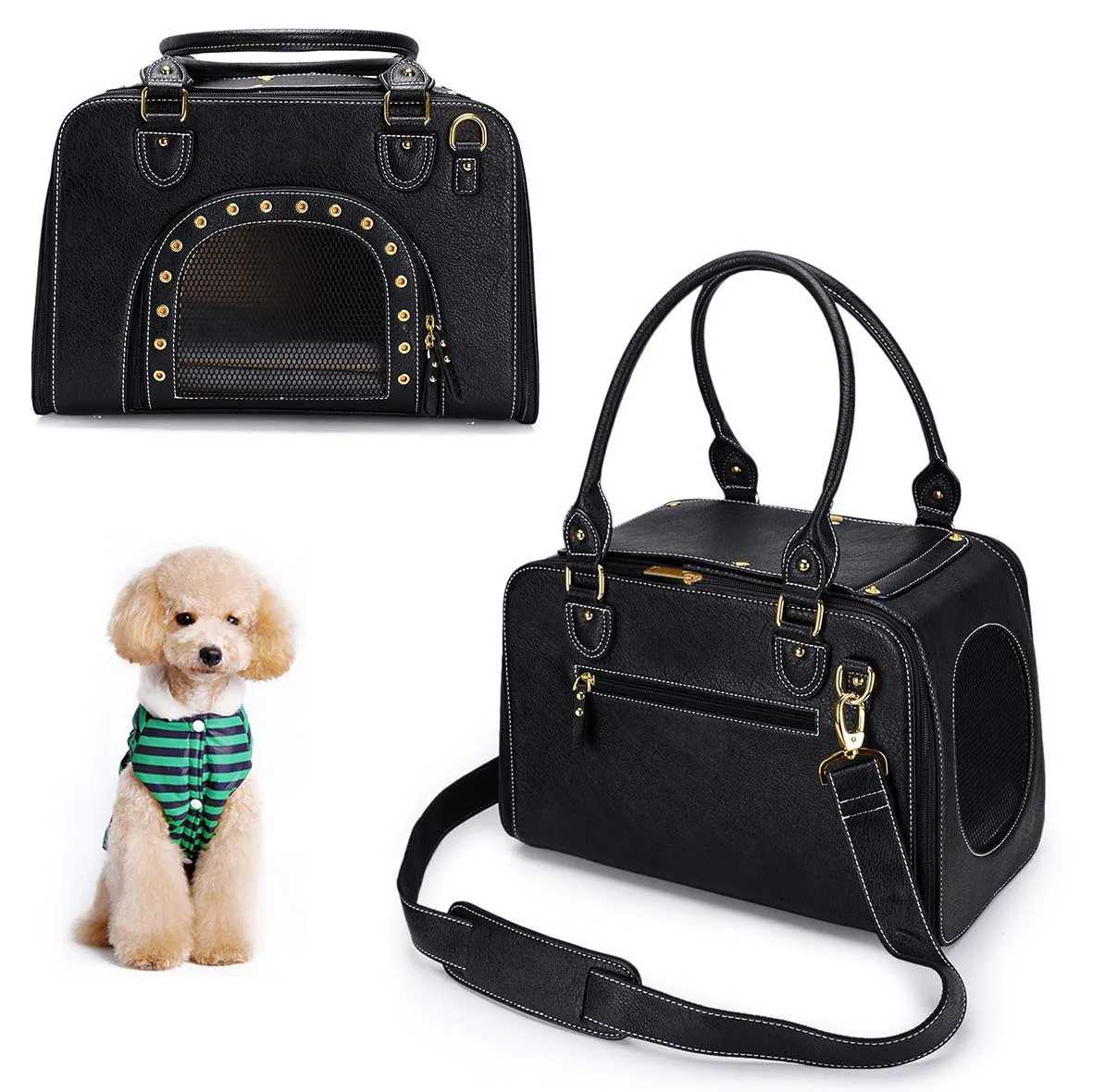
The low profile carries a visual position whether a brand intends one or not: horizontal, restrained, architectural. That is a gift to a brand positioned on design, because the proportion itself does much of the styling work, and it is a trap for a brand that decorates it the way it decorates a tall bag.
Three directions work. The minimal direction uses one colour, one small mark and a single horizontal line of detail, letting the proportion speak. The architectural direction makes the ventilation field a strong horizontal band and treats the hem as a visible design line rather than as construction. The urban-technical direction uses a performance fabric, a visible zip line and a reflective detail, reading as equipment rather than as luggage.
What does not work is vertical composition on a horizontal product. Stacked graphics, tall logos and busy all-over prints fight the proportion and make the bag look busier than it is. Our design team works horizontally on compact shells: wide bands, low-set marks, and detail placed along the length rather than across the height.
Colour behaves differently on a low-profile product too, because the visible surface from a standing eye level is mostly the lid and one side. Those two surfaces should be designed as a pair, and the lid deserves the same attention as the side panel - an inversion of the usual priority, and the reason compact shells are often the most photographed product in a range.
Material hand feel matters more at this scale, because there is less of it. A compact shell in a fabric with a fine, dense hand reads as premium in a way that the same fabric on a large bag does not, which makes this the right place in a range to spend a material upgrade.
Decoration on a Compact Canvas
The compact canvas is a wide, shallow rectangle, and it rewards a horizontal lockup: a wordmark set low on the panel, a wide repeated motif, or a small mark placed off-centre with generous negative space. Vertical stacking and centred emblems both read as borrowed from a taller product.
Decoration area is smaller in absolute terms but not proportionally. Our rule is to cap the block at roughly 50 percent of the side panel width and to keep it below the vertical mid-line, because a mark set low on a low shell reads as intentional while one set centrally reads as misplaced. Keep artwork at least 15 mm clear of the zip track, which on a compact shell runs closer to the panel centre than on a standard one.
Method choice is slightly narrower than on a standard shell. Embroidery is excellent here, because a small mark on a small panel reads as craft and the stitch tension is distributed over less area. Heat transfer works well on the lid, which is a large flat surface on this geometry. Sublimation gives the strongest result for an all-over horizontal pattern, and a small metal plate or woven flag placed at one end reads as a premium detail at very low cost.
Colour approval follows ladder discipline: one dye lot per colourway, approved under a controlled light box against a Pantone reference, with a stated tolerance. Because the lid and side are the two visible surfaces, approve them together and check them together - a pair that matches individually and diverges together is a real and common failure.
Fastness testing should cover the darkest shade in the system using recognised textile methods from bodies such as AATCC, and stain or soil release finishing is worth specifying on a compact shell, because a bag designed for floors, footwells and transit seats will meet more dirt than one designed for tables.
Sampling, MOQ and Launching a Compact Line
A compact line is the cheapest second silhouette a brand can add, because it shares fabric, hardware, colour and decoration with the standard range and changes only the pattern, the board and the carton. That makes it the natural second-season investment for a brand that has established one ladder and wants a differentiated product without a second supply chain.
Sample development runs 6-10 working days per round, with two rounds standard. The critical test in round one is behavioural and specific: put an animal of the rated weight inside, close the bag, and watch whether it can lie in a natural position with its head up for ten minutes. That single observation is worth more than any dimensional check on a compact shell, and it is the one most often skipped because the numbers all look correct.
Minimums are MOQ 500 pieces per colourway. Launch in the hero shade, book the fabric with the standard run, and use the compact shell as the seasonal or limited-edition product where a design-led colourway can be tested at low risk. Its smaller unit cost and smaller cube make it the cheapest place in a range to experiment.
Bulk runs 35-50 days after sign-off and deposit clearance, released only after final random inspection at AQL 2.5 with defects classified critical, major and minor. Independent verification is available through third parties such as SGS, and the quality system behind our partner facilities is maintained to ISO 9001 requirements. Add an exterior height check to the inspection plan, because the product's entire proposition is the number on that dimension.
Handled as a position rather than as a shrink, the compact shell is the product that gives a range a point of view: urban, considered, and designed around the space a customer actually has. For the opposite dimensional problem, see our long body carrier brief, and for the smallest rung in the ladder, the extra small carrier brief.
Production capability
- SGS-verified production space of 4,950 m², 149 machines, 7 assembly lines
- Pet carrier and pet bag output since 2014 from a 137-person team
- 200,000 units shipped monthly under BSCI and ISO 9001 systems
People Also Ask
What is the shortest pet carrier available?
Functional compact shells hold about 25 cm of interior height on a standard footprint. Below roughly 24 cm an animal cannot lie naturally with its head up, so smaller products are fashion items rather than carriers.
Is a low-profile carrier comfortable for a cat?
Yes for most cats, because they travel lying down and the floor is unchanged. Check interior height of at least 24 cm and look for a wrap opening that makes placement easy.
Will a compact carrier fit in a small car footwell?
Usually yes, which is one of the two main reasons to buy one. A 27 cm exterior height fits behind a front seat where a 32 cm standard shell will not.
How much can I save on shipping with a compact design?
Roughly 16 percent of cube per unit, plus better nesting and folding. Across a container and last-mile parcel bands, that usually exceeds any saving available from a material downgrade.
Are compact carriers good for air travel?
They are the best soft-sided candidate for under-seat travel, but acceptance is airline-specific. Publish exterior dimensions and let the traveller confirm with their carrier.
What is the difference between compact and extra small?
Compact reduces height only and keeps the standard floor; extra small reduces all dimensions including the floor. Compact suits an animal that lies down; XS suits a smaller animal.
Frequently Asked Questions
What is a short or compact pet carrier?
A shell that keeps the standard footprint and reduces height: a 45 x 28 cm floor with 25 cm of interior height instead of 30 cm. The animal's lying position is unchanged and only sitting height is reduced.
How much height reduction is practical?
Roughly 5 cm, from 30 cm down to 25 cm of interior height. Below about 24 cm most animals cannot lie naturally with their head up, and the product stops being a carrier.
Does a compact carrier fit under an aircraft seat?
The exterior dimensions usually make it plausible, but acceptance is airline-specific and changes often. Publish exact exterior dimensions and a compressible amount rather than printing an approved claim.
What animals suit a compact shell?
Cats and small dogs up to about 6 kg that travel lying down. Do not offer it for breeds that sit upright, because the reduced interior height is exactly the dimension they need.
Why does a low shell bow outward more?
Because the side walls are shallower and act as weaker beams against the floor's lateral spread. The fix is a stiffened perimeter hem rather than a thicker board.
What is the best opening for a compact bag?
A wrap opening running across the lid and down both ends by about half the shell height, converting the box into a clamshell. A full drop-front end panel is the cheaper structural alternative.
Does a compact design save shipping cost?
Yes - roughly 16 percent less cube per unit, which compounds across a container and across last-mile parcel bands, plus more retail facings per shelf bay.
Can a compact carrier be structured rather than soft?
Yes, with a two-part board that folds along the centre. It gives a flat assembled floor and still collapses to about a third of its height for shipping and storage.
Where should the logo go on a low-profile bag?
Low on the side panel, below the vertical mid-line, capped at about 50 percent of panel width and kept 15 mm clear of the zip track. Horizontal lockups suit the proportion; vertical stacking does not.
What is the minimum order for a compact line?
MOQ 500 pieces per colourway, launched in the hero shade and booked alongside the standard run. Its lower unit cost makes it the cheapest place to test a seasonal colourway.
How long does sampling take for a compact shell?
6-10 working days per round, two rounds standard. The decisive test is behavioural: put a rated-weight animal inside and confirm it can lie naturally with its head up.
Should the lid be designed as carefully as the sides?
Yes, and more so. On a low-profile product the lid and one side are the surfaces visible at standing eye level, so design them as a pair and approve their colour together.
What finishing is worth specifying on a compact shell?
Stain or soil release finishing, because this product is designed for floors, footwells and transit seats and will meet more dirt than a bag that lives on a table.
What inspection check is unique to a compact line?
An exterior height check. The entire proposition is that dimension, and a creeping lid - thicker pad, taller handle base - silently destroys it across sample rounds.
Talk to QUANZHOU JUNYUAN BAGS about a pet carrier program: MOQ 500 pieces per colourway, samples in 6-10 working days, bulk production in 35-50 days under AQL 2.5 inspection.
Get a free quote Request a sample