TPU Liner vs PEVA Liner: Food Safe Options
Choose a TPU film laminate for premium interiors: it stays flexible to roughly -30°C, resists hydrolysis, and can be radio-frequency welded so seams carry no stitch holes at all. PEVA costs about 30-40% less and drapes more softly, but it stiffens in cold conditions and often carries a faint plastic note. For treat pockets and any declared food-contact zone, specify TPU with documented migration testing. Both run at MOQ 500 per colourway and clear AQL 2.5 inspection.
Executive Summary
Interiors fail before exteriors. A shell fabric will still look presentable long after the lining has begun to smell, stain or peel, and because the lining is what the animal touches and what the owner cleans, it carries a disproportionate share of both the functional burden and the review risk. Selecting it well is one of the least glamorous and most commercially effective decisions in a custom programme.
TPU — thermoplastic polyurethane — is the technical answer: tougher, colder-tolerant, weldable and cleaner-sealing. PEVA — polyethylene vinyl acetate — is the commercial answer: cheaper, softer, easier to work with and perfectly adequate for interiors whose only job is to be wiped occasionally. This guide compares them across chemistry, cleanability, odour behaviour, joining technology, regulatory documentation around treat storage, and total cost, then sets out the zone-based specification and testing protocol we recommend. Terms are identical for both: MOQ 500 units per colourway, pre-production samples in 6-10 working days, bulk production in 35-50 days, final random inspection to AQL 2.5. Development runs through our production team and SGS-verified partner facilities under ISO 9001 process control.
Customised pet carrier work differs from stock buying in one respect: the pattern is graded to your size ladder and held on file for reorders.
Why Interiors Fail Before Exteriors Do
Walk through any returned product and the pattern is remarkably consistent. The shell is scuffed but serviceable, the hardware works, the zips run — and the interior is stained, odorous, delaminated or sticky. This is not a quality failure so much as a physics one: the lining experiences moisture, warmth, organic soiling, cleaning chemicals and mechanical stress from claws, all in the same place, several times a week.
Yet the lining is usually specified last and value-engineered first. Because it is hidden in photography and rarely mentioned in the product description, it attracts less design attention and more cost pressure than any other component. Every experienced brand learns the same lesson eventually, usually after a season of negative reviews describing exactly the problems above.
The commercial mathematics are unfriendly. A customer who cannot remove a smell does not complain about the lining; they return the product or write about the brand. Either outcome costs considerably more than the difference between a premium laminate and an economy one, which is why we argue for spending material budget inward rather than outward.
- Moisture: accidents, spilled water, condensation — all sit in the base seam, not on the shell
- Organic soiling: oils and proteins penetrate textiles and generate odour that survives surface cleaning
- Cleaning chemistry: owners use whatever is nearest, often far more aggressive than the material was tested against
- Abrasion: claws work locally at high stress, in exactly the place least likely to be reinforced
The corollary is that interior specification deserves the same rigour as exterior. Ask how a proposed liner behaves after fifty wipe-downs with a household spray, not just how it looks in a sample photograph, and the decision usually becomes obvious very quickly.
There is also a design-language argument hiding here. A dark matte welded interior reads as technical and considered; a pale glossy liner reads as budget, regardless of what either actually cost. Because the lining is the surface customers photograph most often after purchase — pet pictures almost always show the inside — its appearance contributes more to user-generated content than anything visible in your own catalogue.
The Two Films, Described Without Marketing Language
Both materials are polymer films laminated to a knit or woven substrate, and both exist to turn a textile into something wipe-clean. The differences lie in how the polymer behaves under stress, temperature and time.
TPU is thermoplastic polyurethane. It has high elasticity, exceptional abrasion resistance, excellent low-temperature flexibility and strong resistance to oils — which matters enormously given how much pet soiling is oil-based. It can be joined by radio-frequency or hot-air welding rather than stitching, producing seams that are genuinely liquid-tight. It costs more, it is marginally heavier, and it requires slightly more process control during conversion.
PEVA is a polyethylene vinyl acetate copolymer. It is softer, lighter, considerably cheaper and easy to heat-seal. Its weaknesses are cold stiffness — it becomes noticeably board-like in low temperatures — lower abrasion resistance, and a tendency to retain a faint vinyl odour that some reviewers describe as chemical smell. For many applications none of these matter much.
| Property | TPU laminate | PEVA laminate | Consequence for your programme |
|---|---|---|---|
| Film thickness | 0.15-0.40 mm typical | 0.10-0.25 mm typical | Thicker film survives claws and repeated cleaning better |
| Cold flexibility | Supple near -30°C | Stiffens below roughly 5°C | Matters for winter markets and cold-vehicle storage |
| Abrasion resistance | Very high | Moderate | Claw contact concentrate at the base and lower walls |
| Oil resistance | Strong | Fair | Oil-based soiling is the hardest odour source to remove |
| Joining method | Radio-frequency or hot-air welding | Heat sealing or conventional sewing | Welded seams eliminate thousands of stitch holes |
| Odour profile | Low | Faint vinyl note possible | Odour complaints frequently read as safety concerns |
| Cost index | 1.5-1.8 | 1.0 | Usually recovered through fewer returns and better reviews |
A practical note on thickness: film gauge often matters more than chemistry. A thick PEVA outperforms a thin TPU in puncture resistance, so comparing like for like means comparing gauge and laminate construction together rather than comparing polymer names alone.
Adhesion between film and substrate is the other hidden variable. Two laminates with identical gauge can behave completely differently if the bonding layer is weak, and lamination failure shows up as bubbling or clouding after the first washing rather than during sampling. Asking how peel strength is verified before and after washing separates laminates that merely look identical from ones that perform identically.
Food-Contact: What Is Actually Required and How to Prove It
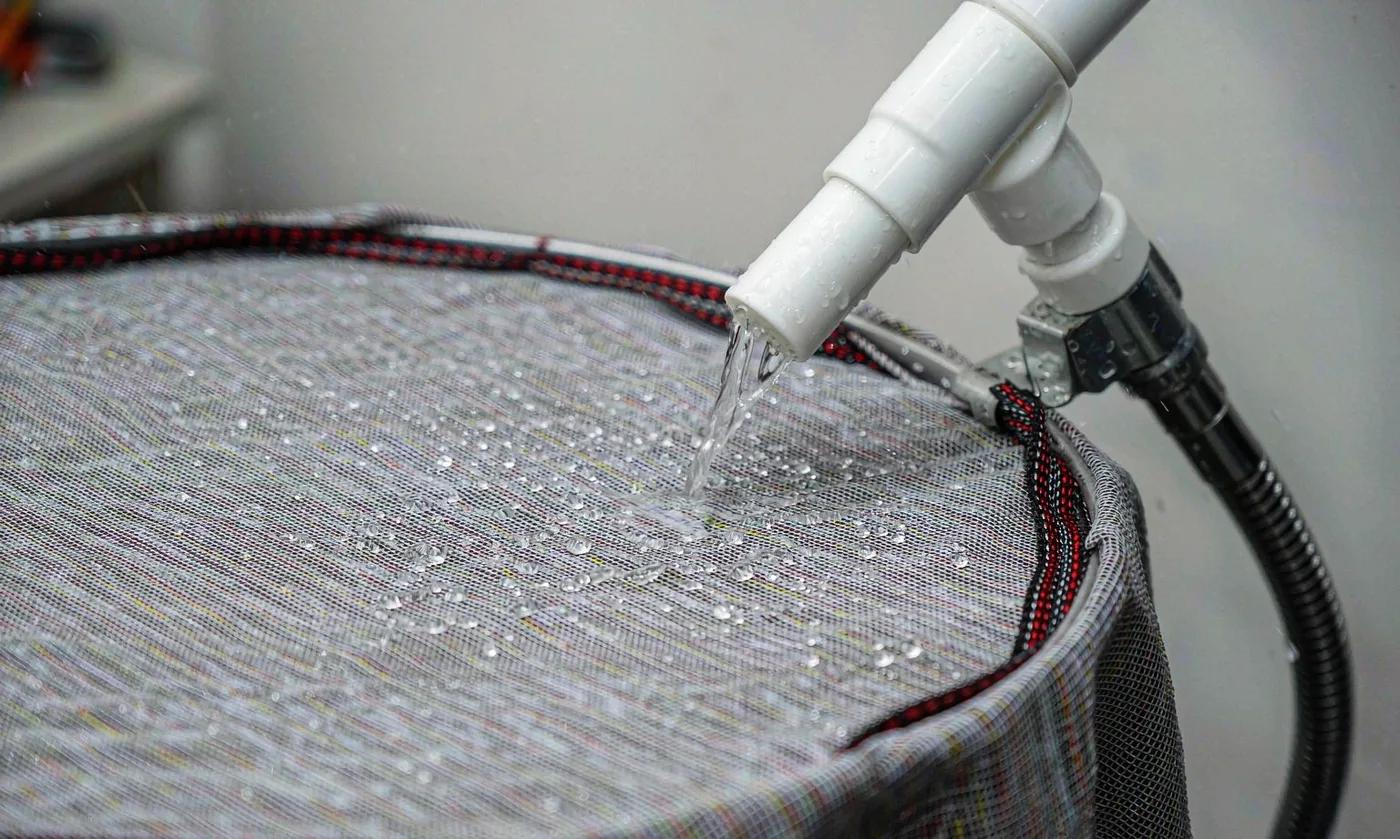
"Food safe" is used loosely in this category, and the loose usage creates risk. Strictly, a material intended to contact food is assessed for migration — whether constituents transfer into food in quantities above defined limits — under specific conditions of temperature and duration, using specified simulants.
The practical question for most carriers is narrower: does anything in this product legally and realistically need to be food-contact compliant? If you include a treat pocket, a removable food cup, a water-bottle liner or any interior surface the marketing positions as suitable for storing food, the answer is yes and documentation is required. If the interior is simply where an animal sits, food-contact status is not legally engaged, though it still reads well in retail conversations.
Where compliance applies, two things must be true. First, the material must be formulated for it — not all TPU and very little economy PEVA is. Second, you must hold documentation, typically a supplier declaration supported by migration test results against the relevant regulatory framework for your destination market. In Europe, chemical substances placed on the market fall within the regime administered by the European Chemicals Agency, and buyers will ask for the certificate rather than a verbal assurance.
Verification deserves the same discipline as specification, and recognised process frameworks exist precisely so results mean the same thing across suppliers. Frameworks such as those published by the International Organization for Standardization give buyers and suppliers a common language for documented control rather than a certificate to hang on a wall. Requesting test results by method number is what turns a claim into evidence.Plan this early. Sourcing a food-contact grade adds time to development and occasionally constrains colour options, because some pigments have not been assessed for those applications. Discovering this at sampling is inconvenient; discovering it after a retailer request is expensive.
Finally, document honestly. If only the treat pocket is food-contact grade, describe it that way rather than implying the whole interior qualifies. Overstated claims create liability that no amount of good review management will erase.
Cleanability: The Property Owners Judge You On
Cleanability has three components that are often conflated: release, washability and resilience. Release describes how easily soil leaves the surface. Washability describes whether cleaning damages the material. Resilience describes whether the surface still releases soil after fifty cleaning cycles rather than three. Owners only experience resilience, and it is what generates reviews.
Both materials release well when new. In that sense, choosing between them on day-one wipeability is pointless — a wet cloth removes most soiling from either. The divergence begins around month three, as micro-abrasion from claws, grit and scrubbing accumulates. TPU's elastic surface tends to absorb that damage and keep releasing; PEVA's softer surface scratches more readily, and once scratched it holds soil in the marks it cannot shed.
Chemical exposure accelerates everything. Owners use dish soap, vinegar, enzyme cleaners, diluted bleach and occasionally something considerably stronger. TPU tolerates most of this gracefully. PEVA is more susceptible to surface dulling and eventual embrittlement from repeated chemical exposure, which is why its cleanability declines faster than its appearance suggests.
- Test cleanability cyclically during sampling: fifty wipe-downs with your worst-case cleaner, then retest release
- Market actual care instructions rather than aspirational ones — owners follow whichever is easiest
- Specify film gauge generously at the base, where scrubbing concentrates
- Prefer welded seams so cleaning liquid cannot enter the interlining and generate odour
The commercially relevant conclusion is simple: a liner is the one component most likely to determine whether a customer recommends your brand, and it is a poor place to save money.
Consider too how cleaning actually happens rather than how it is intended to happen. Most owners do not remove debris before wiping; they wipe over grit, which is effectively abrasion. Specifying a surface that survives that behaviour, rather than one that requires careful handling, is the difference between a material that performs in a laboratory and one that performs in a home.
Odour, Off-Gassing and the Smell Problem
Odour deserves its own discussion because of how customers interpret it. A new-product smell is not read as a material characteristic; it is read as a warning. Reviews that mention chemical smell frequently escalate into questions about safety, and those reviews travel further than ordinary complaints because they feel like disclosures.
PEVA is more likely to present a faint vinyl note, particularly immediately after unpacking from sealed retail packaging. It dissipates, usually within a few days of airing, but timing matters: if your unboxing experience is also the customer's first impression, the critical window is the first ten minutes rather than the next ten days.
TPU is substantially lower odour, though no polymer is odourless and laminate adhesives contribute their own share. Ask your converter which adhesive system is used and whether it is water-based or solvent-based; solvent residues are the hidden variable in odour complaints even when the film itself is faultless.
There are three practical mitigations. First, allow the retail carton to breathe — avoid heat-sealing the product in a polybag immediately after conversion. Second, air finished goods before packing; a couple of days in a ventilated warehouse is inexpensive. Third, test noses other than your own during sampling, because olfactory fatigue means anyone who has been handling the material all week cannot judge it.
Do not overlook how packaging interacts with this. A product sealed immediately inside its retail carton traps volatiles for the whole shipping period, and the concentration builds with transit time and container heat. Perforating polybags costs nothing and specifying a short conditioning period before packing costs almost nothing, yet together they remove the single largest contributor to out-of-box odour complaints.
Welding Versus Sewing: How Joining Changes Everything
The most consequential difference between these liners is not the film at all; it is how the seams are made. A conventional sewn lining has thousands of needle holes per product, each one a capillary path for liquid to enter the absorbent interlining behind the film. Once liquid reaches there, no surface cleaning will remove it, and odour becomes permanent. This is the single most common cause of irretrievable smell in pet carriers.
Radio-frequency welding eliminates the problem. Because TPU responds to dielectric heating, panels can be fused into continuous liquid-tight structures with no perforation whatsoever. A fully welded TPU interior can be hosed out and left to dry — a genuinely different product experience from anything achievable with a sewn liner.
PEVA can be heat-sealed, but the results are less robust and many converters still stitch it for speed and cost. Where PEVA is specified, we recommend taped seams at minimum: a waterproof tape applied over stitched seams inside the product, which is cheap, effective and frequently skipped.
Design for the joining method from the start. Welded construction favours simple, continuous geometries and dislikes tight internal corners, so involving your designer before the pattern is cut avoids discovering a shape that cannot be welded cleanly.
Cost differences between methods are smaller than expected once labour is counted. Welding equipment requires tooling — typically a shaped electrode per seam geometry, which is inexpensive at production volumes but not free — while sewn plus taped construction adds two manual operations. Programmes running fifty thousand units annually frequently find welded TPU to be the cheaper landed option, which is a surprise worth discovering during development.
Hand Feel, Noise and Temperature Behaviour
Hand feel matters less inside a product than outside, but it is not irrelevant. Owners feel the liner every time they reach in, and animals respond to what they stand on. TPU is slightly rubbery and grippy, which many animals find more secure; PEVA is smoother and cooler initially.
Noise is the more interesting difference. TPU has a degree of tactile damping; PEVA crackles. In video content, that crackle becomes audible through microphones in a way the room microphone does not capture, so it is worth making a recording before committing. Several of our clients have switched materials purely on the strength of a fifteen-second audio test.
Temperature behaviour reinforces the winter-markets argument. PEVA stiffens perceptibly in cold conditions and can crease permanently if folded while cold — a genuine problem for flat-packed e-commerce shipments arriving in northern markets during winter. TPU remains flexible well below freezing, which preserves both appearance and function.
Neither material should be specified without considering how the product will be packed. Tight folding is the enemy of both; loose rolling preserves both. It costs a slightly larger carton and prevents a category of complaints that no amount of customer service can properly resolve.
Slip is the remaining consideration, and it divides opinion. Very smooth linings let an animal slide during transport, which some owners then perceive as the interior being uncomfortable, even though the reverse — a very grippy surface that holds soiling — brings its own complaints. A lightly embossed TPU film typically sits in the acceptable middle, which is why embossing is worth specifying rather than treating as decoration.
Cost, Weight and Where Each Liner Belongs
TPU costs roughly 1.5 to 1.8 times PEVA at equivalent gauge, which sounds decisive until the whole cost is assembled. Set against the premium are three recoveries: welded construction can reduce labour steps, fewer returns directly improves contribution margin, and stronger reviews sustain sell-through without promotional discounting. Programmes that have made the switch rarely reverse it.
Weight runs marginally higher for TPU, and because the liner is a large continuous component the difference is not trivial. It is rarely decisive, however, against the functional gains, and it is usually offset by removing a separate waterproof interlining that sewn constructions require.
The zone-based approach is what we actually recommend. Specify TPU for the base panel and lower walls, welded where possible, since this region carries the majority of soiling and is scrubbed most often. Specify PEVA for upper interior surfaces and for removable pads, where neither functional nor economic justification for TPU exists. Several programmes also use a removable TPU pad inside a PEVA-lined product, giving owners something they can take out and hose down.
Finally, treat the liner as a marketing asset rather than a cost line. Cleanability is the most repeatable claim in this category, and it is considerably cheaper to deliver genuinely than to imply.
Two further cost lines deserve inclusion in any honest comparison. The first is sampling cost: because gauge changes are invisible on a quote sheet, comparing two liner quotations requires comparing thickness as well as price, and the cheaper line frequently carries the thinner film. The second is end-of-life handling, since some retail partners now ask how materials are disposed of, and a mono-material TPU interior is easier to characterise than a multi-ply laminate.
A Specification Checklist Worth Copying Into Your Tech Pack
Most liner problems trace back to specifications that were incomplete rather than wrong. A complete interior specification below takes ten minutes to write and prevents the majority of disputes that otherwise arrive after bulk.
- State polymer type and film gauge in millimetres with tolerance, alongside the substrate it is laminated to
- State joining method explicitly: radio-frequency welded, heat sealed, or sewn with taped seams
- State cold-flex requirement and target service temperature range
- State whether food-contact grade is required, and for which specific zones rather than generally
- Request the supplier declaration and migration report where food-contact applies, before sampling rather than after
- Retain a signed bulk swatch from every approved production lot as the reference standard
- Request odour assessment from someone outside the development team before approving
Verification then closes the loop. Pre-production samples arrive in 6-10 working days; bulk follows approval in 35-50 days; finished goods clear AQL 2.5 inspection before release, with interior checks covering seam adhesion, delamination, clouding and residual odour specifically.
The programmes that perform best over several seasons share one habit: they re-review the interior specification annually even when nothing appears to have changed, because material formulations drift quietly and the only way to catch drift is to look for it.
One page is usually enough to prevent most problems. Create a simple interior datasheet per product — film type, gauge, weld method, care instructions and the date of approval — and attach it to every purchase order. When a new buyer asks how the interior performs, or when a new operator takes over the line, that single page removes the guesswork from decisions that otherwise get made by whoever is standing closest.
Production capability
- SGS-verified production space of 4,950 m², 149 machines, 7 assembly lines
- Pet carrier and pet bag output since 2014 from a 137-person team
- 200,000 units shipped monthly under BSCI and ISO 9001 systems
People Also Ask
What is the difference between TPU and PEVA liners?
TPU is thermoplastic polyurethane: tough, cold-flexible to around -30°C, oil-resistant and weldable by radio frequency. PEVA is polyethylene vinyl acetate: softer and 30-40% cheaper, but it stiffens in cold conditions and offers lower abrasion resistance.
Is PEVA safe for food contact?
Standard PEVA is generally not supplied with food-contact documentation. Where a treat pocket or similar zone genuinely contacts food, specify a food-contact grade material and hold the migration report rather than relying on a general claim of safety.
Which liner is easier to clean?
Both release soil well initially, but TPU keeps releasing after dozens of cleaning cycles while PEVA scratches and then retains soil in those scratches. TPU also tolerates aggressive household cleaners considerably better over time.
Why do some carriers develop permanent smells?
Because liquid entered the interlining through stitch holes and cannot be removed by surface cleaning. This is why welded TPU seams, which are fully liquid-tight, solve the problem structurally rather than masking it.
Does either liner smell chemical when new?
PEVA more often carries a faint vinyl note that usually dissipates within days. Odour complaints are risky because customers interpret smell as a safety signal, so air finished goods before packing and test with a fresh nose during sampling.
Can liners be welded instead of sewn?
TPU can be radio-frequency or hot-air welded into liquid-tight structures with no needle holes at all. PEVA can be heat sealed but weaker joins mean many converters still stitch it, in which case seam taping is strongly recommended.
Frequently Asked Questions
What is the minimum order quantity for liners?
MOQ is 500 units per colourway whether the interior is specified in TPU or PEVA. Because both are laminated onto standard substrates, changing material does not alter your minimum commitment.
How long does a liner sample take?
Pre-production samples take 6-10 working days once the interior specification is agreed. If you would like both options built into identical products for comparison, that costs no additional calendar time.
What are the bulk production terms?
Bulk production runs 35-50 days following sample approval and deposit. Welded TPU interiors occasionally sit at the longer end because of additional tooling setup, which we confirm at quotation rather than after scheduling.
How is the interior inspected before shipment?
Final random inspection follows AQL 2.5 for major defects. Interior-specific checks cover seam adhesion, delamination, clouding or haze in the film, foreign matter trapped between plies, and residual odour against the retained reference sample.
Can you supply food-contact documentation?
Yes, for materials formulated for that purpose. We arrange the supplier declaration and migration testing before sampling begins, since certain pigments are not assessed for food contact and colour choices can be constrained by the requirement.
What film thickness do you recommend?
Gauge often matters more than polymer type. For the base panel, where claws and scrubbing concentrate, we recommend the thicker end of the available range regardless of which material you select, and lighter gauges on upper surfaces.
Is TPU worth the premium?
Usually yes for mid-tier and premium programmes. Welded construction can reduce labour steps, returns fall measurably, and cleanability supports a durable marketing claim. Entry-tier products sold on price may reasonably use PEVA.
Will a PEVA liner crack in cold weather?
It stiffens rather than cracks, though folding it while cold can leave persistent creases. For winter product launches or cold-climate distribution we strongly recommend loose packing and either TPU or taped-seam construction.
How should the liner be cleaned?
Wipe with mild detergent and warm water, avoid solvent-based cleaners and abrasive pads, and dry fully before storage. A welded TPU interior tolerates considerably more than this; a sewn liner tolerates less.
Can the liner be a different colour from the shell?
Yes, and contrasting linings are an effective brand device that also hides soiling better than pale interiors. Consider that very dark linings show dust and hair more readily, while very light ones show stains.
Do you test with third-party laboratories?
Yes. Migration, physical and chemical testing is arranged through independent laboratories, with additional verification available through SGS where a retailer or programme specifically requires it.
Can a removable pad replace welded seams?
A removable TPU pad offers many benefits at lower tooling cost and is often the right choice for entry tiers. It does not protect the permanent base thoroughly, so pair it with taped seams on the fixed liner.
Does the liner affect product weight much?
TPU adds modest weight over equivalent PEVA, usually offset by removing the separate waterproof interlining that sewn constructions require. The net difference is generally small relative to total unit weight.
What happens if the material is discontinued?
We identify an equivalent grade and submit it for physical approval with retained reference swatches before it enters production. Reviewing the specification annually catches formulation drift before it becomes visible in finished goods.
Talk to QUANZHOU JUNYUAN BAGS about a pet carrier program: MOQ 500 pieces per colourway, samples in 6-10 working days, bulk production in 35-50 days under AQL 2.5 inspection.
Get a free quote Request a sample