Custom Pet Gate: Room Divider Design and Brand Programme
A custom pet gate program is specified around five numbers: a pressure mount holding 60 kg of lateral push without displacement, an opening span covering 75-145 cm with extensions, a walk-through door surviving 10,000 open-close cycles, a gap tolerance under 6 cm at every edge, and a latch requiring more than 40 N to release. Those five figures separate a room divider from a decorative panel.
Our production team runs private label gate programs on a fixed commercial frame: MOQ 500 units per colourway, prototypes in 6-10 working days from tech pack sign-off, and bulk production in 35-50 days after sample approval, released at AQL 2.5 with push, cycle and dimensional records attached to the shipment file. Standard terms are FOB Xiamen with T/T 30/70.
The design brief is dominated by one tension: a gate has to look like a considered object in a hallway while surviving a determined animal. That pushes the brand toward a furniture-adjacent frame finish and toward hardware that reads as engineered rather than temporary. Two sampling rounds are standard - mounting and structure first, finish and graphics second - and the frame geometry should be frozen before artwork starts, because span and mounting decisions drive the carton, the tooling and the listing copy at the same time, and revisiting any one of them after the tooling is cut costs more than the entire sampling budget.
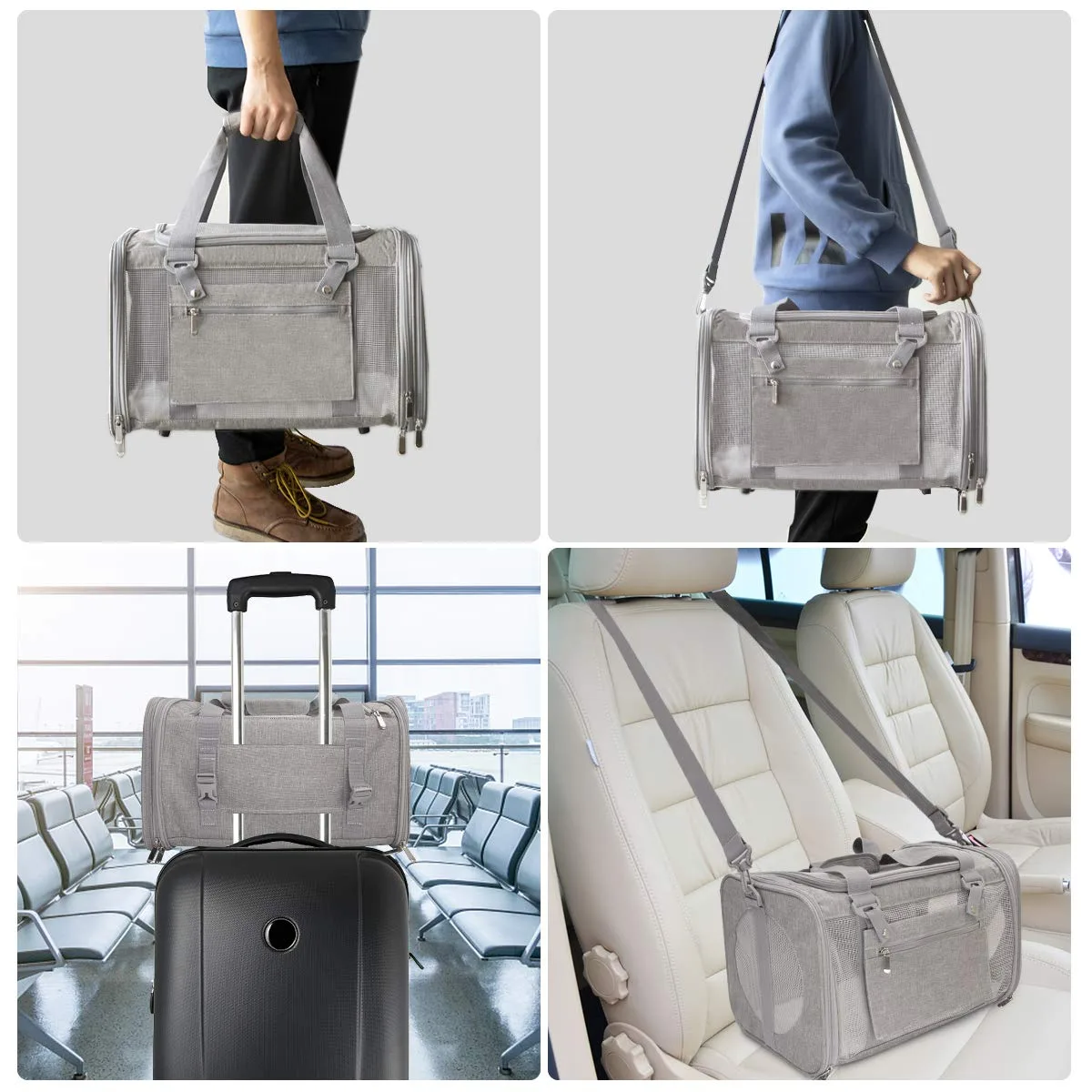
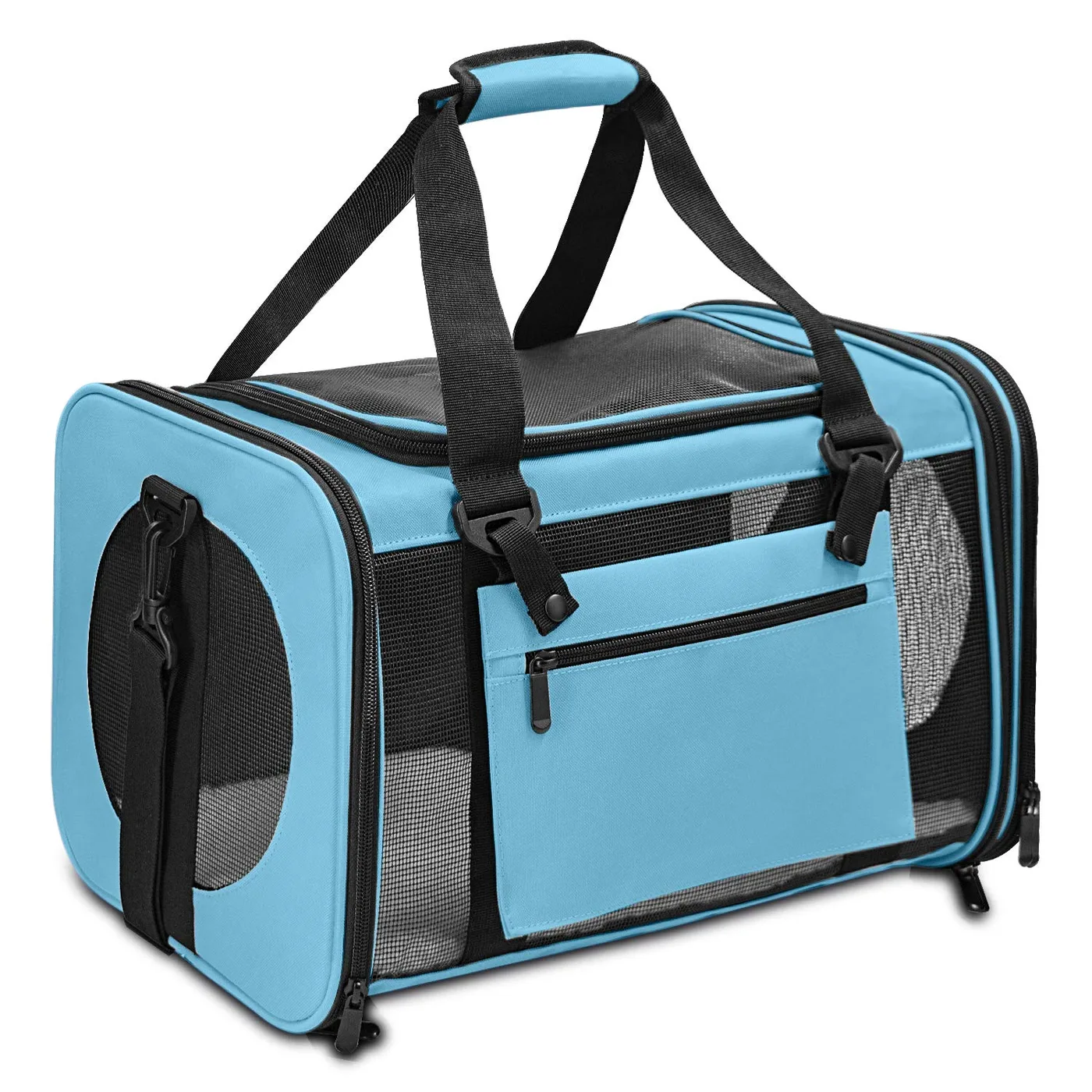
Custom dog carrier programmes usually run three size platforms at MOQ 500 pieces per colourway, with sizes mixed inside one style to reach the threshold.
Mounting Systems: Pressure, Hardware and the Wall Question
Mounting is the decision that determines both the product's safety case and its retail positioning. Three systems exist - pressure mount, hardware mount and a hybrid - and each suits a different customer and a different price point.
Pressure mounting uses four adjustable feet pushing outward against a door frame or hallway wall. It requires no tools, suits renters and installs in minutes, which makes it the volume choice for most markets. The engineering requirement is a stated holding force: a gate that displaces under 60 kg of lateral push is not adequate, and the test should be run after the feet have been cycled rather than only when new.
Hardware mounting screws into studs or a door frame and is substantially stronger. It suits top-of-stairs applications and households with large animals, but it limits the addressable market because a meaningful share of customers will not drill. For a premium tier it is the correct specification and a defensible upgrade story.
The hybrid offers pressure mounting with an optional hardware kit included in the box. It costs a few currency units more, it removes the objection at point of sale and it lets one SKU serve both conversations. For a brand building a core tier, this is usually the best commercial answer.
Foot design deserves its own specification. A large-diameter non-marking rubber foot spreads load and protects paintwork and woodwork, while a small hard foot concentrates it and leaves marks that generate complaints. Specify durometer, diameter and a non-marking compound test.
Wall protection is a small detail customers notice. A removable wall cup or a clear film pad prevents the ring marks that otherwise appear after a few months, and it costs pennies. Products that include it mention it in reviews with surprising frequency.
Finally, state the mounting type clearly on the pack. Customers buy a gate for a specific opening, and discovering at home that the product needs drilling is one of the most common causes of return in the category.
Span, Extensions and the Geometry of Real Openings
Openings are less standard than they appear. Interior doorways cluster around 75-85 cm, hallways around 90-110 cm, and wide or open-plan openings can reach 145 cm. A gate designed for a single width will either not fit or will require an extension the brand does not sell.
The efficient architecture is a base width covering 75-95 cm with bolt-on extension panels in 15 cm and 30 cm increments. That combination reaches 145 cm with two components and one tooling set, and it lets a brand sell the extension separately later, which is a genuine second purchase rather than a forced bundle.
Extension joinery is where cheap gates fail. A bolted joint with a locating pin and two fasteners stays rigid; a simple slot-in panel develops play within weeks. Specify two fasteners per joint and test the assembled maximum span for deflection, not just the base width.
Height selection follows the application. A 75 cm gate suits most small and medium animals; 90 cm suits larger breeds and any top-of-stairs use. Offering both shares the frame tooling and doubles the addressable listings at marginal development cost.
Gap tolerance is the specification with the most serious consequence. Any opening between the gate and the wall, or beneath the gate, larger than about 6 cm becomes an entrapment risk and a product liability. Write the maximum gap into the tech pack and check it at minimum and maximum span, not only at the nominal width.
Bar or mesh spacing follows the same logic. Vertical elements should be spaced so that no animal can pass a head through and become trapped, which for a general pet gate means spacing under 5 cm at the narrowest point.
The practical tool remains a fit board. Build it from the six most common opening widths in the target market, assemble the sample at each, and record both the configuration and the resulting gap. It is an afternoon of work that prevents the most serious class of failure in the category.
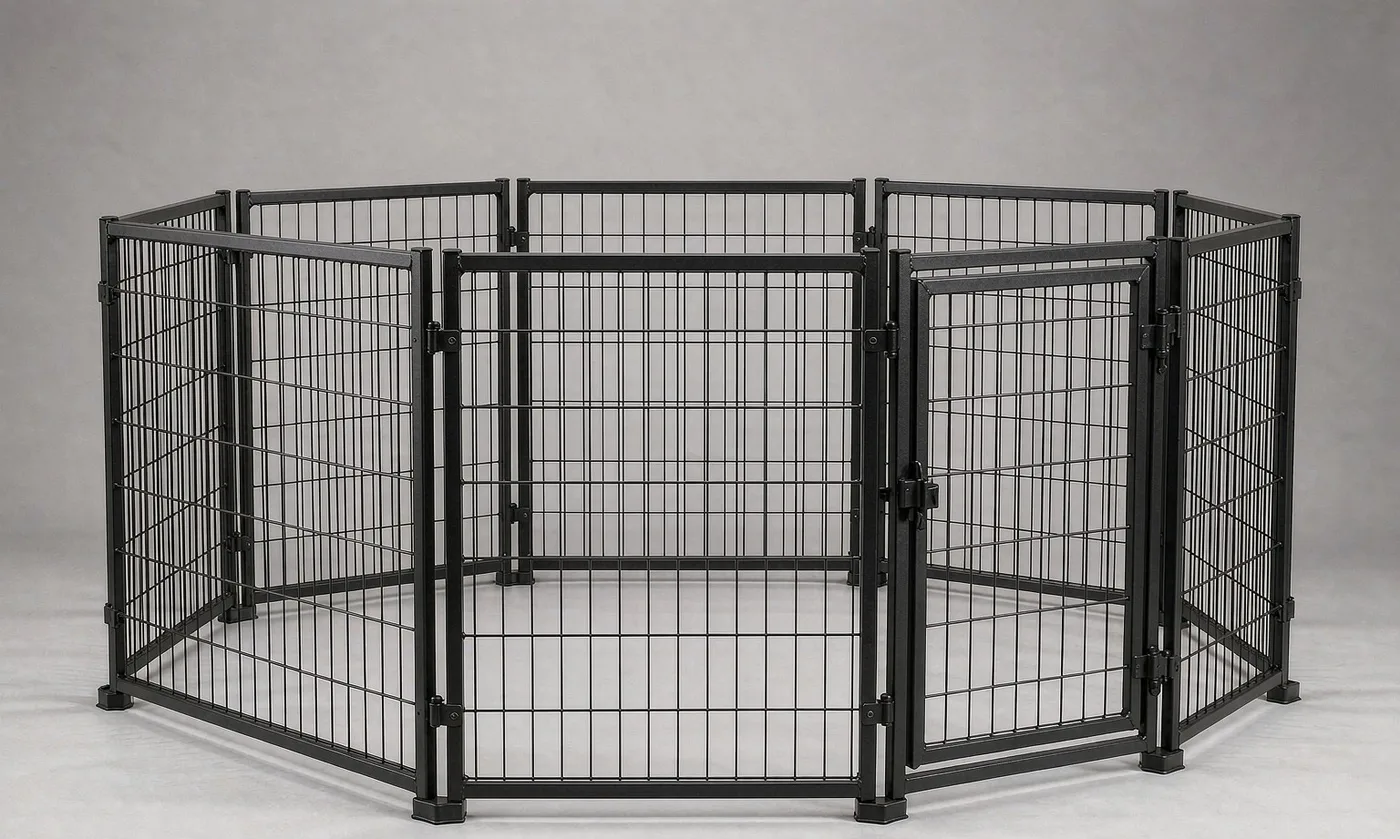
Walk-Through Door: Latch, Swing and Cycle Life
A walk-through door converts a barrier into a piece of household infrastructure, and it is the feature that most affects daily satisfaction. Customers open it dozens of times a day, so the latch and the hinge carry more interaction than any other part of the product.
Latch design must balance two opposing requirements. It has to be operable by an adult with one hand, often while carrying something, and it has to resist an animal that leans or paws at it. A two-action latch - lift and slide, or squeeze and pull - achieves both, and it should be specified with a release force above 40 N.
Hinge geometry determines whether the door stays open when needed. A gate that swings shut on its own is convenient in a doorway and annoying when carrying a load through, so a hold-open position at 90 degrees is worth specifying. A self-closing spring is the right choice for stair applications and can be offered as a variant.
Cycle life should be stated and tested. Ten thousand open-close cycles with no measurable sag, no latch wear beyond tolerance and no hinge looseness is a realistic target, and it maps to roughly five years of household use.
| Element | Entry build | Core build | Premium build | Target |
|---|---|---|---|---|
| Frame | Steel tube, powder coat | Steel tube, matched finish | Hardwood or aluminium | 60 kg lateral hold |
| Infilled panel | Welded mesh | Welded mesh, printed | Woven panel or slats | Spacing under 5 cm |
| Latch | Single action | Two action | Two action, metal | Above 40 N release |
| Door | Fixed, no door | Walk-through | Walk-through, hold open | 10,000 cycles |
| Foot | Hard plastic | Rubber, non-marking | Large diameter rubber | No marking after 30 days |
Noise is an underrated specification. A metal latch that clacks on every close is heard dozens of times a day and generates more irritation than any functional shortcoming. A polymer strike plate or a damped catch costs very little and removes the complaint entirely.
Direction should be reversible where possible. A door that can be configured to swing either way removes an install constraint and reduces the number of customers who discover the product does not suit their hallway.
Panel Design: Mesh, Slats and the Hallway Aesthetic
The infilled panel is the largest visual element of a gate and the one that decides whether the product reads as household furniture or as temporary equipment. Three families exist, and each carries a different brand message.
Welded mesh is the volume default. It is light, strong, inexpensive and visually neutral, and it takes a powder coat in the brand's colour. Its weakness is that it reads functional, which is fine for a utility positioning and limiting for a premium one.
Vertical slats in timber or in a wood-look extrusion read as interior joinery and suit a furniture-adjacent brand. They are heavier and more expensive, and spacing has to be controlled carefully so that the gap requirement is met at every point, including where the slats meet the frame.
A fabric or woven panel over a frame reads soft and residential and is the most distinctive option available. It suits brands with a strong textile identity, it can carry a woven or printed mark across the full width, and it requires a tension specification so the panel does not sag over time.
Finish consistency across the range matters here. If the brand sells a crate, a bed and a gate, one hardware finish and one neutral tone across all three is what makes them read as a collection rather than as separate purchases.
Colour matching on metal and on any textile element should be handled separately, with a Delta E tolerance per substrate and a physical approved plaque for each. Reference Pantone standards under controlled lighting so approvals are repeatable across seasons.
One caution on dark finishes in a hallway: a near-black frame shows scuff marks from passing hands and bags more readily than a mid-tone. A warm grey or a soft bronze holds up better in a high-traffic location and photographs more honestly.
Branding on a Product People Walk Past Every Day
A gate occupies a fixed position in a home and is seen dozens of times a day by the household and by visitors. That repetition is valuable, and it means the brand mark should be placed for glance recognition rather than for close inspection.
The best surface is usually the top rail, because it sits at eye level for most adults and is visible from both sides. A coined or laser-marked plate, or a woven label inset into a textile rail, reads clearly without shouting.
The second-best surface is the door pull or latch housing, which is touched on every use. A small moulded or etched mark there is the closest thing to a daily handshake the brand will get, and it is cheap to add at tooling stage but impossible to add later.
Printed or woven panels carry the largest area but the lowest glance value, because the pattern is usually read as texture rather than as identity. Use the panel for the brand's repeat pattern and let the rail and hardware carry the mark.
Packaging and in-pack material matter more than usual here, because a gate is assembled at home. A branded assembly diagram, a small branded tool if one is needed, and a card that introduces the wider range all land at the moment of highest attention.
Safety text placement needs early thought. Install warnings, maximum span and weight guidance have to appear somewhere, and the cleanest home is a durable label on the frame underside or a recessed plate, legible at purchase and invisible in daily use.
Testing Protocol, Labelling and Retail Readiness
Gates attract more technical scrutiny than most pet products because the failure mode involves containment, and retail reviewers know it. A complete documents pack assembled during sampling removes most of the onboarding friction.
The pack should cover lateral push resistance with the method named, door cycle life, maximum gap at minimum and maximum span, bar or mesh spacing, and material composition for all contact surfaces. Five documents, one folder, produced before bulk rather than after.
General consumer product expectations published by the U.S. Consumer Product Safety Commission cover labelling, traceability, small parts and entrapment, and they should be checked before artwork is finalised rather than after the carton is printed.
Where a structural claim is made, name the method. Verification against recognised ASTM frameworks for strength and cycling gives the brand a report a buyer recognises, and it removes the interpretation argument that otherwise consumes a sampling round.
Process credibility supports the conversation. Production running under a quality management system certified to ISO 9001 answers lot-to-lot consistency questions, and third-party verification through SGS produces reports in a format retail technical reviewers already recognise.
Retained samples close the loop. Hold one unit per production lot for twenty-four months, tagged with the batch code, so a query about a specific shipment can be answered with a physical item and its report within a day.
One further check belongs in the protocol: test the gate after it has been repositioned three times. Pressure feet lose holding force once they have been compressed, released and reset, and a gate that passes on first install and fails on the fourth is a real and avoidable pattern.
Packaging, Assembly and the First-Hour Experience
A gate is a flat-pack product by necessity, which means the customer's first hour with it is an assembly experience. That hour determines review sentiment more reliably than the product's performance over the following year, and it deserves design attention.
Carton design should protect the frame corners and the finish, because a scratched top rail is visible every day for years. Corner protection and a separating layer between metal components are cheap and effective, and the shipper should be validated against a recognised transit protocol.
Component organisation inside the box is the highest-return detail. Bagged and labelled hardware, in the order it is used, removes the frustration that otherwise dominates first impressions. It costs a small amount of packaging labour and it is mentioned in reviews more often than any feature.
Instructions should be photographic, numbered and large. Where the product offers both mounting options, lead with the pressure mount and place the hardware option on a clearly separated page, so the customer who does not intend to drill is not confused.
Tool requirement should be minimised and stated on the front of the carton. A product that assembles with one included tool converts better than one requiring a screwdriver, and saying so at point of sale is a genuine differentiator in this category.
One in-pack item earns its place: a single card showing the matching extensions and the wider containment range in the same finish. A customer who has just installed a gate is unusually receptive to the idea of a second one, and the card costs almost nothing.
Range Architecture: Gates, Pens and the Containment Family
Containment products form a natural family. A gate solves a doorway, a playpen solves a room or a garden, and an exercise pen solves a larger outdoor area. Customers who need one frequently need another, and a coherent family converts a single purchase into a small system.
Sequencing should start with the gate. It is the most universal product in the family, it is bought earliest in a pet's life and it establishes the finish and colour language that the pens can inherit. Launching a pen first leaves the brand without the visual reference that makes the pen recognisable.
Tiering follows construction. An entry tier uses a mesh panel and a single-action latch; a core tier adds a two-action latch, a walk-through door and extension compatibility; a premium tier moves to slats or a woven panel with metal hardware. All three share the frame tooling.
| Sequence | SKU | Space solved | Shared asset |
|---|---|---|---|
| 1 | Room gate | Doorways and hallways | Frame finish, colour standard |
| 2 | Extension panels | Wide openings | Finish and joinery |
| 3 | Playpen | Indoor room or zone | Panel system and finish |
| 4 | Exercise pen | Outdoor area | Finish and ground anchoring |
| 5 | Seasonal finish | Renewal without re-test | Frame tooling |
Extensions deserve treatment as a product rather than as an accessory. Selling them separately at a healthy margin, with the base gate priced competitively, is the standard pattern in this category and it produces a second purchase from customers who already own the brand.
Colourway strategy should keep one core neutral across the family and rotate accent finishes seasonally. Because a finish change does not alter the frame geometry or the latch, it requires no re-test, which makes it the cheapest form of newness available.
Timing follows the standard arithmetic: bulk at 35-50 days plus transit, landing eight weeks before the drop, which puts tech pack sign-off roughly five months ahead. Containment sells steadily with a lift in spring, when households acquire young animals.
The measure at the end of season two is whether gate owners go on to buy extensions or a pen. If they do, the family is compounding and the next investment belongs in finishes rather than in a fourth structural product.
Serviceability, Spares and the Long Ownership
A gate stays in a home for years, often longer than the animal's need for it, which makes serviceability a genuine brand consideration rather than a cost question. The parts that wear are predictable, and designing them to be replaceable turns a product that would be discarded into one that is maintained.
Feet wear first. They are compressed continuously, they are dragged during repositioning and they pick up grit that abrades both the foot and the wall. A foot that unclips or unscrews, sold as a four-pack, is the simplest spare programme available and it keeps the product performing as specified.
The latch is second. It is operated dozens of times a day, and a worn catch eventually releases below the specified force. Specifying the latch as a replaceable module with a standard fixing pattern means a single spare part covers the whole range and can be stocked economically.
Wall cups and protective pads are third, and they are the cheapest spares to offer. Customers who move house, redecorate or reposition the gate need fresh pads, and a small branded pack solves a real problem at negligible cost.
Publishing a spares list does something else that is commercially useful: it signals that the brand expects the product to last. In a category where most competitors sell disposable barriers, that expectation is a positioning statement customers read before they buy.
Warranty terms should follow the same logic. A two-year warranty on a pressure-mounted gate is defensible if the push and cycle testing supports it, and it gives the brand a line on the pack that competitors cannot match without their own data.
One operational note: spares should be ordered with the first bulk run, not after complaints arrive. Including a small quantity in the initial shipment costs almost nothing in freight and prevents the six-month gap that otherwise turns a small problem into a review problem.
The longer view is straightforward. A household that repairs a gate rather than replacing it stays with the brand, recommends it and buys the extension or the pen when the need arises. Serviceability is not a cost centre; in this category it is retention.
Production capability
- SGS-verified production space of 4,950 m², 149 machines, 7 assembly lines
- Pet carrier and pet bag output since 2014 from a 137-person team
- 200,000 units shipped monthly under BSCI and ISO 9001 systems
People Also Ask
Should a custom pet gate be pressure mounted or hardware mounted?
Pressure mounting suits most households and installs without tools; hardware mounting suits large animals and stair tops. A hybrid with an optional kit in the box serves both conversations from one SKU.
What width range should a pet gate cover?
Cover 75-95 cm from the base frame and reach 145 cm with bolt-on extensions in 15 cm and 30 cm increments, using two fasteners per joint.
How strong should a pet gate latch be?
Specify a two-action latch with a release force above 40 N, operable one-handed by an adult but resistant to an animal leaning or pawing at it.
What gap is safe around a pet gate?
Keep every gap under 6 cm at minimum and maximum span, including beneath the gate and at the frame junction. Larger gaps become an entrapment risk.
How long should a walk-through door last?
Specify 10,000 open-close cycles with no measurable sag, no latch wear beyond tolerance and no hinge looseness, which maps to roughly five years of household use.
Can a gate be branded without looking temporary?
Yes. Mark the top rail at eye level and the latch housing that is touched daily, and use the panel for a repeat pattern rather than a large logo.
Should extensions be sold separately?
Yes. Price the base gate competitively and sell extensions at a healthy margin as a genuine second purchase from customers who already own the brand.
Frequently Asked Questions
What is the MOQ for a custom pet gate?
MOQ is 500 units per colourway. Most brands open with the 75-95 cm base gate in one finish and add the tall version and extensions in the second season.
How long does sampling take?
Prototypes are delivered in 6-10 working days from tech pack sign-off. Two rounds are standard: one for mounting and structure, one for finish and graphics.
What is the bulk lead time?
Bulk runs 35-50 days from sample approval, released at AQL 2.5 and shipped FOB Xiamen on T/T 30/70 terms.
Which test reports come with a shipment?
Lateral push resistance, door cycle life, maximum gap at minimum and maximum span, bar or mesh spacing, and material composition for contact surfaces.
Can you match our brand finish on metal?
Yes, against a physical Pantone reference with a stated Delta E tolerance and an approved physical plaque, because powder coat and anodising shift differently from the same reference.
Will the feet mark walls or woodwork?
Not if a large-diameter non-marking rubber foot is specified with a durometer and diameter requirement and a non-marking compound test.
Is the door reversible?
Yes where specified, and it should be. Reversibility removes an install constraint and reduces the number of customers who find the product unsuited to their hallway.
How noisy is the latch?
With a polymer strike plate or damped catch, effectively silent. Without one, a metal latch clacks dozens of times a day and generates disproportionate irritation.
Do we need to state the mounting type on the pack?
Yes. Discovering at home that a gate needs drilling is one of the most common causes of return in this category.
Should the gate be self-closing?
For stair applications, yes. For general doorways, a hold-open position at 90 degrees is more convenient, and offering both as variants covers the market.
What spacing should bars or mesh use?
Under 5 cm at the narrowest point, so no animal can pass a head through and become trapped. Check this where slats meet the frame, not only mid-panel.
Can we claim the gate is child-safe?
Only with the relevant testing and certification behind the claim. Describe containment performance and gap dimensions, and avoid borrowing a certification the product does not hold.
Should a gate launch before a playpen?
Usually yes. The gate is the most universal product in the containment family and it establishes the finish and colour language the pens inherit.
Talk to QUANZHOU JUNYUAN BAGS about a pet carrier program: MOQ 500 pieces per colourway, samples in 6-10 working days, bulk production in 35-50 days under AQL 2.5 inspection.
Get a free quote Request a sample